
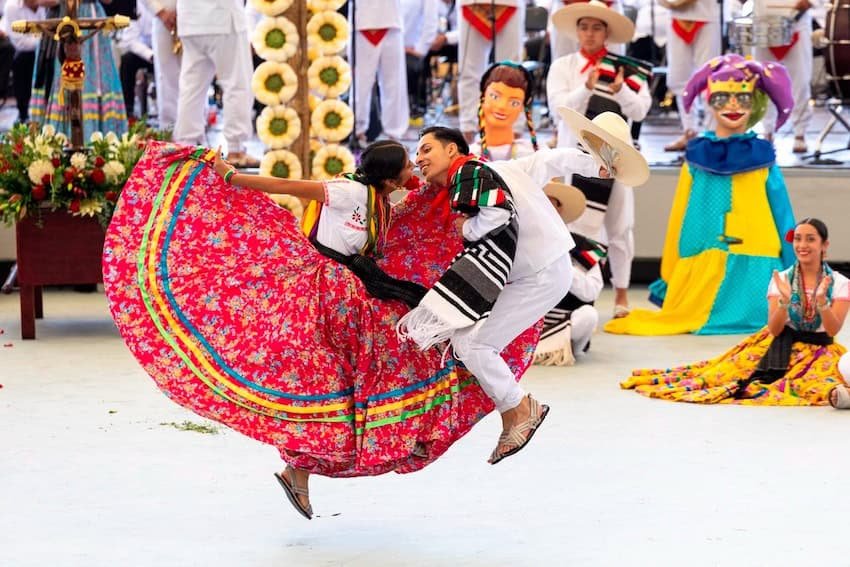
A packed house of more than 11,000 people was on hand Monday for the opening of the 94th edition of Oaxaca’s famous Guelaguetza festival.
The first Monday on the Hill kicked off what is widely considered Latin America’s largest ethnic celebration, with 13 delegations from across the state presenting dances, music and regional customs.
The festivities took place in the Guelaguetza Auditorium, an open-air amphitheater built in the 1970s on the slope of Cerro del Fortín above Oaxaca’s historic center.
Modernized and renovated from 2008 to 2010, the facility will also host a second Lunes del Cerro (Monday on the Hill) on July 27 — part of the closing stretch of the festival, even as side fairs and events continue.
As in 2025 and years past, the opening show focused on the traditions and music of Oaxaca’s 16 Indigenous peoples and Afro-Mexican communities.
Enid Azucena Torres Agustiniano — a nursing student, cyclist and activist for Afro-Mexican rights — was chosen by the state’s Ministry of Culture and Arts as the festival’s official ambassador, Goddess Centéotl.
The first Afro-Mexican woman to serve in that role, Torres is originally from Santiago Pinotepa Nacional in the Costa Chica area, a corridor on the coast of Oaxaca and Guerrero with some of Mexico’s highest concentrations of Afro-Mexican communities.

“Being Afro-Mexican is not something to hide,” Torres told the audience. “It is something to honor and live with dignity.”
Opening day featured performances from communities including Ciudad Ixtepec, San Juan Bautista Tuxtepec and Santiago Pinotepa Nacional. Signature moments included a sing-along of “Dios Nunca Muere” and closing dances that drew standing ovations.
“Oaxaca is a melting pot of our country’s cultures,” Federal Tourism Minister Josefina Rodríguez Zamora said in a press release. “Here, our history, our traditions and the pride of our people come alive.”
The festival traces its roots to a Zapotec ritual known as Daninayaaloani, or Hill of the Beautiful View, in honor of Centéotl, the corn goddess. As part of that ritual, people gathered over eight days to share offerings, eat and dance.
In the Zapotec language, “Guelaguetza” refers to reciprocal offerings — a tradition of giving and sharing within the community.
Officials said the current festivities, running throughout the month of July, include more than 140 events statewide, from fairs and parades to gastronomic and artisanal exhibitions.
Tourism officials said they expect about 149,000 visitors, an economic impact exceeding 668 million pesos (US $38.4 million) and average hotel occupancy of 83%.
With reports from Infobae, El Universal Oaxaca, Político MX and Reporte Indig
