
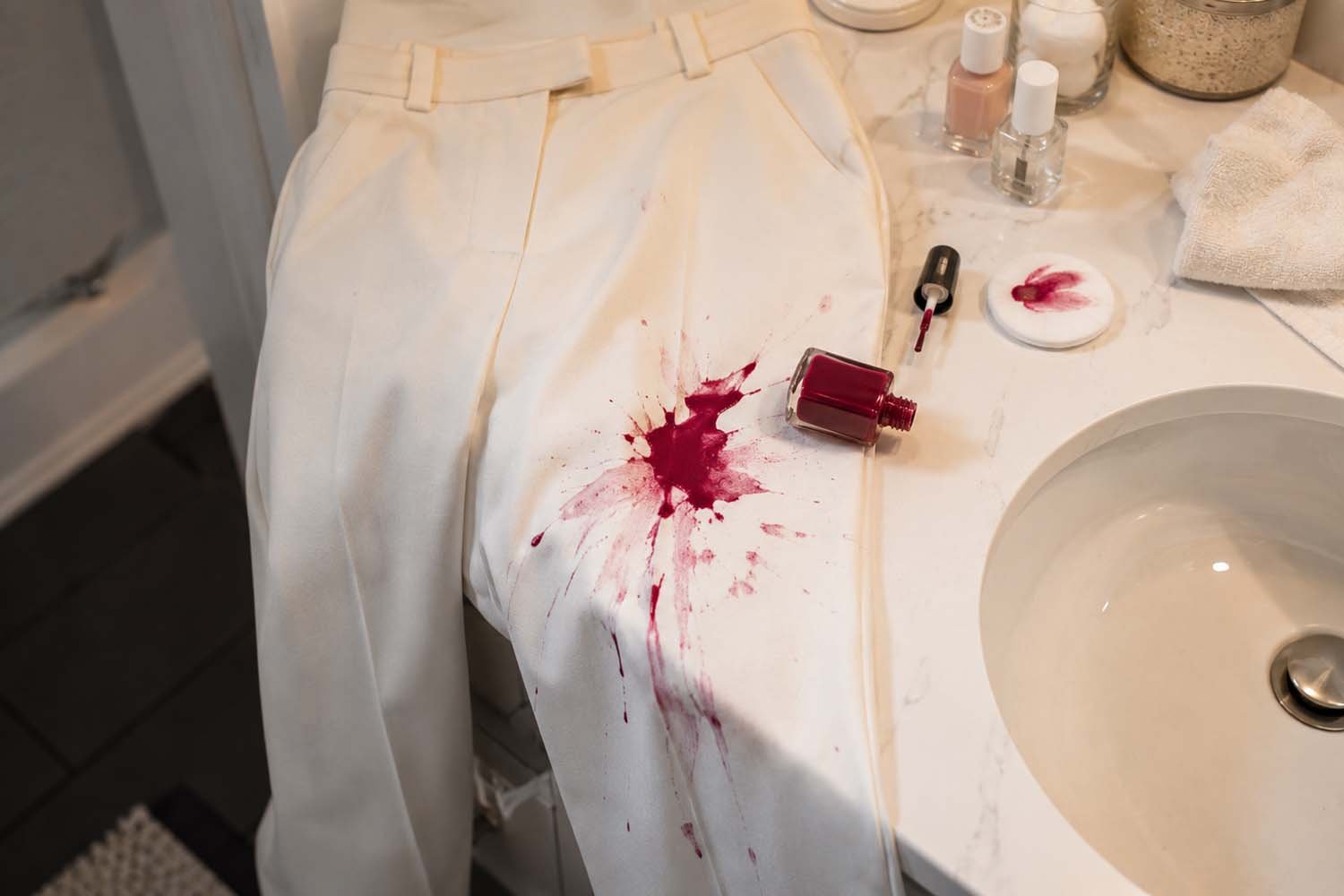
I was doing my own manicure on the bathroom counter the night before a photo shoot, going for a color I’d never tried, and the second I unscrewed the cap the bottle tipped off the edge of the sink and landed straight on the leg of the cream trousers I’d already picked out to wear. Not a drop on the tile. Not a drop on the counter. Directly onto the one pair of pants I’d laid out specifically because they didn’t need ironing.
I did what most people do: grabbed a cotton ball, soaked it in the same nail polish remover sitting right there, and started scrubbing. Twenty minutes later I had a lighter, blurrier, larger stain than the one I started with, and a faint bleached ring around it where the acetone had gone to work on the dye. The trousers survived, barely, but only because I stopped and looked up what was actually happening before I made it worse.
The Short Answer: Nail polish is a hardened plastic film, not a stain that soap can dissolve, so you need a solvent that matches both the polish type and the fabric. Acetone works fastest but only on cotton and linen. Non-acetone remover is the safer choice for synthetics. Gel and dip powder polish need more time and patience than regular lacquer because they’re chemically built to resist exactly this kind of breakdown. Silk, wool, acetate, and triacetate should skip home treatment and go to a professional cleaner.
Why Nail Polish Stains Are Different
Every stain guide on the internet treats nail polish like ketchup or coffee: dab it, treat it, wash it. That approach misses what nail polish actually is. Regular nail polish is nitrocellulose lacquer, essentially a thin plastic film loaded with pigment, resin, and plasticizers so it can flex without cracking on your nail. When it lands on fabric, it doesn’t soak into the fibers the way a liquid stain does. It dries into a sealed coating sitting on top of and slightly bonded to the weave.
That single fact changes everything about how you treat it. Detergent and dish soap are built to lift oil and protein off fibers. They do essentially nothing to a cured plastic film. Only a solvent, something that can dissolve the polish itself, has any real chance of working, which is why acetone and non-acetone polish removers show up in every method rather than the usual dish soap or enzyme pretreater.
The Golden Rule
The question every other guide gets wrong is “how strong a remover do I need.” The real question is which of two things you’re dealing with: what kind of polish it is, and what the fabric can survive. A cotton t-shirt and a polyester blouse need completely different solvents even for the exact same drop of the exact same polish. Match the wrong solvent to the wrong fabric and you’ll either fail to touch the stain or dissolve the garment along with it, which is exactly what nearly happened to my trousers.
Stain Variants: Fresh, Dried, and the Polish Type That Matters More Than Either
Fresh, wet polish is by far your best case. It hasn’t had time to cure and bond to the fibers, so blotting and an early solvent treatment usually lifts most of it. Dried polish that’s been sitting for hours has fully hardened into that plastic film and will take longer, more solvent contact, and more patience.
But the bigger variable most guides skip entirely is the type of polish:
- Regular lacquer polish is nitrocellulose based. It’s the easiest of the three to break down with acetone or non-acetone remover.
- Gel or UV polish is cured under a UV or LED lamp, which deliberately cross-links the polymer into a much tougher, more solvent-resistant network than air-dried lacquer. If you or someone in your household does gel manicures, expect a gel drip to take noticeably longer to dissolve than a regular polish drip, even with the same acetone.
- Dip powder polish behaves similarly to gel in that it’s built to resist exactly the kind of breakdown you’re attempting, so budget extra time and don’t expect a five-minute fix.
If you don’t know which type caused the stain, treat it like gel: start conservative, be patient, and don’t assume one round of solvent will finish the job.
Method Cards
1
2
3
4
Pro tip: Keep both a acetone nail polish remover and a non-acetone nail polish remover on hand rather than assuming one covers every fabric you own. Once the polish itself is dissolved and lifted, any faint pigment shadow left behind can usually be finished off with an enzyme-based stain remover as a presoak, and for white or colorfast fabrics an oxygen bleach powder soak afterward will handle any last trace of discoloration. Neither of those is the right tool for the polish itself, they’re just the cleanup step once the solvent has done the real work.
Fabric-by-Fabric Guide
White cotton: Acetone is safe and effective. Follow with an oxygen bleach soak if any pigment shadow remains.
Colored cotton: Acetone works but spot test on an inside seam first, since some dyes can fade or shift with solvent contact.
Linen: Treat the same as cotton with acetone, but keep any oxygen bleach soak under an hour or two, since high alkalinity can yellow flax fibers over longer soaks.
Polyester: Use non-acetone remover only. Acetone can dissolve or distort polyester, especially finer weaves.
Silk: Do not attempt home treatment. Take it to a professional cleaner.
Wool: Same as silk. Solvents can alter the dye even without destroying the fiber, so a cleaner is the safer route.
Denim: Acetone works well on the sturdy cotton weave, though it may lighten dark indigo slightly, so test an inside cuff first.
Dry-clean-only fabrics: Skip home solvents entirely. Tell the cleaner the polish type if you know it.
Step-by-Step Protocol
- Scrape off any excess dried polish with a dull knife or spoon edge, working gently so you don’t press it deeper into the fibers.
- If the polish is still wet, freeze it with an ice cube in a bag for a few minutes, then scrape again.
- Check the fabric. Acetate, triacetate, modacrylic, silk, and wool go straight to a professional cleaner. Everything else, continue below.
- Place a folded paper towel or clean cloth underneath the stain.
- Choose acetone for cotton and linen, or non-acetone remover for polyester and blends. Dab the back of the stain with a cotton pad soaked in the solvent, never rub.
- Replace the cotton pad and paper towel as they pick up dissolved polish, and keep dabbing until no more color transfers.
- For gel or dip powder polish, expect to repeat this step several times, since the cured polymer resists solvent longer than regular lacquer.
- Rinse the area with cool water from the back of the fabric to flush out any remaining solvent and loosened polish.
- Launder as usual according to the care label, then check the stain before drying. Heat will set anything left behind, so if a shadow remains, treat again before it goes in the dryer.
Never do this:
- Never use acetone on acetate, triacetate, or modacrylic fabrics. It will dissolve them.
- Never rub the stain. Rubbing spreads dissolved polish deeper into the weave instead of lifting it out.
- Never put the garment in the dryer before the stain is fully gone. Heat sets any remaining pigment permanently.
- Never use acetone on silk or wool expecting it to be safe just because it won’t destroy the fiber outright. It can still alter the dye.
- Never assume dish soap or regular detergent alone will touch a cured polish film. It’s a solvent problem, not a soap problem.
- Never soak an entire garment in acetone. Treat the stain locally to limit fabric and dye exposure.
- Never put a garment treated with acetone or non-acetone remover into the dryer, even once the stain looks gone. Both solvents are flammable, and residual vapor left in the fabric is a fire risk, not just a staining one. Air dry treated garments instead.
What Does Not Work
Hairspray comes up constantly as a nail polish fix, and it does have a real basis: aerosol hairsprays typically run 25 to 50 percent alcohol, and alcohol is a genuine, if weak, solvent for nail polish. That’s why it can soften a fresh, undisturbed stain in a pinch. It’s still a poor substitute for a dedicated remover, though, since the effect is inconsistent between brands, pump hairsprays carry far less alcohol than aerosols, and none of it works reliably once the polish has fully dried or if it’s gel or dip powder.
A dish soap and vinegar paste shows up on a few sites as a nail polish fix, with the claim that vinegar’s acidity dissolves the polish. It doesn’t. Acetic acid isn’t a solvent for the nitrocellulose or acrylate polymers in nail polish, so at best this loosens a bit of surface residue through mild agitation, and it does nothing for polish that’s already bonded to the weave. Don’t rely on it in place of acetone or non-acetone remover.
It’s also worth being honest about something most guides won’t say outright: once nail polish has fully dried on fabric, complete removal isn’t guaranteed even with the right solvent. Getting the polish to dissolve is one thing. Working that dissolved polish completely back out of a tight weave is another, and on some fabrics a faint shadow can remain even after a correct treatment. That’s not a reason to skip the steps above, it’s a reason to treat the stain the moment you notice it rather than waiting.
The One Thing I Wish I’d Known Sooner
I wish I’d known that the color of the polish had nothing to do with how hard it would be to remove, and the fabric label did. I grabbed the fastest-acting solvent in the house without checking what my trousers were made of, and came within a shade of ruining them. Reading the care tag first would have taken ten extra seconds and saved me the bleached ring I’m still living with.
Final Thoughts
Nail polish is one of the few stains where speed matters less than accuracy. A wrong solvent on the wrong fabric does more damage than waiting an extra hour to do it correctly. If you’re dealing with makeup stains generally, our foundation and makeup stain guide covers the oil-based side of beauty stains, and if this happened during a rushed morning routine, our ChapStick and lip balm guide and lipstick stain guide share some of the same fabric-first logic. Acetone shows up again in our ink stain guide, so it’s worth keeping a bottle around either way.
Frequently Asked Questions
Does nail polish remover actually get nail polish out of clothes?
Yes, but only when matched to the fabric. Acetone works on cotton and linen, while non-acetone remover is the safer choice for polyester and blends. Neither is safe on silk, wool, acetate, triacetate, or modacrylic.
Is gel nail polish harder to remove from clothes than regular polish?
Yes. Gel polish is cured under UV or LED light, which cross-links the polymer into a tougher, more solvent-resistant film than air-dried regular lacquer, so it takes longer and more repeated treatment.
Can you use acetone on all fabrics?
No. Acetone dissolves acetate, triacetate, and modacrylic outright and can attack some fine polyesters. Reach for non-acetone remover on synthetics instead.
Does hairspray remove nail polish stains?
It can help on a fresh, undisturbed stain, since aerosol hairsprays typically contain enough alcohol to act as a weak solvent. It’s inconsistent between brands and won’t do much once the polish has dried or if it’s gel or dip powder, so treat it as a backup, not a first choice.
What if the nail polish stain has already dried?
Dried polish takes longer and more solvent contact than a fresh stain, and on some fabrics a faint shadow may remain even after correct treatment, so treat it as soon as you notice it rather than waiting.
Should silk or wool go straight to a dry cleaner?
Yes. Home solvents can alter dye on both fibers even when they don’t destroy the fabric outright, so professional cleaning is the safer route.
Does dish soap remove nail polish stains?
Not on its own. Nail polish is a cured plastic film that surfactants can’t dissolve, only a solvent can, so dish soap alone won’t meaningfully treat a set stain.
Can freezing help with a nail polish stain?
Freezing a fresh, wet drip hardens it enough to scrape off before it spreads, but it’s a prep step, not a full treatment. You’ll still need a solvent for what’s left behind.
Related Stain Removal Guides
