
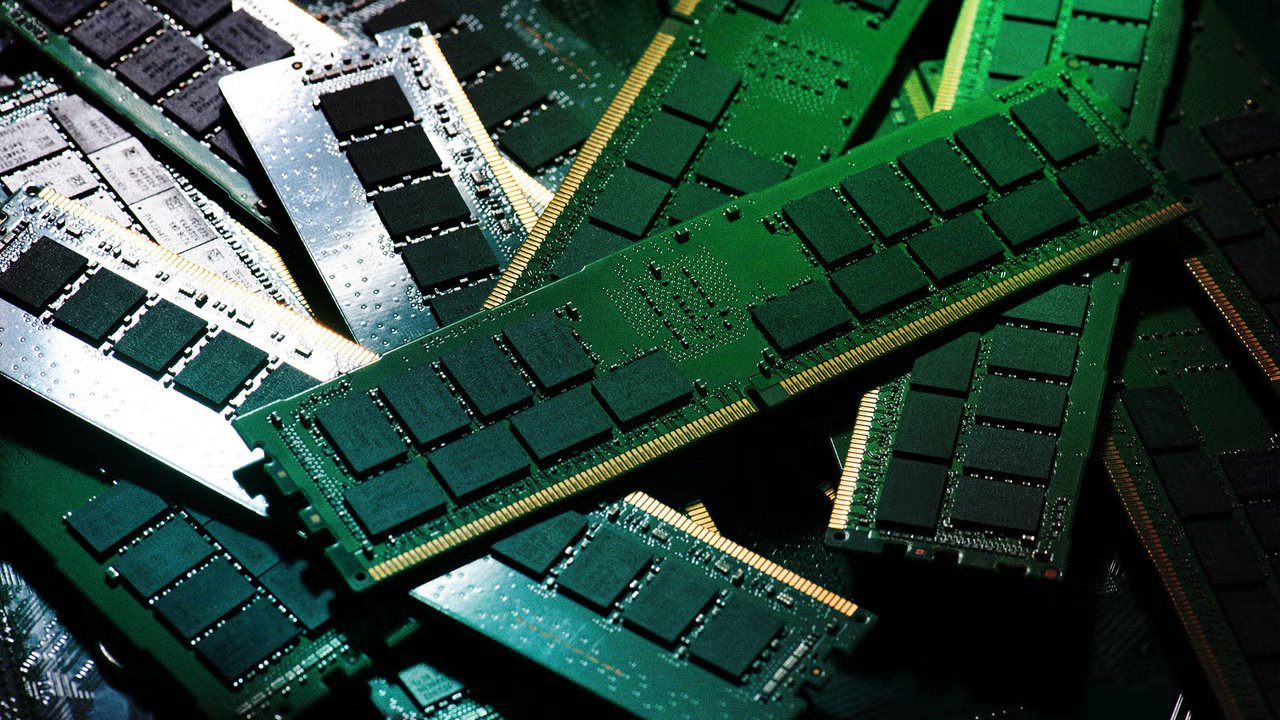
Shares in major U.S. chip and memory companies, including Micron, Sandisk, and Intel, are sinking this morning in premarket trading after the stock prices of similar companies in Asia got hammered hard.
Here’s what you need to know—and what’s behind the current fall in chip stocks.
What’s happened?
It was a bad day for chip stocks in Asia, where the markets are already closed for the day.
In South Korea, major chipmakers saw their stock prices plunge. Memory giant SK Hynix Inc. (KSE: 000660.KS) saw its shares fall more than 14.6%. Chipmaker competitor Samsung Electronics Co., Ltd. (KSE: 005930.KS) got hit nearly as hard, with shares ending down over 13.3% for the day.
Chipmakers in Japan didn’t fare better. Flash memory maker Kioxia Holdings (TSE: 285A.T) saw its shares drop more than 18%
The fall in the stock prices of major chipmakers in Asian markets now looks to be spooking investors in the West. Currently in premarket trading, major U.S.-traded chipmakers are seeing their shares down significantly, including:
- Micron Technology, Inc. (Nasdaq: MU): down 5.6%
- Sandisk Corporation (Nasdaq: SNDK): down 5%
- Western Digital Corporation (Nasdaq: WDC): down 5%
- Seagate Technology Holdings plc (Nasdaq: STX): down 4%
In part driven by this decline in chipmaker stocks, Nasdaq Futures are already down nearly nine-tenths of a percent ahead of the opening bell as of the time of this writing.
But just what is behind the fall in these chipmakers’ stock prices?
AI uncertainty is spooking investors
For years now, the AI boom has driven a the valuations of not just AI model giants like Anthropic and OpenAI (both currently private companies), but also companies that make the hardware components needed to build the massive data centers those models require.
The most salient example of a hardware company benefiting from the AI boom is, of course, Nvidia Corporation (Nasdaq: NVDA), which makes the powerful GPUs AI companies rely on. Thanks to the AI boom, over the past five years, Nvidia stock has surged more than 920%.
But more recently, the importance of GPUs to the AI boom has taken a back seat to other components, namely memory chips, storage, and CPUs.
Demand for these components has exploded. That has caused the stock prices of chipmakers to skyrocket over the past year, including Micron (up around 700%), SanDisk (up nearly 3,000%), and Intel (up around 340%).
The problem is, investors are now increasingly worried about the levels of uncertainty surrounding the AI industry. Particularly, investors are increasingly concerned that AI investments by tech companies may not pay out in the short, medium, or even long term.
If these tech giants conclude that their AI-focused capital expenditure (capex) investments aren’t going to return profits, they will eventually start scaling back, which could have severe consequences for the bottom lines, valuations, and stock prices of chipmakers.
Immediate concerns
While the increasing uncertainty over the AI boom is ever present in investors’ minds, there are more specific, immediate events that likely led to the selloff in Asian chipmakers’ stocks.
Those include recent reports that Nvidia is considering providing $250 billion in financial guarantees to OpenAI to help it build out data centers.
This has alarmed investors who see it as yet more evidence of circular financing deals in the industry, where clients prop up their customers with cash so those customers can keep buying the client’s products.
Another event that has spooked investors in Japan, South Korea, and the United States is the news that an unnamed Chinese company has begun manufacturing an immersion deep ultraviolet lithography (DUV) machine, reports CNBC.
DUV technology is essential to manufacturing chips at scale, and currently the market is dominated by the Dutch giant ASML Holding N.V. (Nasdaq: ASML). Historically, Chinese chip companies have been reliant on foreign companies supplying these machines, which Western regulators have placed export caps on.
If China can now manufacture its own DUV’s, it could give Chinese chipmakers like ChangXin Memory Technologies (ticker: CXMT), which went public on the Shanghai Stock Exchange’s tech-focused STAR Market this week, a massive advantage when it comes to boosting manufacturing of the chips the AI industry needs.
More supply from Chinese chipmakers could drastically eat into the bottom lines of foreign competitors, like SK Hynix, Samsung, Micron, and Kioxia.
In short, there isn’t any one reason why chipmaker stocks are declining today. Rather, it’s a confluence of reasons, or multiple storms, if you will, that are giving investors pause and causing many to dump shares now to lock in the tremendous gains they’ve accumulated in recent years.
