
I still remember sitting on my couch years ago watching a CONCACAF Gold Cup soccer game when I was in high school. It was a Mexico game. I was not a soccer fan at that time, and the game was mostly just background noise for whatever social media app I was more engaged with on my phone.
I heard the Mexican fans begin to wind up a chant, and I started to pay more attention. I watched as the fans built into a unifying crescendo while waving jazz hands in the air. Their harmony became louder and louder until it stopped, and they all shouted puto (male prostitute) so loud that it echoed throughout the stadium. The ref stopped play and warned the Mexican fans to stop the chant or risk a forfeit.
That was my introduction to the “puto” chant, a homophobic slur that has marred Mexico’s fan culture in controversy as it has become a staple at El Tri games around the world.
To me, chants from fans of national teams are representations of a nation’s culture, both on and off the pitch. So this became my first impression of how queer rights were treated in Mexico. To an outsider, it looked like a country coming together to insult an opposing team using a homophobic slur, and that the force behind it had only become greater as the world has increasingly told them to stop.
I had never been to Mexico until I arrived in San Miguel de Allende in late June to start a nine-week journalism internship with Mexico News Daily. Now I found myself with a chance to find out what the queer experience was actually like in Mexico — a country famous for its entrenched Catholic beliefs that is incongruent and often intolerant of gay rights.
My first impactful experience came just 10 days after I arrived when I embarked on a four-hour bus ride to Mexico City to experience the Mexico vs. Ecuador round of 32 game. I was surrounded by hundreds of thousands of fans in the Zócalo, Mexico City’s main square, in what immediately became one of the most memorable experiences of my life.
Soccer authorities plan measures to stop fans chanting ‘Eh puto’
Despite the eruptions after both of Mexico’s goals, the deafening national anthem and witnessing nearly 1.5 million people take to the streets in celebration, the “puto” chant still stuck out. Nearly all of the hundreds of thousands of attendees in the Zócalo — ranging from more stereotypically conservative young men to middle-aged women and even children — partook in the tradition. It made me, a gay 21-year-old who has only lived in progressive areas of the United States, a bit uncomfortable.
As a lifelong sports fan, I am no stranger to hooliganism, racism and homophobia at sporting events. It is almost expected among certain people and at some games, but when a chant like this is belted by women and children and by those young and old, it makes you feel like maybe the entire nation subscribes to outward intolerance.
I returned to San Miguel and was continuously reassured by my colleagues that the word had changed in interpretation throughout the years, and more vulgar speech was popular in casual conversation in Mexico. I understood, but the word clearly still had a negative connotation, as it is used directly at opposing teams and players. So even if the meaning is no longer a direct slur towards gay people, it still had a negative connotation that evolved from that word.
However, the next three weeks did not produce any evidence of homophobia, despite me keeping a keen eye out for it. At a watch party for the Mexico vs. England round of 16 game, a large crowd that gathered in front of the Parroquia de San Miguel Arcangel church barely uttered the chant. My daily life in San Miguel went on without ever feeling unsafe or witnessing any blatant acts of homophobia.
This past weekend I found myself with some free time, so I decided to go read a book in Parque Zeferrino, a newer park a little over a mile north of San Miguel Centro. I was enjoying the weather and watching fish dart around the pond, but I started to notice something every time I looked up. Seemingly every minute, more and more people were showing up at the park adorned in pride flags.
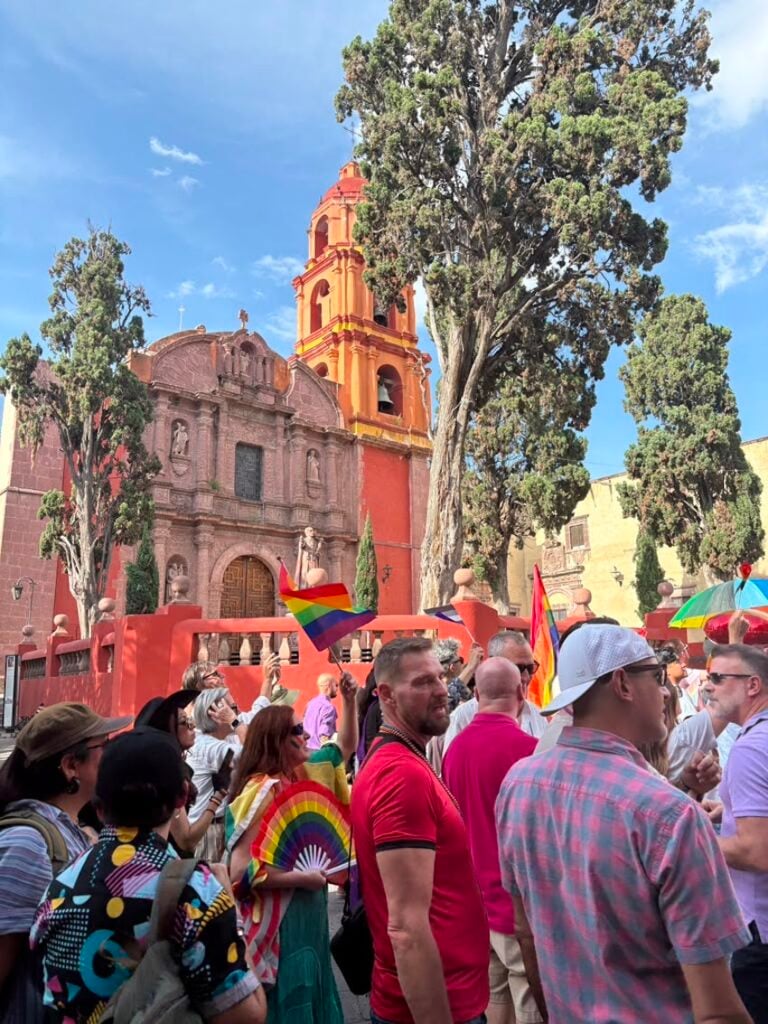
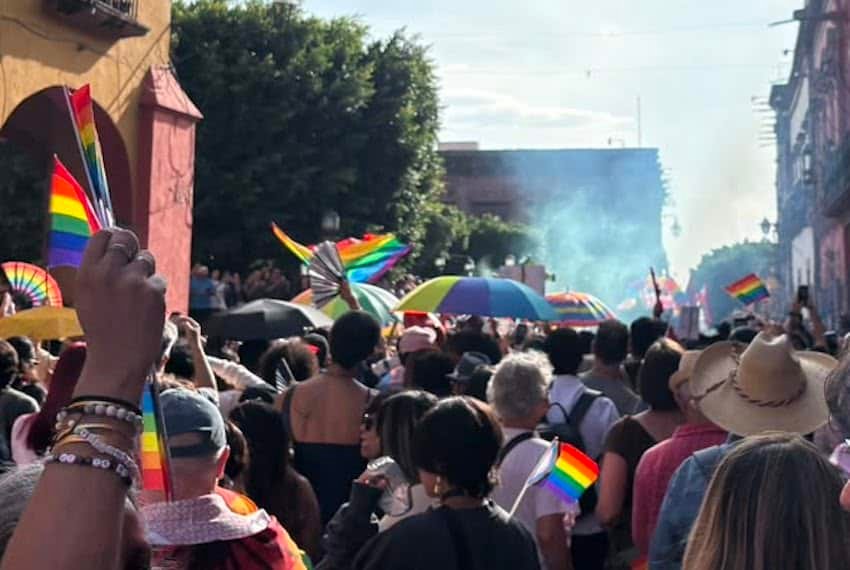
I went over to ask what was going on and found out that I had coincidentally stumbled upon the starting point of the San Miguel de Allende Pride Parade.
Nearly one thousand people — both locals and foreigners — marched from the park down to the Parroquia. It was a celebration filled with dancing, singing and chanting. People waved flags and folding fans. They brought skeptical onlookers watching from the sidewalks to join in. It was a beautiful and colorful scene, especially in one of the most conservative regions in Mexico known for its strong ties to the church.
From everything I had experienced at the Zócalo, it felt like onlookers could have treated the parade with disdain. But that word was never yelled. No one in the parade felt unsafe. No one seemed like they had to be hyper-aware of their surroundings. They were just expressing their pride.
Same sex marriage was legalized in all of Mexico’s 32 states in 2022. Mexico City first legalized it in 2009. The San Miguel Pride Parade has only existed for a few years, but it has since grown into a signature summer event.
I may have found it by accident, but the parade — and all the locals watching and supporting from the sidewalks — showed me that Mexico, despite its insistence on belting a homophobic chant and its entrenched catholic beliefs, can still be prideful and a space that feels welcoming to people from all over the world.
This does not forgive the chant at the Zócalo or the meaning behind it. But the United States — which has championed itself as a safe haven for gay rights — continues to move backwards as half the country vies to eliminate gay marriage. Mexico may be comfortable spewing a homophobic chant at its sporting events, but as of today, it just might be a safer place for queer people than its northern neighbor.
Jared Tucker is a summer intern at Mexico News Daily in San Miguel de Allende and a rising senior at the University of Washington in Seattle, where he is the sports editor for The Daily UW. He was previously a fellow at TheFulcrum.us, where he covered public participation in American democracy.
