
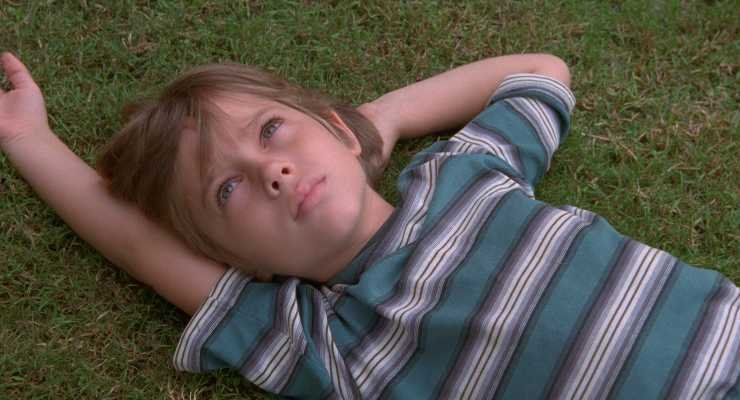
12 years ago, American filmmaker Richard Linklater, the director behind the Before trilogy and Dazed and Confused, released his 17th feature, Boyhood. This is the epic coming-of-age drama centred on the life of Mason Evans Jr., as he grows from six to eighteen in Texas, experiencing his parents separating and growing into a young man.
Despite its seemingly straightforward, slice-of-life logline, Boyhood’s hook lies in the fact it was a project secretly shot over a period of 12 years (2002-2013), using the same cast members as they age over time and using a budget of $200,000. Starring Patricia Arquette, Ellar Coltrane, Lorelei Linklater, and Ethan Hawke, the film made its premiere at Sundance in 2014 and went on to be nominated for around 17 major awards, winning seven.
Upon the film’s anniversary, director Linklater reflected on Boyhood’s conception and impact in an interview. He shared that the idea came to him when he sat down to initally pen an “experimental novel about growing up” when “this film popped into [his] head fully formed“, one which prompted the filmmaker to ask himself “What if everyone just aged throughout the movie, and by the end of this one feature film, everybody would be older? Why can’t you do that?”.
Linklater instantly set the idea in motion, driven by the fact that he “hadn’t seen that in a narrative.” He also embedded a more personal, emotional ambience into Boyhood by casting his daughter to play Mason’s sister, Samantha.
“Going back about 25 years — I had been a parent for a while at that point. Lorelei was eight or nine when I got this idea. I wanted to make a film about childhood,” the filmmaker explained. “I hadn’t done that, and being a parent, you can’t help but revisit your own childhood. Everybody thinks they have their 400 Blows in them somewhere, but I never could land on one moment of childhood.”
Further illustrating how “the origin of Boyhood was [from] being frustrated with what [he] felt was the limited canvas of making a film about a kid,” the director addressed that “Most of the great childhood movies are really about a specific moment, a specific summer, a specific three days.” However, he “was interested in the growing up part — all of it.”
“I was thinking more like a novelist. I wanted to bite off a much bigger chunk of development, and you can’t really do that on film unless you skip a lot of years and cast someone else,” Linklater said. You can’t ask a seven-year-old, “OK, now you’re 10, now you’re 13.”
Linklater also made sure to touch upon Boyhood’s portrayal of, obviously, boyhood, masculinity and societal pressures in America, stating, “The way that society kind of boosts you up, reinforcing masculinity and maleness — well, what is it? Is it sexual? Is it power? Is it aggression? What form does it take and what does it mean? That’s a real thing.”
“I was raised by a single mom with two older sisters, so there were a lot of men in my life who thought it was their job to help make a man out of me. Truth is, I had a very stable, wonderful dad — I just saw him on weekends, but they didn’t know him,” he added, drawing from his own experience. “They thought I was this kid who needed a little male reinforcement, and my mom promoted that too. Some guy would take me on a motorcycle ride, and I’m like, “What am I doing? I don’t need this.”
Linklater’s additional film credits include Slacker, School of Rock, Hit Man, and recently, Blue Moon and Nouvelle Vague.
Discover more from
Subscribe to get the latest posts sent to your email.

