
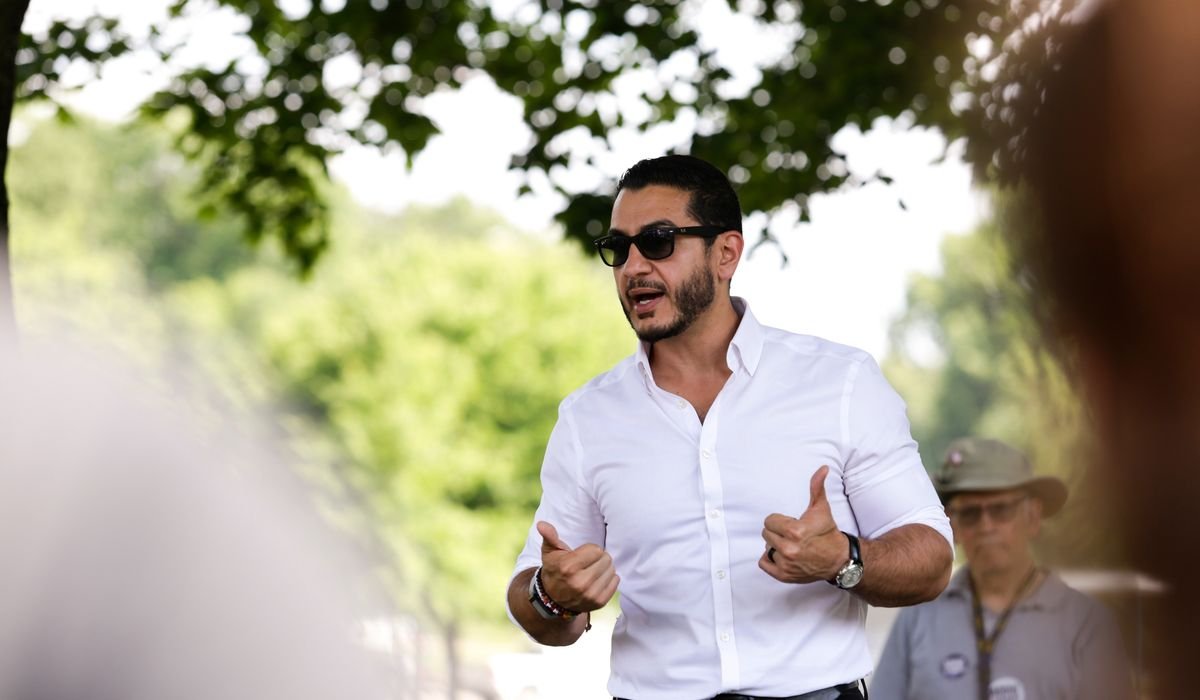
Abdul El‑Sayed is running for the U.S. Senate on a paradox. He embodies a version of the American Dream — the immigrant‑family success story, the academic standout, the public‑health reformer — yet he argues that the very systems that helped him rise are broken and need a far‑left overhaul.
The son of Egyptian immigrants, he grew up in the affluent suburbs of Detroit, excelled in school and sports, and climbed from top honors at the University of Michigan and Oxford as a Rhodes Scholar, then Columbia’s medical school. Now 41, he is a leading contender to become the first Muslim elected to the U.S. Senate.
But his critics say the resume he’s running on doesn’t hold up and that most voters won’t buy his political vision. Ed Sarpolus, a longtime Michigan pollster, put it bluntly: “Every time you look at him, it is like an onion — the more you peel apart, the more you learn that he doesn’t want you to know.”
Dogged by transparency, experience questions
The latest controversy surfaced days before the primary, when Mr. El‑Sayed disclosed that his wife, Sarah Jukaku, owns a rental property in Dubai — on top of one she reported last year in India and a jointly held retail property in Ann Arbor.
Mr. El‑Sayed, who has pledged to “stand up to greedy landlords and corporate profiteers,” brushed off the uproar by suggesting it fit “within a well‑worked trope,” asking why critics were “so focused on foreign properties with somebody with a name like mine?”
This isn’t the first time he has faced transparency questions. His primary rival, Rep. Haley Stevens, regularly asks, “What’s he hiding?”
For years, Mr. El‑Sayed described himself as a “physician,” even though public records show he never held a medical license, completed a residency, or passed a board exam. It led to criticism that he misled the public into thinking he treated patients in a clinical practice, rather than working in public health leadership, research, and government administration.
Still, he built a political identity around the idea that he trained to become a doctor but realized broken politics were making people sick.
He has also been accused of inflating his record leading Detroit and Wayne County’s public‑health departments — a four‑year stretch he uses to cast himself as a turnaround artist. During that time, he launched his podcast, America Dissected with Dr. Abdul El‑Sayed.
Adrian Hemond, a veteran Democratic operative, said Mr. El‑Sayed proved “a bit slippery.”
“It is not that he didn’t do anything productive, but he is definitely overselling it,” Mr. Hemond said. “This is not a particularly well‑vetted candidate.”
Moderate Democrats, Mr. Hemond added, have been cautious about criticizing him too aggressively, wary of alienating far‑left voters who abandoned the party in 2024 via the “uncommitted” movement over President Biden’s support for Israel.
That dynamic has frustrated some Black voters, who blame Mr. El‑Sayed, in part, for damaging Vice President Kamala Harris’ presidential run.
A left‑wing star with polarizing allies
None of the doubts have slowed Mr. El‑Sayed’s rise. He has become a left‑wing rock star — a fresh face promising to upend the political establishment while championing causes like Medicare for All, abolishing ICE, and ending U.S. military aid to Israel.
The father of two girls is the only Senate candidate endorsed by Rep. Alexandria Ocasio‑Cortez. Sens. Sens. Bernard Sanders and Elizabeth Warren are backing him, as is Michigan Rep. Rashida Tlaib, one of his mentors.
He is also supported by Twitch streamer Hassan Piker. Critics accuse Mr. Piker of using antisemitic rhetoric. He has defended Hamas, and once said: “America deserved 9/11.” Mr. Piker later walked back the remark, calling it “inappropriate.”
Mr. El‑Sayed campaigned with Mr. Piker in April — a month after Ayman Mohamad Ghazali rammed his truck into a Temple Israel in West Bloomfield Township, opened fire, and killed himself.
After the attack, Mr. El‑Sayed praised the “heroism of Temple security and law enforcement” and reaffirmed “my commitment to your rights to worship, to learn, to practice and to celebrate your faith.” He added: “Antisemitism has no place in our communities. Ever. Full stop.”
But he also said “violence is a cycle,” noting that some of the attacker’s family members had died in an Israeli airstrike in Lebanon, as Israel Defense Forces alleged the attacker’s brother, identified as Ibrahim Muhammad Ghazali, was a Hezbollah commander.
Jewish leaders, including Temple Israel’s rabbi, bristled at Mr. El-Sayed’s framing, saying it was offensive and negated his condemnation of the attack.
Establishment rallies behind his rival
The Democratic establishment has lined up behind Rep. Stevens. She is backed by Senate Minority Leader Charles Schumer, former House Speaker Nancy Pelosi and Gov. Gretchen Whitmer.
AIPAC has spent heavily against Mr. El‑Sayed because of his criticism of Israel, including his charge that it is committing “genocide” in Gaza.
Mr. El‑Sayed says AIPAC is trying to stop him because Ms. Stevens or former Rep. Mike Rogers — the GOP’s uncontested nominee — would give them “a reliable vote in the U.S. Senate” that prioritizes Israel over struggling taxpayers.
“I want your tax dollars spent in Michigan to provide schools in Michigan, to build healthcare in Michigan, to build roads in Michigan,” he said in a debate this week. “And I think that money sent over there to kill kids and women is the worst use of our tax dollars.”
His campaign is now a test of whether a far‑left insurgent message can break through in an aging battleground state accustomed to traditional Democratic appeals, and one increasingly strained by political tensions between Arab and African American communities.
The early life that anchors his narrative
Mr. El‑Sayed’s story begins with upward mobility, academic achievement, and immigration. Born in 1984, his parents, Mohamed and Fatten, came from Egypt in the late 1970s. His father earned a fellowship to pursue a Ph.D. at Wayne State University. They divorced when he was a preschooler.
His father later married Jacqueline Johnson, a Michigan native who converted to Islam. On LinkedIn, she describes herself and her husband as “nerdy engineers” who were the first in their families to earn doctorates.
Mohamed worked as an engineering professor at Kettering University in Flint and Eastern Michigan University in Ypsilanti; Ms. Johnson also worked as a professor of mechanical engineering at Kettering University. She also served as Vice President for Academic Affairs and Chief Academic Officer at Marygrove College and went on to lead SAE International and the American Society for Engineering Education. She also served on the local school board.
His mother also remarried and works as a nurse practitioner in Missouri.
The New York Times reported that Mr. El‑Sayed has two half‑Palestinian and two half‑white siblings. The campaign did not respond to multiple requests for comment.
He grew up in Bloomfield Hills — one of the wealthiest pockets of Michigan’s wealthiest county, where three out of four residents hold college degrees. Statewide, the share is closer to one in three.
Sports, politics and the roots of a worldview
In high school, Mr. El‑Sayed captained the football, wrestling, and lacrosse teams. His academic strength earned him a full‑tuition scholarship to the University of Michigan, and later another to Michigan’s medical school before he left for Oxford as a Rhodes Scholar.
Lacrosse became a formative space — a sport, he says, that didn’t “tend progressive.” He often debated teammates during the Iraq War. “I was one of the few people on the team who opposed the war, and opposed a lot of what then-President Bush was doing,” he recently said on WJR‑AM in Detroit. “I learned so much about having difficult political conversations with people you still love and had to work with every day, and being able to put that aside and come back to it later.”
That instinct — linking personal experience to broader social forces — followed him into the college classroom. As an undergraduate, he became fascinated by how “the social world shaped the biological world, which, in effect, is public health.”
Sandro Galea, then a professor at the University of Michigan, said Mr. El‑Sayed was relentless. He offered to work for Mr. Galea for free. “I took him on, and moved him to paid soon after, impressed by his energy and commitment to doing right.”
“Abdul was always what he is today — eager, committed and wanting to make a difference,” Mr. Galea said. “His efforts to be in electoral politics are all about doing the most he can to help as many people as possible. That has been with him all his life.”
Indeed, in an interview more than a decade later, he said his Islamic faith and belief in God “commands me to create a more just, more equitable world.”
In his 2007 commencement speech, Mr. El‑Sayed provided insight into his developing worldview, urging classmates to carry their “mercy, compassion, and love” into a world that “absolutely needs us,” declaring they had “the audacity to believe that we can change this world.”
Former President Bill Clinton, the keynote speaker, told the crowd he wished “every person in the world” who fears a clash of civilizations could have heard Mr. El‑Sayed speak.
Public service and a debatable record
In 2015, at 30, Mr. El‑Sayed left a tenure‑track job as an assistant professor of epidemiology at Columbia University to accept an appointment running Detroit’s Department of Public Health — two years after the Motor City declared bankruptcy. He spent 17 months there before launching a failed 2018 bid for governor.
In 2019, he was appointed as a scholar-in-residence at Wayne State University, where he delivered public lectures and taught an interdisciplinary course titled “Wellbeing + Public Policy: Issues and Concepts”.
In late 2022, he became a project consultant for Wayne County’s health department, assuming the reins in March 2023.
Mr. El‑Sayed casts both periods as proof of his effectiveness. He highlights initiatives he says he led: free eyeglasses for children, removing lead from Detroit schools, expanding access to Narcan, taking on polluters, and spearheading a medical‑debt program projected to cancel up to $700 million.
But independent reviews have complicated the narrative.
Bridge Michigan reported the medical‑debt effort had “only settled $57.38 million so far” for just over 83,000 residents — far short of the 300,000 he promoted — and that he scaled back claims about “tens of thousands” of free glasses, noting the real number was closer to 16,000.
Others say he moved the ball on lead pipes in schools, but not as far as he claims.
“Nothing really got fixed in Abdul’s two years here in Wayne County,” Charlie LeDuff, a Detroit government watchdog and local personality, said on a recent podcast. “In fact, life expectancy in Detroit — Wayne County’s biggest city — is plummeting.”
Those criticisms feed the broader debate over Mr. El‑Sayed’s Senate bid. Supporters see a reform‑minded public‑health expert. Detractors see a politician whose record doesn’t match his rhetoric.
Voters on Tuesday will decide which version prevails.
