
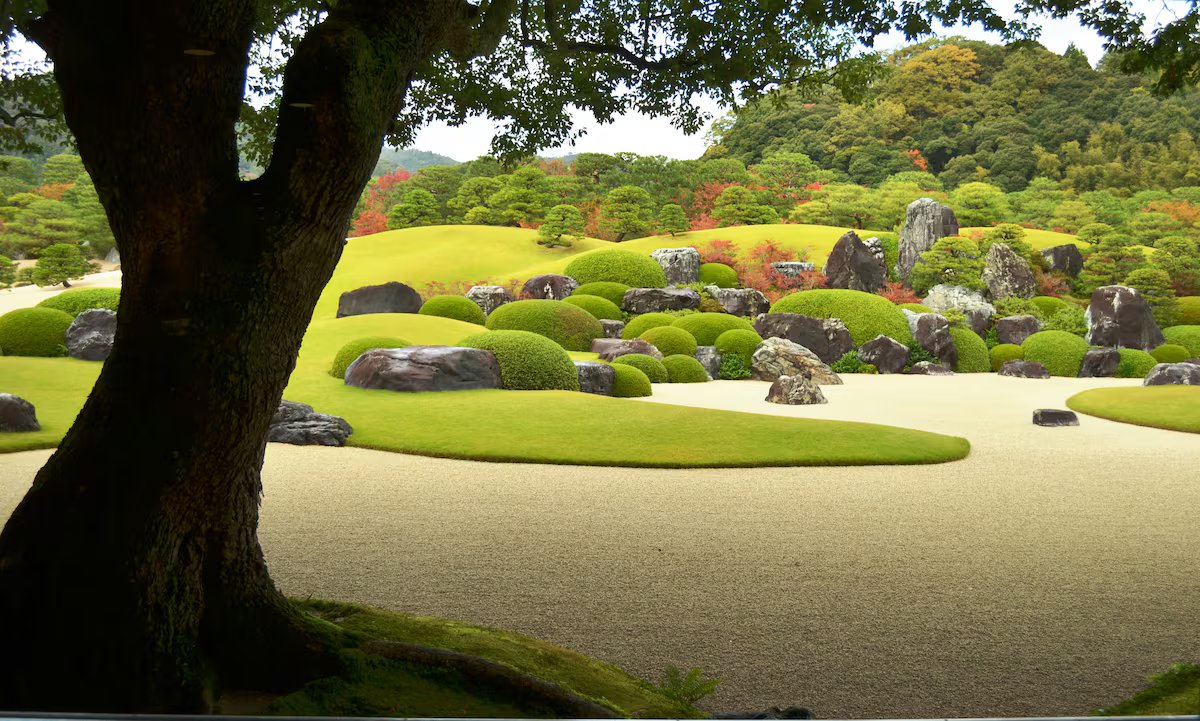
In Japan, there is no distinction between art and the arts. Since the 13th century, gardening has been as important as painting and as architecture. The integration of drawing, landscaping and geography is legendary because gardens there speak simultaneously of a moment and of the world. That is: of the oceans, the islands, the mountains, waterfalls, lakes, rivers, turtles, cranes, the camellia, the azalea or water. Above all, water. And they do it from a state of calm and humility.
In Japan, a few rocks can form a garden, a mountain standing in a dry garden. The Japanese also have a way of framing nature without enclosing it — the technique of shakkei, which means ‘‘borrowed landscape.’’ The shakkei invites designers to plan a garden so that it adds the resonances of neighboring tree canopies or views of hills, rivers or the sea to the composition.
Japanese culture explains time in eras: Asuka, Nara, Heian, Kamakura, Muromachi, Momoyama, Meiji, Taisho, Showa, Heisei and Reiwa, which do not align with the Western chronological order. For that reason, after decades of travel in Japan, the Spanish architect Javier Vives has learned to take that distance into account. In his book History and Art of the Japanese Garden (Satori) he attempts to explain, in a didactic way, what has been his passion since his first trip to Japan in 1979: the relationships among the garden, architecture, theater and Japanese culture. Let’s see how he does it.
To begin with, by speaking of nature. That is: of imperfection and asymmetry. Of beauty as chance and also as a perfected craft. Of the charm of the ephemeral. Of reverence for the environment and of the Shinto deities, the Kami, who could inhabit trees, rocks, mountains or rivers. “With Shinto, boulders acquire symbolic value.” And with Buddhism it is the great mountain, rising from the sea, that becomes the center of the universe — and which, starting from the 14th century, reaches Japanese gardens in the form of large rocks.
The pebbles on garden grounds not only prevent the soil from turning to mud, they also mark the boundary between the divine and the human realms. In pre-Buddhist enclosures, ponds with carp appear, and ropes made of rice fiber replace fences to separate the sacred from the profane. From these elements, there emerges a sense of originality different from ours. There, the idea is what matters. With decay, an architectural element can be repaired or replaced. The original stone or wood is not what matters. What is preserved is the image perpetuated through change.
Vives believes that Japanese civilization blossomed in the 11th century, when the naturalistic garden was born. Thanks to the Zen monk Muso Soseki, gardening in Japan took a giant step. The architect explains that it was Soseki, during the Kamakura period (1185–1333), who suggested that landscapes, besides surprising, beautifying and serving practical purposes, could help with meditation and contemplation.
In the subsequent Muromachi period (1333–1573), the military government moved from Kamakura to Kyoto amid succession disputes that devastated the country. Nevertheless, those years saw the flourishing of the great Japanese arts. From that era came the austere shoin architecture, Noh theater and the tea ceremony. Also the dry gardens — without plant or aquatic elements. Zen, with its aesthetic universe focused on restraint, prevailed over other Buddhist schools. Thus, stone waterfalls invited inward reflection rather than sensory gratification.
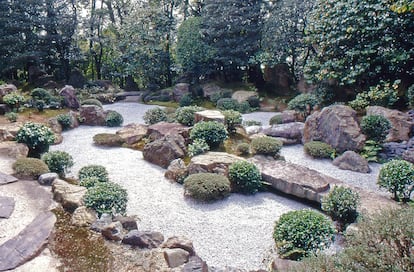
The best-known dry gardens are Daisen-in and Ryoan-ji, both in Kyoto, which were laid out in the 16th and 15th centuries respectively. Vives analyzes them in depth. However, his book goes further and pays attention to many of their successors, such as Taizō-in in Kyoto, attributed to the painter Kano Motonobu, who, with his father, founded the Kano school of painting. As if it were a landscape painted from above, stones and slabs form bridges between the shrubs, and the gravel symbolizes a river.
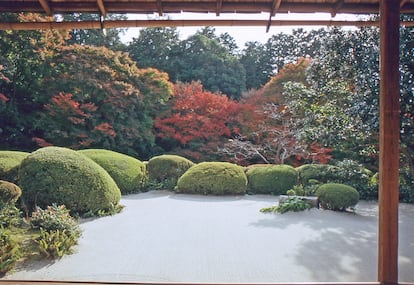
Some of the larger gardens, which combine landscape, dry garden and ponds, date to the Momoyama period (1573–1603) when the country’s unification began. For that reason, in the later Edo period (until 1868), which coincided with the capital’s move to Tokyo to distance it from the intrigues of the Kyoto court, some feudal lords built gardens intended for retirement. Known as samurai gardens, they are small and private, yet their construction appears larger than their actual size. In Kyoto’s Shisen-dō (17th century), the boundary between inside and outside disappeared. The reflection on the gravel illuminates the small garden created in the Edo period as a refuge for an enlightened samurai.
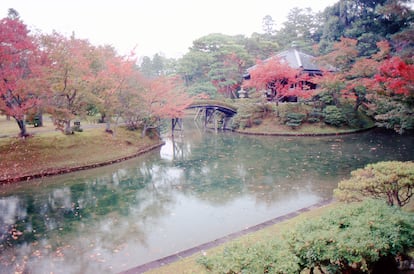
It was in that era that the Imperial Villa of Katsura in Kyoto was built. It is a seemingly simple garden in which every element is attractive in any season. Stones on the moss form subtle paths. Tree canopies do not steal space and soften their colors.
Constants
The gardens of different eras have left as a legacy a set of constants in what is today known as the Japanese garden. To begin with, the close relationship between landscape and architecture, and the blurred boundary between exterior and interior. Architectural elements frame the best views.
Emptiness is also a key to these spaces. Likewise, in contrast to classical Western gardens, asymmetry — closer to nature’s disorderly order — prevails. The rest is subtlety: fences so integrated they do not divide; paths almost absorbed by vegetation that whisper routes; rocks that form bridges and symbols — the mountain — and water, which never has a geometric perimeter but adds dynamism, coolness and sound — and which in dry gardens is represented by gravel. There are stone lanterns used to light the night with candles. Also islands and bridges made of stone and vegetation.
Among the more recent traditional gardens, the one at the Adachi Museum of Modern Japanese Art in Yasugi was designed in 1970 by Nakane Kinsaku with four zones. One contains a waterfall inspired by a painting by Yokoyama Taikan that can be seen in the museum itself. That garden, like any Japanese garden, is at once complex and simple. It is, in fact, a microcosm and, as such, it summarizes the world.
Sign up for our weekly newsletter to get more English-language news coverage from EL PAÍS USA Edition
