
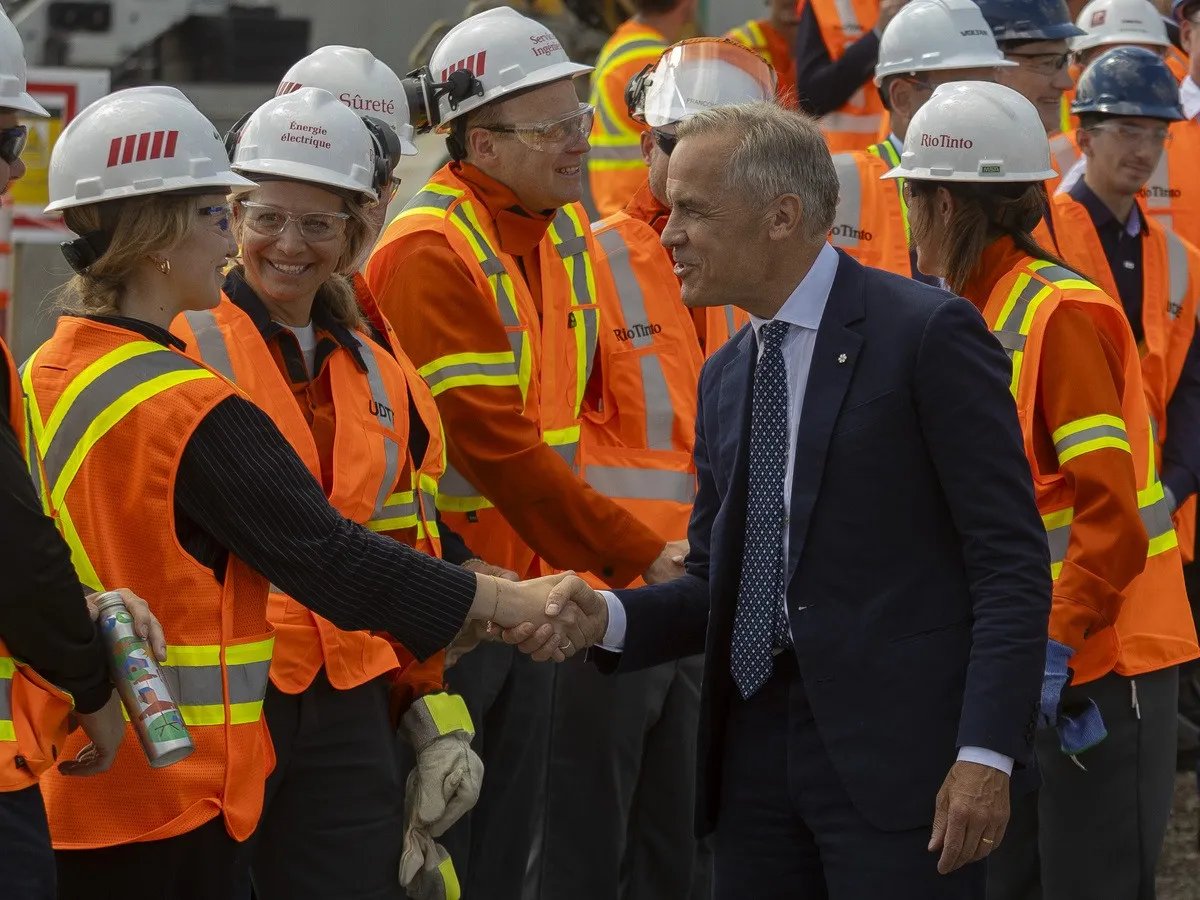
OTTAWA — Quebec, Newfoundland and Ottawa announced a deal Monday that would see a massive redevelopment and expansion of the Churchill Falls hydroelectric facility and both provinces set aside a decades-long conflict over electricity prices… for now.
Prime Minister Mark Carney and his Quebec and Newfoundland counterparts Christine Fréchette and Tony Wakeham were in Newfoundland to announce the new deal on Monday afternoon.
“After months of occasionally tense but always positive negotiations, we have achieved a rare win-win-win,” N.L. Premier Wakeham said, calling the original 1969 energy deal between Quebec and his province “one of the darkest chapters” of its past.
“What a great day it is for Quebec, Newfoundland and Labrador,” Fréchette added.
The renegotiated but non-binding deal promises to boost energy production at the Churchill Falls hydroelectric facilities significantly, as well as commits to build a long-debated new production facility at nearby Gull Island.
Plans to expand existing facilities and building the Gull Island power project as well as an onshore wind energy project and new transmission lines to Labrador in Quebec would triple the generating capacity of Churchill Falls to 14,000 megawatts of renewable power, Carney said.
In the renegotiated deal, Hydro Québec will also pay slightly more per kilowatt hour on average compared to a 2024 deal (7.4 cents versus 5.9 cents), though Fréchette argued the price remained vastly below the average cost for energy.
Both provinces noted that the deal would not have happened without significant federal government investment. The new projects will cost an estimated $50 billion, with Ottawa is committing up to $10 billion and promising to expedite approvals for the construction projects by referring it to the new Major Projects Office, according a news release.
“That is more than the entire generating capacity of BC Hydro. It’s more than double the output of Bruce Power, the largest nuclear plant on this continent. It is the equivalent of 18 Hoover Dams in America, at its current operating capacity,” the prime minister said, calling it the largest renewable energy investment in Canada’s history.
The premiers confirmed that much of the current agreement is non-binding until the deal is completely finalized and approved, likely by the end of the year.
That means the agreement risks getting upended for the second time in two years if the Parti Québécois gets elected in the province’s upcoming provincial election in October. The PQ currently leads in provincial opinion polls.
The PQ previously told National Post that if elected, it would look into redrafting any deal to include further compensation for the province’s historic loss of the territory of Labrador roughly one century ago. That could explain why both provinces moved to sign a deal before the provincial elections are called.
At the press conference, Fréchette said “it’s a possibility” that PQ could rip up the deal if it forms the next provincial government.
In a statement after the announcement, PQ leader Paul St-Pierre Plamondon ripped Fréchette for claiming he would rip up the deal without knowing its details.
“The reality is that no one has read the agreement and if the agreement is positive for Quebec, obviously a Parti Québécois government will be interested in maintaining this agreement,” Plamondon wrote on X.
“We will study the agreement carefully to understand what it entails, because to date no one has been able to explain to us why Christine Fréchette’s CAQ government rushed to negotiate an agreement with Newfoundland, a week before the election was called.”
In an interview, Natural Resources Minister Tim Hodgson said he could not understand why any political leader would want to rip up a deal he considered to be extremely beneficial to all parties and Canada.
“Given what’s going on in the world right now, that we’re in a more dangerous world, we’re in a more volatile world, we’re staring down the barrel of unfair and unjust tariffs designed to hurt our economy… I can’t understand in that environment how someone thinks about ripping up agreements,” he said.
“I suppose someone could do that. I think people would scratch their head and say, ‘now’s not the time to do that’,” he added.
With the Quebec election looming, both Hydro-Québec and N.L. Hydro hammered out a new agreement to update the terms of the 2024 memorandum of understanding to develop Gull Island and expand capacity at the Churchill Falls plant.
That 2024 deal was signed between then-Quebec Premier François Legault and former N.L. Premier Andrew Furey to replace a contentious 1969 energy deal that saw Hydro-Québec develop the Churchill Falls site and benefit from cheap hydroelectricity for decades. The deal caused generations of resentment in Newfoundland and Labrador, where it was perceived as a terrible deal on made the back of the province.
However, when Wakeham was elected N.L. premier in 2025, he promised to review the 2024 MOU. A report concluded the deal was not in Newfoundland and Labrador’s best interests and negotiations restarted between both sides.
Monday, Wakeham said that he was reneging on his promise to put the agreement to a provincial referendum and would instead reconvene the legislature in mid-September to debate the deal. The move could be tied to a desire to accelerate final negotiations before the Quebec election.
National Post, with files from Catherine Lévesque
cnardi@postmedia.com
Our website is the place for the latest breaking news, exclusive scoops, longreads and provocative commentary. Please bookmark nationalpost.com and sign up for our politics newsletter, First Reading, here.
