

Following a bout of heavy rains in September 1629, water rose through the streets of Mexico City and did not recede. The city had just spent 22 years digging a drainage channel through the mountains, the Desagüe de Huehuetoca, meant to solve a problem the closed, mountain-ringed basin had faced for centuries: nowhere for excess water to go.
The project failed. Parts of the city stayed flooded for years and more than 30,000 people died, mostly from disease in the standing, sewage-laced water.
The city kept making the same trade for four centuries after that: draining the water to survive and turning every success into a new, worse problem.
A city that traded its lake for a sinking foundation
Before the Spanish conquest, Tenochtitlán sat on an island in Lake Texcoco, its neighborhoods built with the lake rather than against it. Colonial and then Porfirian-era engineers kept draining it instead, culminating in the Gran Canal del Desagüe around 1900. Draining the lake solved flooding and erased the city’s water supply at the same time, so the city turned to pumping the aquifer beneath the old lakebed’s soft, clay-rich sediment.
Pumping that aquifer releases the pressure holding the clay open. The clay compacts, causing the ground to drop. A 2021 study published in the Journal of Geophysical Research: Solid Earth measured subsidence near 50 centimeters a year in the worst areas, and found the sinking no longer tracks current pumping rates: It is now driven by decades-old compaction that cannot be undone, even if every well stopped tomorrow.
That uneven sinking has warped the Gran Canal itself, leaving stretches of the drainage system sloping the wrong way. Mexico City has sunk roughly 30 feet across the lakebed zone, and engineers now run pumping stations just to lift sewage back up to where gravity can take over — the same 1607 trade, repeated at greater cost.
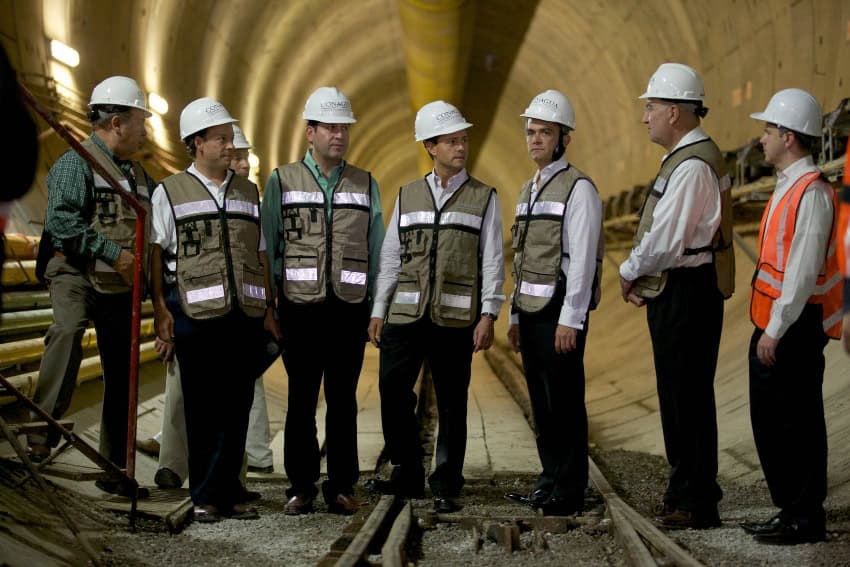
The newest version, the Túnel Emisor Oriente, finished in 2019 after 11 years of digging, carries wastewater 62.5 kilometers (39 miles) to Hidalgo state, where it irrigates the Mezquital Valley. Only about 36% of the city’s wastewater gets treated at all; the nearby Tula Valley region now draws 90% to 100% of its own aquifer from decades of Mexico City’s former runoff.
What survives to reach a kitchen tap
Mexico City’s water is treated properly at the source. What happens after is where the system fails.
Official figures from Mexico City’s water agency, the Sistema de Aguas de la Ciudad de México (SACMEX), put network-wide leak loss at roughly 40%, while researchers studying intermittent, low-pressure water systems in general have documented exactly how contamination gets in through a leaking network: a crack or joint, a nearby contaminant source, and a pressure gradient pulling inward.
Rooftop reservoirs, also known as tinacos, exist precisely because city pressure is not continuous, and a small pilot study in Guadalajara found contamination rates more than double after water sat in a home’s storage tank versus straight off the network.
Water contamination
Two boroughs carry a documented, more specific version of this.
In Iztapalapa, two named SACMEX/UNAM wells have shown arsenic and heavy-metal levels exceeding Mexico’s own drinking-water standard since they opened; separately, UNAM researchers found microplastics, Giardia muris and E. coli in the borough’s water.
SACMEX’s own 2020 data recorded arsenic violations across 28 wells in Tláhuac, Tlalpan, Coyoacán, Iztapalapa, Iztacalco and Azcapotzalco, signifying a documented national pattern: Only 1 in 10 Mexican treatment plants is even equipped to remove arsenic or fluoride.
Stressing the system
Meanwhile, large companies are also extracting from the same stressed basin. CONAGUA’s public registry shows Coca-Cola FEMSA holds a well concession in Cuauhtémoc, where it extracts 1.13 billion liters a year. PepsiCo’s bottler holds another in Iztacalco, extracting 511 million liters.
Nationally, Coca-Cola and PepsiCo’s Mexican bottlers have extracted roughly 14.7 billion and 25.7 billion liters, respectively, since 1994.
What none of the public record shows is what becomes of the 15% to 30% of that water any industrial reverse-osmosis system inevitably rejects as concentrate, a limit set by the physics of the membrane itself.
Where the hope is
The subsidence side of this cycle has already been broken elsewhere.
Tokyo sank roughly 4 meters before two laws, the 1956 Industrial Water Law and the 1962 Law on Regulation of Groundwater Use in Office Buildings, made new wells prohibitively expensive to drill while the government subsidized cheaper surface-water infrastructure as the replacement. Groundwater pumping in the city’s 23 wards peaked in 1964 and has fallen since; subsidence in the most heavily regulated districts was brought close to zero.
Venice stopped pumping groundwater entirely and now draws its drinking water from the Italian mainland instead, sinking at about 1 millimeter a year, down from a rate that once threatened the city outright.
Neither city undid the damage already on the books. Both proved the mechanism itself can be stopped, and both did it with a law, not a technology.
Legal remedies vs. a household fix
The legislative move mirrors Tokyo’s. Sustained public pressure on regulators, not new technology, is what got its fix passed. Here, that looks like contacting a local representative directly, and backing investigations like “Veneno en mi agua,” or “Poison in my water,” that keep this issue on the public record instead of letting it fade after one news cycle.
A household’s own move is smaller and immediate: A fix goes under the sink.
An ultrafiltration membrane, at roughly 0.01 microns, physically blocks the bacteria and parasitic cysts responsible for most water-borne illness here, the exact risk documented above. It runs on the building’s own water pressure: no pump, no electricity and a 100% water recovery rate, so there is no reject stream at all. The water that enters the membrane is the water that leaves the tap, only cleaner. That combination — no pump, no electricity, no wasted water — also makes it the cheapest of these options to buy and run.
Reverse osmosis, run at home, sends roughly 3 liters down the drain for every liter it produces, a smaller version of the same tradeoff bottlers make at industrial scale. Given how much of this city’s wastewater exits the basin rather than getting treated and returned, that reject water is likely gone from the Valley of Mexico’s own water cycle for good, unlike ultrafiltration, which never enters that path at all.
Ultrafiltration
Garrafón delivery carries its own documented risk: Independent testing found the majority of samples in one Mexico City study contaminated with coliform bacteria, and nearly a quarter with E. coli, in an industry that grew 85% between 2012 and 2018.
Ultrafiltration is the one choice in this entire chain that does not ask the aquifer for anything extra to keep a household safe. It does not fix the leaking network, the sinking ground, or the four centuries of trades that got the city here. It is the one piece of the cycle a single kitchen can opt out of today, without waiting on a General Water Law that has been stalled in Congress for eight years, or a recharge program that exists as exactly one working pilot against a documented crisis.
Andrew D. Daily lives in Roma Norte, where he runs a water filtration company and mexicocitytravel.com, a simplified guide for visitors. Before meeting his wife and relocating to CDMX, he worked 11 years in Los Angeles, CA, as a television Production Manager on shows like Shark Tank, The Voice, and Miss Universe.
