
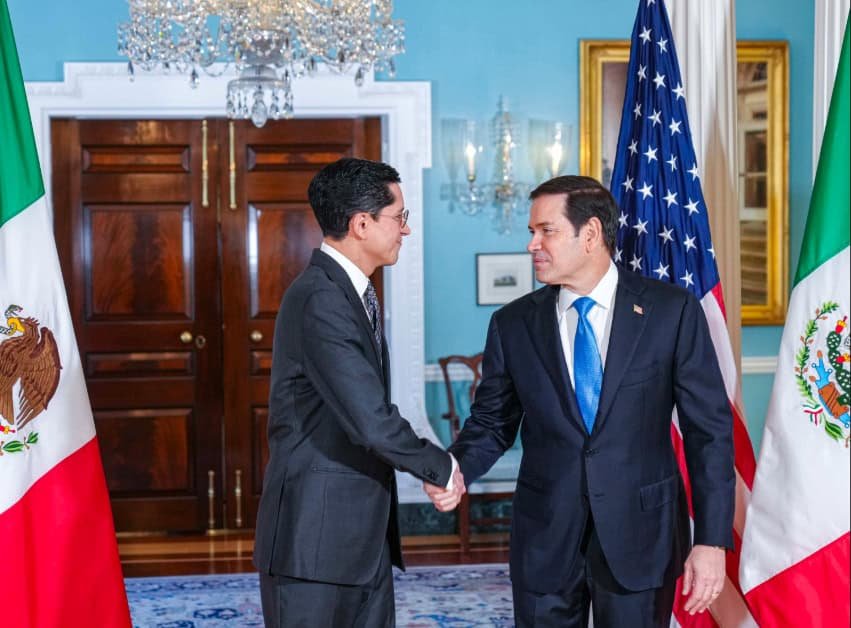
Foreign Affairs Minister Roberto Velasco and U.S. Secretary of State Marco Rubio held their first face-to-face meeting in Washington, D.C., on Thursday, amid tensions in Mexico-U.S. relations.
Both officials commented on the meeting in social media posts, though a Bloomberg report citing sources familiar with the matter revealed a tougher private ask.
Velasco, who succeeded Juan Ramón de la Fuente as foreign minister in April, wrote on X that he and Rubio “reviewed security progress” and Mexico and the United States’ “joint work against drugs and arms trafficking and against transnational organized crime.”
He asserted that the bilateral “security cooperation scheme” has “yielded the best results in the region.”
Homicides in Mexico have declined significantly during the term of the current government, firearm seizures have increased and U.S. intelligence has helped Mexican authorities capture high-profile criminals, including former Jalisco New Generation Cartel (CJNG) leader Nemesio Rubén “El Mencho” Oseguera Cervantes, who was fatally wounded during a military operation in Jalisco in February. In addition, irregular migration to the United States via Mexico has declined sharply during the second Trump administration, although U.S. Border Patrol’s encounters with migrants at the United States’ southern border doubled in annual terms to more than 9,200 in July.
Velasco said that he and Rubio also spoke about “respect for the human rights of Mexican migrants in the United States.”
Me reuní hoy en Washington, D. C., con el secretario de Estado @SecRubio. Revisamos los avances en materia de seguridad: el trabajo conjunto contra el tráfico de drogas y armas y contra la delincuencia organizada transnacional. Es el esquema de cooperación en seguridad que ha… pic.twitter.com/6niYVJY0md
— Roberto Velasco Álvarez (@r_velascoa) August 26, 2026
“I reiterated that our work with the United States is based on respect for sovereignty and territorial integrity, shared responsibility, mutual trust and collaboration without subordination,” he wrote on X.
Mexico’s Ambassador to the United States Roberto Lazzeri and various other Mexican officials accompanied Velasco during his meeting with the U.S. secretary of state.
Rubio offered a briefer summary of Wednesday’s meeting, writing on X that he met with Velasco to “discuss decisive actions to end illegal immigration, halt fentanyl trafficking, and dismantle Foreign Terrorist Organizations and cartels.”
Eight Mexican cartels, including the CJNG and the Sinaloa Cartel, have been designated as foreign terrorist organizations by the U.S. government.
Bloomberg News spoke with anonymous sources who offered additional insight into the meeting between Velasco and Rubio.
Citing “people familiar with the matter,” the news agency reported on Thursday that the U.S. secretary of state told his Mexican counterpart that the Trump administration wants the Mexican government “to do more to stop undocumented migrants from crossing the U.S. border” given the recent spike in migrant apprehensions.
“… The push is led by Homeland Security Adviser Stephen Miller, a top Trump adviser, and the main U.S. demand is that Mexico stop its own citizens from crossing the border,” Bloomberg reported, once again citing its anonymous sources.
“That presents a constitutional and legal complication for [President] Sheinbaum’s government because Mexican nationals are free to travel within their own country, including from the poorer southern states where many migrants originate to northern Mexico and the U.S. border region,” Bloomberg wrote.
Meeting takes place against a backdrop of bilateral tension
The meeting between Velasco and Rubio took place at a time when Mexico-U.S. relations are strained for a variety of reasons.
Among the reasons for the bilateral tension are:
In a major speech on May 31, Sheinbaum railed against what she framed as U.S. interference in Mexican affairs, but nevertheless vowed to continue security collaboration with the Trump administration.
She has maintained a respectful relationship with Trump, even though the U.S. president has claimed she is “scared” of Mexican cartels and publicly mocked and mimicked her way of speaking.
With reports from La Jornada and Reforma
