
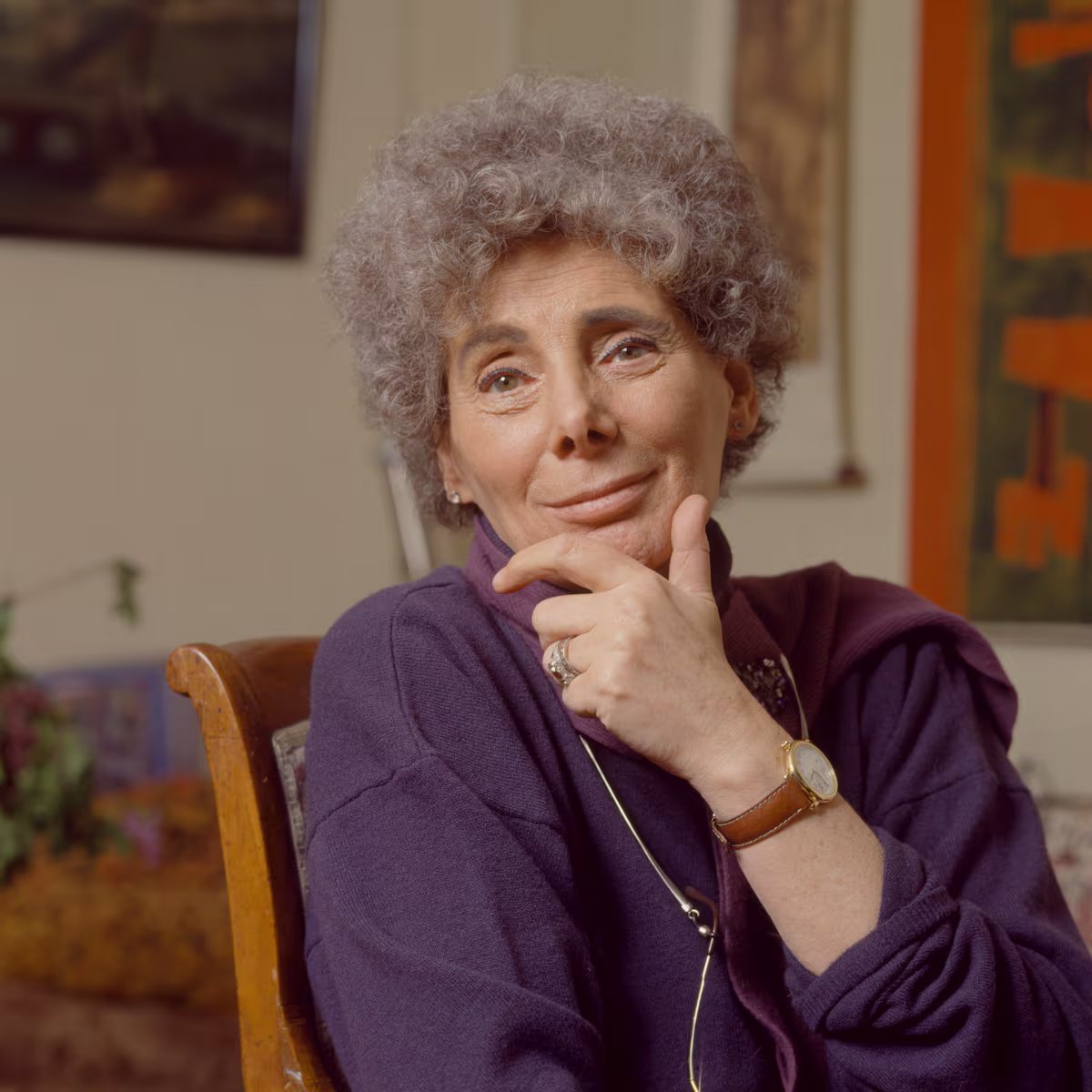
Jacqueline Harpman (Etterbeek, 1929–Brussels, 2012) used her novels and short stories to ask who we are, how and what we desire, how we relate to one another and what of us endures when we disappear. Thirty years after her best-known works were published, a new generation is debating those questions on social media. Driven by BookTok, TikTok’s literary community, I Who Have Never Known Men has become a phenomenon: Transit Books’ 2022 edition has sold more than 800,000 copies in North America and, in the United Kingdom, Vintage — which reissued the novel in 2019 — sold 45,000 copies in 2024, 11 times more than two years earlier.
Dua Lipa included the story of a young woman locked with 39 other women in a bunker on Service95, her book club, and in Spain, Alianza rode the wave to reissue it in September 2025, four years after first releasing it. “It did not respond with immediate success, but it has been finding readers progressively and in recent months we have seen clear and sustained growth. TikTok and Dua Lipa’s recommendation broadened its reach, but the most interesting thing is that it did not remain a one-off spike: the book circulates thanks to word of mouth among readers and booksellers,” says Elena Martínez Bavière, editorial director at Alianza.
“I learned of its publication thanks to a student,” says Juan Varo, professor of comparative literature at the University of Granada. Science fiction is back: after the successful adaptation of The Handmaid’s Tale, Consonni has reissued Izumi Suzuki’s Terminal Boredom (2025) and Marge Piercy’s Woman on the Edge of Time (2019). “And much of Ursula K. Le Guin’s and Octavia Butler’s work is being reissued, as well as key theoretical texts from the 1970s such as Shulamith Firestone’s The Dialectic of Sex,” Varo adds.
Science fiction — Varo reminds us as he invokes Kingsley Amis — is the literature of desire, of sexual destruction, of domination. “Catastrophe is seductive for a society that faces politics, social relations and the economic situation with disillusionment,” he adds. Another key to its success is Darko Suvin’s estrangement: science fiction invents a strange world from which to view the present. The threat posed by the far right to sexual freedom, reproductive rights, and gender issues keeps Harpman relevant.
On September 10, Alianza will publish Orlanda in Spanish, the novel that won Harpman the Médicis in 1996 and that inverts the game of Virginia Woolf’s Orlando (1928): Aline Berger, a 35-year-old teacher, is in a café rereading the passage in which Orlando changes sex when part of her consciousness leaves her body and takes up residence in Lucien’s — a young man at the next table. Harpman names that half, where she concentrates Aline’s strength, initiative, anger and desire, as masculine. It is an essentialist framework the novel complicates: at age 12 Aline is strong, loud and self-assured, but her mother rebukes her as a “tomboy” and the injunction to be pleasing represses her. “Orlanda belongs to a framework older than the one we now use to think about gender identity. In Harpman it has to do with psychoanalysis, the androgynous and the double: who am I, what part of me have I repressed, and how to gather those pieces,” explains Alicia Martorell, Harpman’s Spanish translator.
The writer presents femininity as a social construction but, as philosopher Anne Coignard points out, she risks naturalizing as masculine the vitality and spontaneity that that upbringing represses. That opens a gender question and channels it back into binary, heterosexual categories. Martorell, who has translated Judith Butler, resists labeling Harpman a queer author. “I think the most important thing in Orlanda remains that ‘who am I.’ And also: whom I desire, and why I desire,” she says. For Martínez Bavière at Alianza, the power of Orlanda and the contemporary issues it addresses will help make “an author who for too long has been a secret jewel” visible. “With Harpman everything seems to work in the long term: word of mouth, sustained sales growth and the passion of those who discover her,” she believes.
Separate halves
Harpman’s novels pose existential questions without becoming arid. In Orlanda she revives the Platonic myth of the separated halves from The Symposium, while the bunker’s exit in I Who Have Never Known Men has been read through the allegory of the cave. “The novel is written in a simple style, reads easily and keeps so many narrative mysteries that it invites an intrigued reading. Harpman’s appeal among young people is self-explanatory: the protagonist of I Who Have Never Known Men lacks memory of the past and has no future,” Varo explains. The continuous present in which the protagonist lives is attractive to a hypermodern generation. “As Gilles Lipovetsky warns, this generation lives with disillusionment or indifference toward the inherited world and culture and rejects the future, either because it does not trust it or because it conceives of it as an undefined present. The protagonist’s loneliness connects with the individualism and anxiety with which this young generation is perceived,” Varo adds.
Harpman’s life illuminates her work. The daughter of a Jewish father, she fled with her family to Casablanca during the Nazi occupation; several relatives died in Auschwitz. After spending two years in a sanatorium for tuberculosis, she studied psychology and practiced as a psychoanalyst. “All her work concerns identity: how I construct myself and which satellite elements affect what I am,” Martorell says. Each novel subjects that question to an experiment. In I Who Have Never Known Men, a narrator with no memories before the bunker builds her self without cultural tools; in Orlanda, a repressed part acquires its own body; in the third work Martorell is translating — La Fille démantelée (The Dismantled Girl), by Harpman, scheduled for publication in 2027 — a daughter constructs herself in relation to her mother. Form reproduces that obsession. Harpman works with stream of consciousness and shifts the standpoint from which her characters speak.
Rediscovery, yes, but of an author celebrated in Belgium: Harpman won the Prix Rossel in 1959 and the Médicis in 1996. Martorell did not know her work when Alianza commissioned her translation of I Who Have Never Known Men, which she considers “a major work of world literature.” “As I translated it, I couldn’t understand how she had stayed off the radar. She does things with enunciation, with the voice that tells and the voice that is told, that have an impressive richness,” she says.
Sign up for our weekly newsletter to get more English-language news coverage from EL PAÍS USA Edition
