
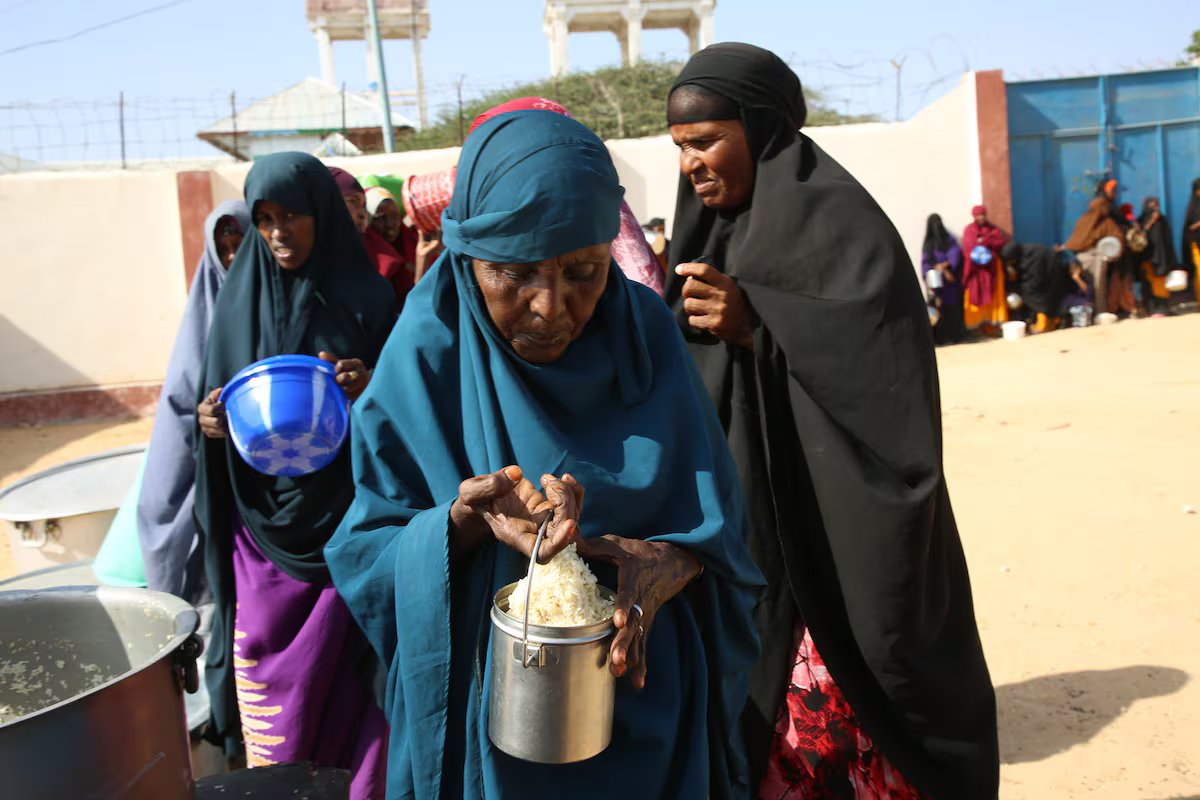
The threat of an information blackout is looming over the Famine Early Warning Systems Network (FEWS NET), one of the world’s leading data-monitoring systems for anticipating food crises and planning humanitarian responses. Created by the now-dismantled U.S. aid agency USAID and currently overseen by the U.S. State Department, the platform has weathered interruptions and political controversies before. Alarm bells rang again this summer after Afghanistan, Somalia and Yemen disappeared from both the annual Peak Food Assistance Needs Outlook and the monthly Food Assistance Outlook reports.
During the online presentation of its latest monthly report, FEWS NET acknowledged that it “no longer publishes information on several countries that were previously included in this product.” The map displayed during the session omitted those three countries. Ethiopia and El Salvador were also missing. Afghanistan, Somalia and Yemen nevertheless are still among the countries with the greatest food needs in the world.
FEWS NET has become a global benchmark because its reports combine meteorological, agricultural, economic and conflict data gathered from satellites and local sources. That body of information makes it possible to forecast trends in food insecurity six to 12 months in advance. The system publishes regular reports and maintains an open-access database that anyone can consult.
Concern intensified after Devex, a news outlet focused on international development, reported the changes, prompting alarm among humanitarian organizations and former USAID officials. USAID, which was dismantled by the Trump administration, created FEWS NET in 1985 and funded and oversaw the program until February 2025.
The platform, which now operates under the supervision of the U.S. State Department, referred all questions about changes to its reporting to the department. A State Department spokesperson neither confirmed nor denied the reported changes. The spokesperson told EL PAÍS, however, that “FEWS NET is a U.S. government-funded contract” that produces information used to guide the department’s food-assistance decisions. It does so, the spokesperson added, by “focusing on countries that align with the secretary’s overall policy priorities.”
But on Tuesday, a State Department official told EL PAÍS that “FEWS NET’s public reports on Somalia, Afghanistan and Yemen will resume starting in September.” The spokesperson added in an email, however, that “the Department will continue to assess whether all programs are making appropriate use of limited resources to advance foreign policy priorities.”
Jeremy Konyndyk, president of Refugees International and a former director of USAID’s Office of U.S. Foreign Disaster Assistance, believes there are enough warning signs to fear another blow to the monitoring system. “If they have stopped reporting on certain countries, the only reason is that the State Department has instructed them to do so,” he said in a video-call interview. “The Trump administration is increasingly politicizing famine analysis. The State Department does not want its own information system to reveal the consequences of its policy decisions.”
Alex de Waal, one of the world’s leading experts on famines and food crises, shares that assessment. “The Trump administration has essentially decided that some countries do not count,” he told this newspaper by email.
Political pressure
Simon Winter, vice president for Humanitarian Nutrition Security at RF Catalytic Capital, an organization affiliated with the Rockefeller Foundation, says agencies such as the World Food Programme (WFP), UNICEF and the U.N. Refugee Agency (UNHCR) rely on FEWS NET to anticipate food emergencies, decide where to deploy resources such as food assistance and cash transfers, and assess the risk of famine. “FEWS NET has become a global public good,” he said by video call.
Although other early-warning systems track food insecurity, including the Integrated Food Security Phase Classification (IPC), which issues official famine determinations, and the WFP’s HungerMap, FEWS NET plays a distinctive role. Konyndyk explains that the U.S.-run platform serves as an independent complement to those systems. “Countries are part of the [IPC reporting] process, and there is often political pressure to avoid a famine declaration. That is why it is important for FEWS NET to conduct a credible, independent analysis in parallel.” The concern now, he adds, is that if the platform stops reporting on Afghanistan, Somalia and Yemen, it may become more difficult to document famine conditions in those countries.
This is not the first time FEWS NET has been targeted by Donald Trump. In 2017, his administration proposed eliminating the system as part of a broader package of cuts to foreign aid. Although it survived that attempt, during Trump’s second term the network was temporarily paralyzed after USAID was dismantled. In February 2025, its website was taken offline and remained inaccessible until June, when it was restored after a strong backlash from humanitarian organizations.
But tensions surrounding FEWS NET have extended beyond budget cuts. During the Biden administration, the system became embroiled in controversy when, in December 2024, it withdrew an alert about the risk of famine in Gaza following pressure from Washington. FEWS NET has not published data or reports on the Gaza Strip since late 2025.
There are now fears that the information blackout could widen further. Rajiv J. Shah, president of the Rockefeller Foundation and a former USAID administrator under Barack Obama, warned in a statement that halting data collection on Afghanistan, Somalia and Yemen “means the world will lose access to information on a total of 38.1 million people who are expected to face food crisis or more severe forms of hunger this year.” “We cannot prevent the world’s hungriest people from starving if we are flying blind,” he added.
A critical moment
The disappearance of Afghanistan, Somalia and Yemen from some of the world’s key food-security reports has raised particular concern because of the context in which it is happening. All three countries have been hit by cuts to humanitarian aid following the suspension of USAID and subsequent reductions in aid budgets by several European governments. By mid-2025, the Trump administration had terminated all foreign-aid awards involving activities in Afghanistan, according to a U.S. congressional report. Médecins Sans Frontières has also warned that Washington excluded Yemen from humanitarian food-assistance funding and that the number of malnourished children is soaring.
Konyndyk, who was in Somalia when he learned of the changes to FEWS NET, says the country has experienced “a complete withdrawal” of U.S. support. “It used to provide about three-quarters of food assistance. When that disappears abruptly, the number of people the WFP supported went from two million to barely 350,000. People are forced to eat only a few days a week,” he said.
Making matters worse is the emergence of a much stronger El Niño event. Indeed, FEWS NET’s July Food Assistance Outlook warned that Somalia could face extreme flooding, major crop losses and the isolation of entire communities between now and January 2027, potentially pushing some regions into famine.
“This is precisely the kind of situation for which FEWS NET was created,” said Konyndyk. “This is the time to prepare for that scenario. But instead of doing that analysis and acting accordingly, the U.S. government is simply nipping the analysis in the bud.”
Furthermore, a week ago, the U.N. warned that current armed conflicts and the blockade of the Strait of Hormuz were threatening global food security like never before. During the Security Council debate, leaders of humanitarian organizations and delegates from various countries stressed the urgency of prevention. “Waiting for famine to be declared is a complete dereliction of duty,” said WFP Director Carl Skau.
As questions continue to surround FEWS NET’s future, philanthropic organizations such as the Rockefeller Foundation are working on a backup plan. A year ago, following the system’s temporary suspension, the foundation launched the Reimagining Humanitarian Nutrition Security initiative, which aims to create a “Data Community” bringing together information from major humanitarian organizations and using artificial intelligence to build early-warning systems that are both more robust and less vulnerable to shifts in international funding.
The initiative is helping expand NASA’s RAAPID system in order, as Winter explains, to make it “less dependent on the U.S. government” and to strengthen the use of satellite data for rapid agricultural assessments. It has also launched pilot local early-warning projects in Somalia, Haiti and the Philippines.
Sign up for our weekly newsletter to get more English-language news coverage from EL PAÍS USA Edition
