
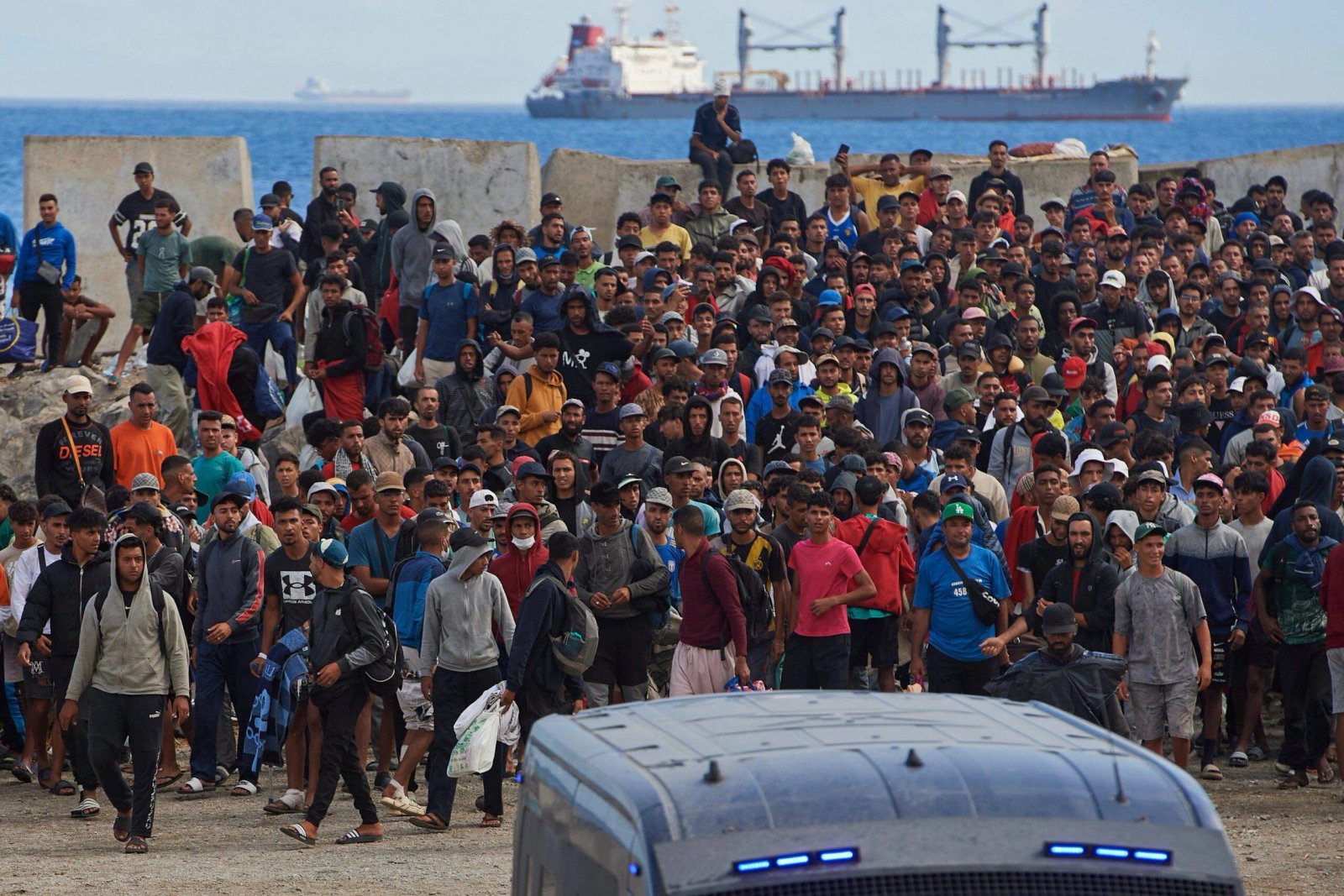
MOROCCAN officers planned and coordinated the mass crossing of more than 70,000 migrants into Ceuta in late July, Spanish police have told a judge.
A report by Spain’s border police intelligence unit (CENIF) said uniformed Moroccan officers gave migrants instructions on how to enter the Spanish enclave from Morocco on July 30 and 31, while plainclothes agents allegedly oversaw the crossing.
According to the document, cited by investigative outlet El Español, the operation was planned by Morocco to overwhelm Spain’s border under the guise of a migrant crisis.
The revelation appears to starkly contradict prime minister Pedro Sanchez, who publicly cleared Morocco of any involvement in the crisis on Monday.
Spanish police handed the CENIF findings to Spain’s National Court on the same day, El Español reported, with sources saying they provided a strong basis for a new investigation into the influx.
The report, which police say is based on footage and image analysis, said migrants appeared to approach the border in organised waves.
The first wave consisted of young Moroccan men equipped with wetsuits, flippers and floats.
Later came families, women and children wearing sports clothes and flip-flops, before another wave of mainly young men arrived overnight and into July 31.
The first wave was used to overwhelm Spain’s border controls at El Tarajal breakwater, according to the report – leaving authorities unable to contain further arrivals.
According to Spanish media reports, the document also rules out a spontaneous surge sparked by social media or people-smuggling gangs.
Instead, it claims the Moroccan Gendarmerie planned, coordinated and carried out the border breach.
It says photographic evidence shows Moroccan agents actively guiding thousands of migrants towards strategic crossing points, including the El Tarajal breakwater.
Security analysts cited in the report describe the operation as a deliberate move by Rabat to challenge Spain’s border controls.
The move also aimed to expose alleged failures by Spanish intelligence, the report continued, and reinforce Morocco’s claims over Ceuta and Melilla – another Spanish north African enclave some 400km from Ceuta.
Police had already issued an ‘extreme risk’ warning on July 29, the report adds, saying coordinated attempts to enter Ceuta by sea and over the fence were expected the following day.
The explosive report has triggered a political storm in Spain.
Police have only shared the document with the National Court and not with the government, prompting outrage from interior minister Fernando Grande-Marlaska.
In a letter to police chief Francisco Pardo, Grande-Marlaska demanded an ‘immediate’ explanation on Wednesday, stressing that the government must be made aware of the report’s contents so it can make informed decisions.
Meanwhile, territorial policy minister Angel Victor Torres urged calm, saying the government should receive the full report before drawing any conclusions.
He told broadcaster RNE: “At the moment, we don’t know whether this is an individual report drawn up by an officer, who requested it, or what its exact status is. So everything needs to be clarified, because that is what the public deserves.”
He added: “If we want to be rigorous, we need to see the report for ourselves.”
The document has also intensified pressure from the opposition, which has been questioning Morocco’s role in the crisis from day one.
Spain’s conservative Partido Popular (PP) has now ramped up pressure on the government, calling on interior minister Fernando Grande-Marlaska to resign over his handling of the Ceuta crisis.
PP secretary general Miguel Tellado branded Marlaska ‘shameless, incompetent and a liar’ on Wednesday, accusing him of denying the police warning for weeks before being exposed.
The PP had for weeks been demanding answers over whether Rabat allowed or encouraged the extraordinary influx, while accusing the government of failing to protect Spain’s borders.
Far-right party Vox has also been piling pressure on ministers to explain what they knew about the looming crisis and what role Moroccan authorities played.
The unprecedented mass influx saw thousands of migrants pour into Ceuta in a matter of just two days, with more than 100 people dying in the attempt.
More than 90% of the migrants then voluntarily crossed back into Morocco in early August, but around 5,000 – including 1,000 children – still remain in the small enclave, Sanchez told Cadena SER on Monday.
The situation quickly turned into a humanitarian crisis, with hundreds of migrants sleeping rough in the streets or camping on beaches as the Red Cross worked around the clock to distribute food.
Sanchez said on Monday that the influx was partly prompted by mafias and human smugglers, who shared ‘fake news’ online to encourage migrants to make the crossing.
The PM added that social media accounts linked to Russia, Israel and the ‘international far right’ then attempted to capitalise on the crisis.
Citing a report by the EU’s diplomatic service, EEAS, Sanchez said the accounts had spread disinformation online to sow ‘division’ across Europe.
In the same interview with Cadena SER, the left-wing PSOE leader also said Morocco was ‘without a doubt’ not behind the mass influx.
Click here to read more International Affairs News from The Olive Press.
