
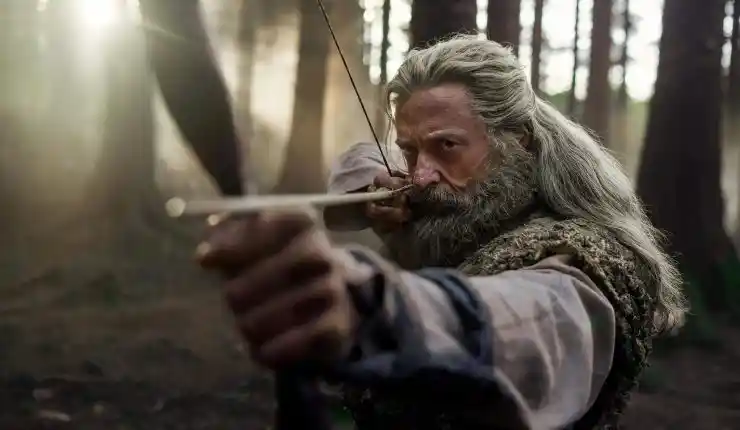
When you think of Robin Hood (Hugh Jackman), it’s likely that your mind goes back to a fox wearing green and sporting a little cap. It’s difficult to escape that version that Disney once popularised, but Robin Hood is a legend that has been around since the 15th century. There have been many retellings of the character, from film to shows to books and even video games. It’s quite hard to go your entire life without knowing the tales of Robin Hood, but Michael Sarnoski decides to tell a tale that’s morbid in nature but focuses on the mortality of the man himself and tries to humanise him.
It’s a coincidence that an actor like Hugh Jackman gets to play this iteration of Robin Hood, as The Death of Robin Hood feels very similar to Logan with its themes. Both films decide to take a deeper look at a man who has lived a life of slaughtering people, comes across a young girl that he must take care of, and faces an inevitable fate, to which the title of the movie alludes. These films take their time to humanise and allow for the audience to understand their past unlike any other iteration before, and just like Logan, I believe The Death of Robin Hood succeeds. It’s only let down by the fact that it runs into a few pacing issues and some characters should’ve had more screen time.
As the movie opens, we meet with a young girl who makes an attempt to kill Robin Hood as revenge but fails as he recognises her smell from before, highlighting how skilled the archer is and how much experience he’s had over the years. A shot of Robin burying the girl is shown as it pans out to reveal a mass grave that he’s created of other victims that have likely tried killing him for revenge, which leads straight into the title shot. A fantastic start to the movie which sets that tone perfectly with only more chaos to follow suit.
This is only the first of many people hurt by Robin Hood’s actions that we meet throughout the film, but the later victims that get revealed completely shift the dynamic of the film and Robin Hood’s character with how he’s affected each person differently. This first act of the movie doesn’t shy away from the violence. We meet Robin’s partner in crime, Young John, aka “Edward” (Bill Skarsgård), which is a name he’s been going by after killing a farmer of the same name, taking his livelihood for his own.
What follows is action-heavy, brutal, gritty, and filthy. There were some moments within the action where I couldn’t believe what I was witnessing with my own eyes. It’s fascinating, as the gruesome violence that ensues within this first act is never really explored again in the film as we lead to the second act, where Robin Hood now finds himself at the Priory of St. Clement with Sister Brigid (Jodie Comer) bringing him back to health after suffering near-death injuries.
The Death of Robin Hood is a beautiful movie from start to finish, and it’s all thanks to Pat Scola, who returns for a third time to collaborate with Sarnoski. Each shot is just as beautiful as the last, and it only makes you wish that some scenes would remain just slightly longer in some shots while other scenes were cut short for overstaying their welcome. The lighting in the film is nothing short of pure excellence, shifting from this gritty, desaturated and lifeless colour palette to one that’s full of life, saturated, and warm. While one colour palette represents a man that’s out of time, the other represents healing, intimacy, and connection.
The other grand shift, which is easily the highlight of The Death of Robin Hood, is how the aspect ratio shifts. As we begin the film, we’re introduced to the more cinematic action feel that is expected from Robin Hood as it’s shot in 2.93:1. As Robin Hood slowly makes his way to the priory, the aspect ratio begins to shift slowly to the point where it might be hard to pick up on until it’s fully shifted. It’s then when we get a 1.66:1 ratio, which allows us to transition into a drama that stays pinpointed on the actors and their performances.
Thankfully, when it comes to performances, everyone in this film delivers. Hugh Jackman is outstanding as Robin Hood and brings so much versatility to the role as we follow him on this journey. Jodie Comer showcases that she could play Sister Brigid in her sleep and was the right choice for the role. She brings this tenderness and comfort to the film that truly makes you believe that anyone can be changed; even a man like Robin Hood can learn to be loved and not just defined by the brutal tales people tell of him. Robin Hood’s and Sister Brigid’s relationship and story are genuinely touching as they prove that the cycle of violence doesn’t have to always continue and that violence can sometimes transform into peace.
The Death of Robin Hood stands tall as a solid movie that takes another look at mortality but is unfortunately let down by its pacing issues and the lack of screentime for some characters that help deliver the nuance this film so desperately needs more of. It’s well-directed by Michael Sarnoski and masterfully shot by Pat Scola, and for that reason alone, it’s a film that’s worth watching on the big screen.
★★★
In cinemas now / Hugh Jackman, Jodie Comer, Bill Skarsgård, Murray Bartlett, Noah Jupe / Dir: Michael Sarnoski / True Brit Entertainment / 15
Discover more from
Subscribe to get the latest posts sent to your email.

