
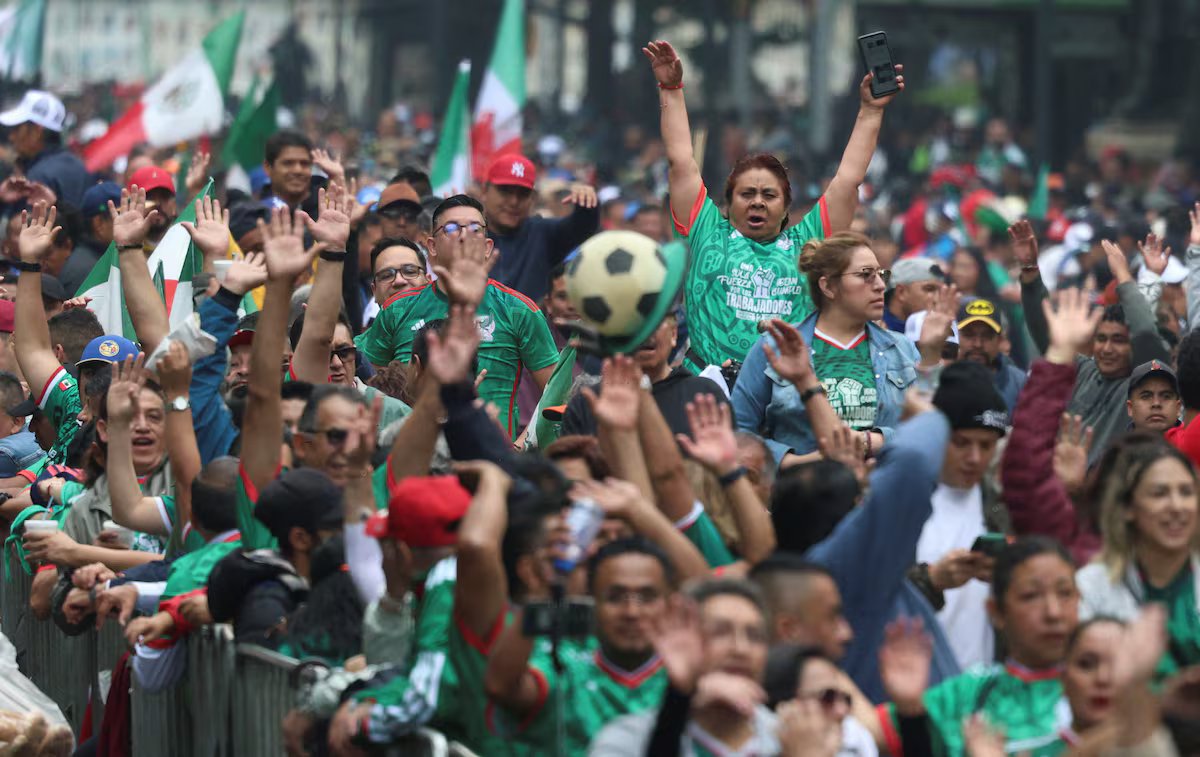
The World Cup kicks off this Thursday when Mexico host South Africa at the historic Estadio Azteca, and FIFA has never wished more for the ball to start rolling. Once again, the game and its universal passion call for the rescue of the world or, at least, to bring it some peace of mind. Soccer aspires to serve as the very same unifying force that soothed tensions after World War II, even if the latent, globalized geopolitical tension makes it difficult.
The conflict between the United States and Iran is the hottest topic right now. The organization headed by Gianni Infantino is keeping its fingers crossed that whatever may happen on the streets of Mexico, Canada, or the United States will not affect the 23rd edition of a World Cup in which everything is shaping up to be extreme. For now, the Trump administration’s immigration policy has already interfered at the heart of the competition by denying an entry visa to Somali referee Omar Artan.
The 48 teams taking part in the longest World Cup in history, running from Thursday, June 11 through July 19, will compete under the constraints of kick-off times, long transfers between the three host countries, heat and humidity, storms that threaten to interrupt matches and the extended hydration breaks that will fragment the American-style 90 minutes of play. Within that tricky and uncomfortable context all the classic facets of a World Cup as soccer’s great festival will unfold. The first is the age-old rivalry between Europe and South America.
Lionel Messi’s Argentina defends the title after ending European hegemony at Qatar 2022, which had remained firm since Italy won in 2006. The Argentine superstar (38) and Cristiano Ronaldo (41) remain the biggest draws for fans across the three host nations. Lamine Yamal, Kylian Mbappé and Vinícius are still a couple of steps below the popularity and pull of the rival pair who have dominated the last two decades. On Tuesday, wax figures of the two stars were unveiled at the New-York Historical Society as an unmistakable sign of their legend and, also, the passage of time. This will be Messi’s last World Cup; the same cannot be confirmed of Ronaldo, given his obsession with competing and the lure of playing in 2030, with Portugal co-hosting alongside Spain and Morocco. What is certain is that this will be the final chapter with both active in the unique rivalry that fed them.
Spain, France, England, Germany, and Brazil, along with Argentina and Portugal, are among the select group of favorites, which presents two historical peculiarities: the disheartening absence of Italy for the third consecutive time and the fact that three of the contenders are coached by foreigners. Roberto Martínez, Carlo Ancelotti and Thomas Tuchel will be managing under the added pressure of leading Portugal, Brazil and England, respectively. By mystique and competitive DNA, Marcelo Bielsa’s transformed Uruguay can also be included among these rarefied contenders. Among the dark horses are Morocco, a 2022 semifinalist, Erling Haaland’s Norway, Colombia, Ecuador, and Senegal. For the last three, the combination of improved technical levels and the physical attributes of many of their players is expected to be decisive in progressing through the knockout rounds.
The knockout bracket opens with the unusual round of 32, which will include the top two from each of the 12 groups plus the eight best third-placed teams. The role of teams from the third and fourth tiers of world football — such as debutants Curaçao, Cape Verde, Uzbekistan and Jordan — will largely determine whether expanding the tournament to 48 teams, ostensibly to fatten television revenues, was a justified gamble.
In the Europe-versus-America contest there has always been a distinction between schools and styles: physicality and speed of execution versus the South American pause and street-learned talent. Now everything is more homogeneous because of the early plundering Europe carries out across the Atlantic. The vast majority of South American stars play in European leagues, and the paradigm of high pressing and the transitions that break it has been globalized. The 2025 FIFA Club World Cup confirmed this trend, although with national teams the contest will be pure.
The total football that has taken hold may also bring, in this World Cup, the confirmation of the revival of wingers and the hedonism and lethal quality of their dribbling. Most of the contenders have these wide men. Lamine, Vinícius, Raphinha and the French players Ousmane Dembélé, Michael Olise and Désiré Doué top an outstanding list that also includes Bukayo Saka (England), Rafael Leão (Portugal), Leroy Sané (Germany) and Jérémy Doku (Belgium). Among the voracious scorers expected are a select group formed by Mbappé, Harry Kane, Haaland, and Julián Álvarez. All of this, of course, depends on what Messi and Cristiano can still bring to the table — players who, before becoming insatiable goal-scorers, were also wingers.
Sign up for our weekly newsletter to get more English-language news coverage from EL PAÍS USA Edition
