
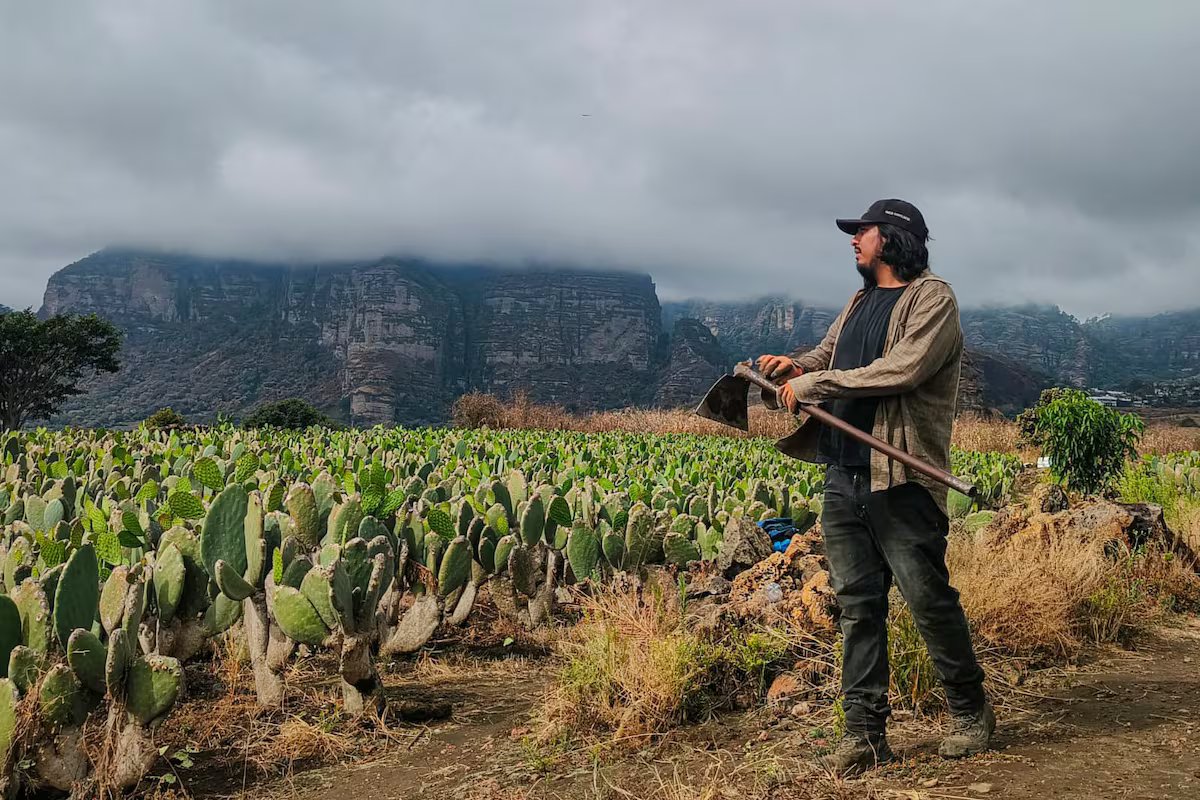
In Mexico, talking about the countryside during World Cup season goes far beyond the pitch. At least that is the case for Eduardo Horcasitas, who grows nopales, or prickly pears, and has attracted attention for joining the public conversation around the 2026 FIFA World Cup to highlight the work of agricultural workers and promote consumption of domestic products.
Through his Instagram account, which is called A lo Bello, this man from Altos de Morelos shared a video in which he calculated that to be able to buy a ticket for the World Cup opening match he would have had to sell at least 200,000 prickly pears — a practically impossible task that resonated with thousands of Mexicans for whom the tournament experience feels distant and disconnected from reality.
“Doing the math, and knowing that I charge one peso and 20 cents for a nopal like these, I would have to peel and sell at least 200,000 nopales. But anyway, I still support Mexico. If you root for Mexico, support the farmer,” he says in the video.
In reality, his intention was never to try to get a ticket for the Mexico vs. South Africa match, since he does not consider himself a soccer fan. “It’s just an absurd measure to represent something even more absurd. I don’t have anything against football; in fact, the sport is cool. What I felt was wrong is that it seems like a party people here won’t be able to enjoy. We set the house for the party but in the end they didn’t even let us in. I think that really hurts people, that everything is so expensive, that things are so complicated, that they want to present a face that doesn’t fit with what we’re going through in the country,” Horcasitas said in an interview with EL PAÍS.
The farmer has stressed that the purpose of his content is simply to focus attention on the conditions faced by field workers. “They pay us very little for the nopal, and sometimes that causes frustration because I’m not a large producer. At that time my product was small because the nopal field was just starting to produce. I said, ‘Well, maybe on social media I can share that I’m selling some boxes directly, so I can earn a bit more. I’m going to start making countryside content because it seems to me a topic that is very forgotten,’” he said.
The nopal, a tribute to Mexican identity
Eduardo Horcasitas studied environmental engineering in Mexico City, but after a decade navigating the capital’s chaos and working in different sectors of his industry, he decided it was time to seek another way of life. He returned to his town to work a family plot. Together with his partner he chose to grow nopales because of their adaptability and ability to thrive with less care than other crops.
The producer has emphasized the symbolic value of this plant, deeply linked to Mexico’s history, culture and identity. “It has a very strong connection with us because of this legend that Mexico-Tenochtitlan was founded because the sign of an eagle devouring a snake on a nopal was found. It reminds me of Mexicans: we have been sidelined, abandoned, exposed to the elements, against all odds, and yet we bear fruit and stand tall against everything. That strength… I feel that’s how we are too,” he reflected.
On his nopal farm, he has found a new passion and the time to devote himself to one of his great loves: music. When his schedule allows, he brings his guitar to the field to rehearse. That side of him has also piqued followers’ interest, who recently heard a cumbia he composed in one of his videos. “I’ve found beauty in fieldwork, and there is also a fulfillment that music gives me and the fact that someone tells me ‘hey, that’s interesting, I like how it sounds.’ It makes me feel that all these years have been worth it. I don’t know how far I’ll get, but we’ll go as far as we can,” he said.
Finally, Horcasitas, who at the time this article was published had more than 25,000 followers on Instagram, said he is grateful for the warm welcome his message has received and the reaction of people who have identified with the struggle. “I think we hit the nail on the head because people in Mexico are not satisfied, they are not at peace, quite the opposite. It’s something that affects us all; this countryside issue hits us all in the gut, because we all eat, dress, wear shoes and work with the raw materials that come from the fields. So it should matter to everyone and we should pay a little more attention because they have left us to our fate.”
Sign up for our weekly newsletter to get more English-language news coverage from EL PAÍS USA Edition
