
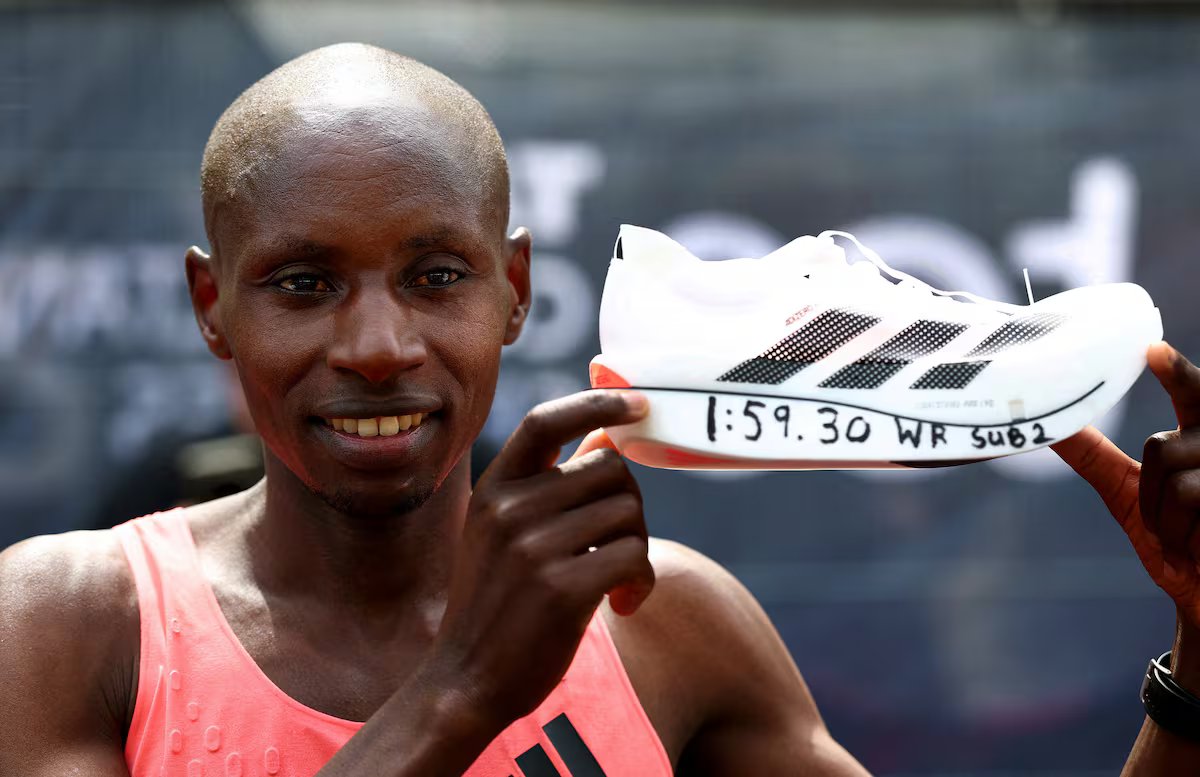
The biggest showcase of the year for sportswear brands is the FIFA World Cup. But when it comes to winning over investors, Adidas has its sights set on the road rather than the soccer pitch. The German company is leaning heavily on its running division, a segment that has become increasingly important to its business as the boom in recreational running gathers pace and following the publicity coup it achieved at the London Marathon last April. There, two athletes became the first men ever to cover the marathon distance of 26.2 miles (42.195 kilometers) in under two hours in an official race, both wearing Adidas’s iconic three-stripe logo on their shoes.
UBS analysts view the running division as a structural growth driver for the company. In their latest report on Adidas, the Swiss bank maintained its Buy recommendation and set a price target of $256 per share. Based on the current share price, this implies upside potential of roughly 17%.
On one hand, UBS believes the FIFA World Cup, where Adidas outfitted more national teams than any other brand, could strengthen the company’s position in the United States, Nike’s home market and one where Adidas still has room to gain market share.
At the same time, UBS believes running could become one of the company’s major sources of revenue over the long term. As Adidas enters a new phase of growth characterized by a more balanced contribution from performance and lifestyle segments, the key area is the running category, the report noted.
The broader context is favorable. Running has become one of the world’s trendiest sports. Registration slots for major races sell out within days, sometimes within hours, and leading marathons are experiencing a new golden age. To illustrate the scale of demand, the London Marathon received 1.3 million applications for its 2027 race despite offering only 100,000 places.
That boom is translating directly into business for sportswear companies. Running shoes are no longer chosen solely for their appearance. Runners now buy different models for easy runs, interval workouts, long training sessions and race day. At the elite level, the manufacturer that produces the fastest shoe gains visibility and, with it, sales among amateur runners eager to replicate the performances of the sport’s top athletes and set personal bests.
This is where Adidas appears particularly well positioned. In April, the company achieved a level of media exposure that would have been difficult to purchase through traditional advertising. Adidas-sponsored athletes Sabastian Sawe and Yomif Kejelcha became the first men to officially break the two-hour marathon barrier. Both competed in the Adizero Adios Pro Evo 3.
Priced at approximately $585 per pair, the shoe was released online in limited quantities and sold out within minutes. Investors reacted immediately. Adidas shares rose 2% the day after the achievement. UBS argues that the significance extends far beyond a single trading session.
The real opportunity is not necessarily selling the exact shoe used in the record-breaking performances. Rather, it lies in transferring perceptions of speed, innovation and technological leadership across the broader product portfolio. Recreational runners training for a 10K, a half-marathon or a first marathon may not purchase a $585 racing shoe, but they can enter the Adidas ecosystem through more affordable models. In this way, the performance serves as a global showcase for the entire brand. UBS estimates Adidas sales will increase by roughly 8% annually through 2030.
The stock also still has room to recover. Adidas shares reached three-year highs in February 2025, trading at around $293 per share. They subsequently corrected sharply, falling below $116 per share. The stock also remains well below the all-time highs reached in 2021, when shares traded above $300.
Since April’s London Marathon, however, the shares have regained momentum. Adidas currently trades at approximately $213 per share (based on the current euro price converted to dollars), and UBS’s $256 target price implies upside potential close to 20%.
That said, risks remain. The sportswear and apparel industry is highly sensitive to economic cycles, fashion trends, currency fluctuations and trade tensions. Nevertheless, UBS believes Adidas is operating from a position of strength and that its future growth is no longer dependent solely on major sporting events such as the World Cup.
Sign up for our weekly newsletter to get more English-language news coverage from EL PAÍS USA Edition
