
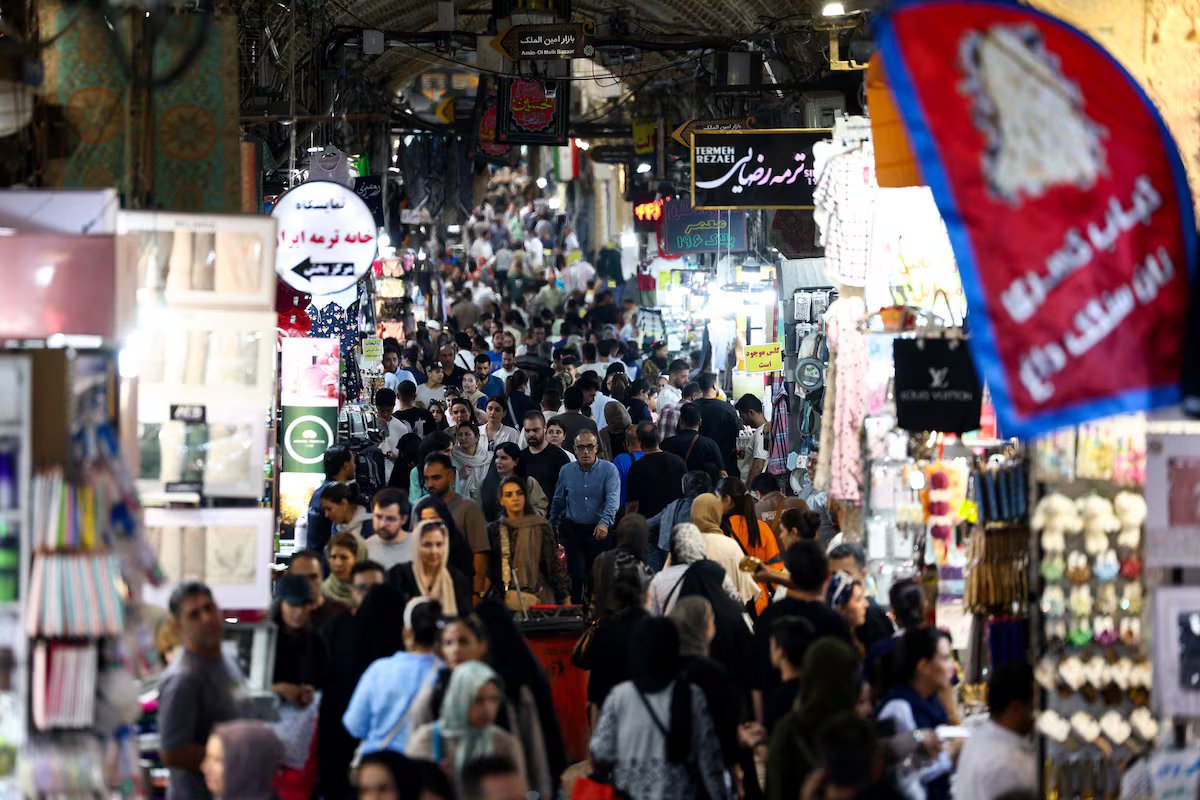
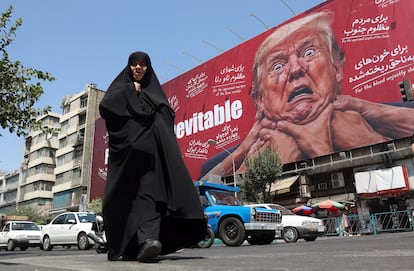
“An economic D-Day.” Donald Trump’s vocabulary is as narrow as it is hyperbolic. But his threat, issued Wednesday, falls into a new category. Referring to June 6, 1944 — the day of the Normandy landings that changed the course of modern history — the U.S. president warned that Iran was facing “the most crushing economic operation ever taken against any country.” Yet, nearly six months into the U.S. offensive against Tehran, its economy, though damaged, is far from derailed: if any society is used to coping with decades of sanctions and autarky, it is the Islamic Republic.
Under decades of Western sanctions, Iranian authorities have long prepared for a resistance economy: import substitution, decentralization of power plants and a well-oiled apparatus to evade oil sanctions, drawing lessons from the recent Russian case, which itself was built on lessons learned from Iran. In practice: a dense phantom fleet and a black market for crude that becomes particularly deep and prolific in times of self-imposed global scarcity, as now.
“Time is a very important factor in this war of resistance. And, so far, Iran has shown greater resilience than the United States,” says Alam Saleh, honorary associate professor of politics and international relations for Iran and the Middle East at the Australian National University, from Tehran.
In March, senior Iranian officials suggested they had enough economic ammunition to withstand up to a year of war. Almost six months later, the prevailing sense is that it is Trump who urgently needs to end a conflict that, with midterm elections around the corner, has sunk his approval rating to 33%, the lowest since he became president and one of the lowest levels with which a U.S. leader has gone into legislative elections.
Iran today faces a sweeping U.S. commercial and financial embargo. Also frozen are assets worth tens of billions; some recent estimates put them above $100 billion, and their thaw was on the negotiating table at moments when both sides seemed closest to a real peace agreement. In theory, the naval blockade prevents Tehran from exporting fossil fuel, although in practice evasion mechanisms appear to be delivering better results than expected. Many Revolutionary Guard officials and senior state figures have been sanctioned for terrorism.
Iranian finances are a huge black box. Official data are scarce and unreliable, and the ones that are reliable, such as World Bank figures, are out of date: between March 2025 and March 2026, according to its numbers, GDP contracted by 2.7% compared with the same period the previous year. That statistic, however, captures only a small part of the conflict — the initial phase — and not the harshest period, after Washington in April announced its own blockade of the Strait of Hormuz to prevent Tehran from selling oil and gas, its main source of financing.
Also in spring, the International Monetary Fund projected a sharp 6.1% decline for the current year, a forecast it revised in July to a 5.4% drop because of “better-than-expected oil export performance [although it sold much less, it did so at notably higher prices] and a certain easing of restrictions on the country’s exports.” That latter caveat is now more uncertain than ever.
Whether 6% or 5%, a contraction that would be disastrous anywhere else does not seem so severe for a nation used to deep recessions in recent decades. “There is food security and the country does not depend on imports for many staples,” Saleh adds by voice message.
The expert concedes, however, that “prices have risen.” And considerably: inflation is running above 80% year-on-year, hitting the most vulnerable groups particularly hard. Food prices have surged even more: over the past 12 months they have more than doubled, according to the latest available data.
From resistance to attrition
Farzaneh (a fictitious name used for fear of reprisals), a civil servant living in Tehran, tells EL PAÍS by phone of the sharp deterioration in purchasing power for families like hers: “Our entire salary goes to daily expenses.” She criticizes the insufficiency of public aid: current payments — one million tomans (almost $6 at the official exchange rate) per person per month — “amount to roughly a kilo of meat or two kilos of chicken.” Many, she says, have had to cut even medical spending. “I don’t know how we’ll hold on another six months or a year.”
Her testimony reflects a reality common to virtually every episode of economic sanctions: the main blow from restrictions and — for Iran — the subsequent U.S. maritime blockade has been borne mostly by the population, not the regime. The already battered middle class has shrunk and weakened, eroding one of the main engines of social change. But pressure on the political elite has barely climbed a few points: it goes little beyond where it stood before thousands of Iranians took to the streets earlier this year demanding better living conditions.
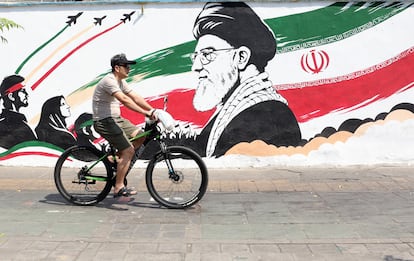
That moment was chosen by the United States and Israel to bomb Iran while urging Iranians to rise up against the ayatollahs and seize power. Far from that outcome, the opposite happened: just when the regime seemed weakest, the missile strikes led part of the population to rally around the flag. Exaggerated nationalism against a common enemy. A boomerang effect.
It is not unreasonable to suggest that the United States and Israel may be waiting for a new wave of protests, especially if pressure on Iran’s energy system increases, which, despite its resilience, remains one of its major Achilles’ heels.
A possible rise in gasoline prices or even the introduction of some form of fuel rationing could become a new flashpoint of social unrest. The precedent of past protests over fuel prices makes this scenario particularly sensitive, although its political consequences are for now hard to predict.
“Sanctions cannot be labeled a failure simply because the economy is still functioning,” argues a finance expert living in Tehran, speaking on condition of anonymity. “Iran operates as a survival economy, but rial depreciation makes almost everything more expensive, reducing household purchasing power,” he writes by message. “If pressure persists, Iran could move from a survival economy to an attrition economy,” progressively degrading its productive capacity.
“If the pressure continues for too long,” adds the director of a company that builds petrochemical complexes, based in Shiraz, “the problem will be less about how much oil we can sell and more about parts, maintenance, repairs, investment, and wear and tear on facilities.” Tehran has shown a huge ability to circumvent sanctions after years of managing its energy resources and seeking alternative trade routes, but everything has a limit.
Shift in Abu Dhabi
While waiting to see what concrete actions will result from this umpteenth round of threats from Trump, there is one factor that suggests the damage Tehran will suffer this time could be greater than before. And it doesn’t exactly come from the White House, but rather from a neighbor — the United Arab Emirates — which is fed up with Iranian missiles and with the closure of the Strait of Hormuz, the main route through which its fossil fuel exports flow.
Tuesday night’s announcement that it would end commercial — and, more importantly, financial — relations with the Islamic Republic is a warning bell whose consequences for Iran’s economy are currently unpredictable. Though at odds because of its close ties to the West, the UAE had become Iran’s main supplier and the third destination for its battered exports, often to be re-exported to third countries.
“Iranian companies have spent decades building large trade networks and making contacts in the United Arab Emirates,” Cyrus Razzaghi, founder and chief executive of Tehran-based consultancy Ara Enterprise, with offices across the Middle East, told Bloomberg. “In that sense, the Emirati embargo could be much more effective and potentially more damaging than U.S. and European sanctions.”
Less than 48 hours after Abu Dhabi’s move — the most forceful since it closed its embassy in Tehran in March — Trump warned of “tremendous economic consequences” for any country that allows its financial institutions, companies, airports, or government entities to give “any type of lifeline to Iran.”
Sign up for our weekly newsletter to get more English-language news coverage from EL PAÍS USA Edition
