
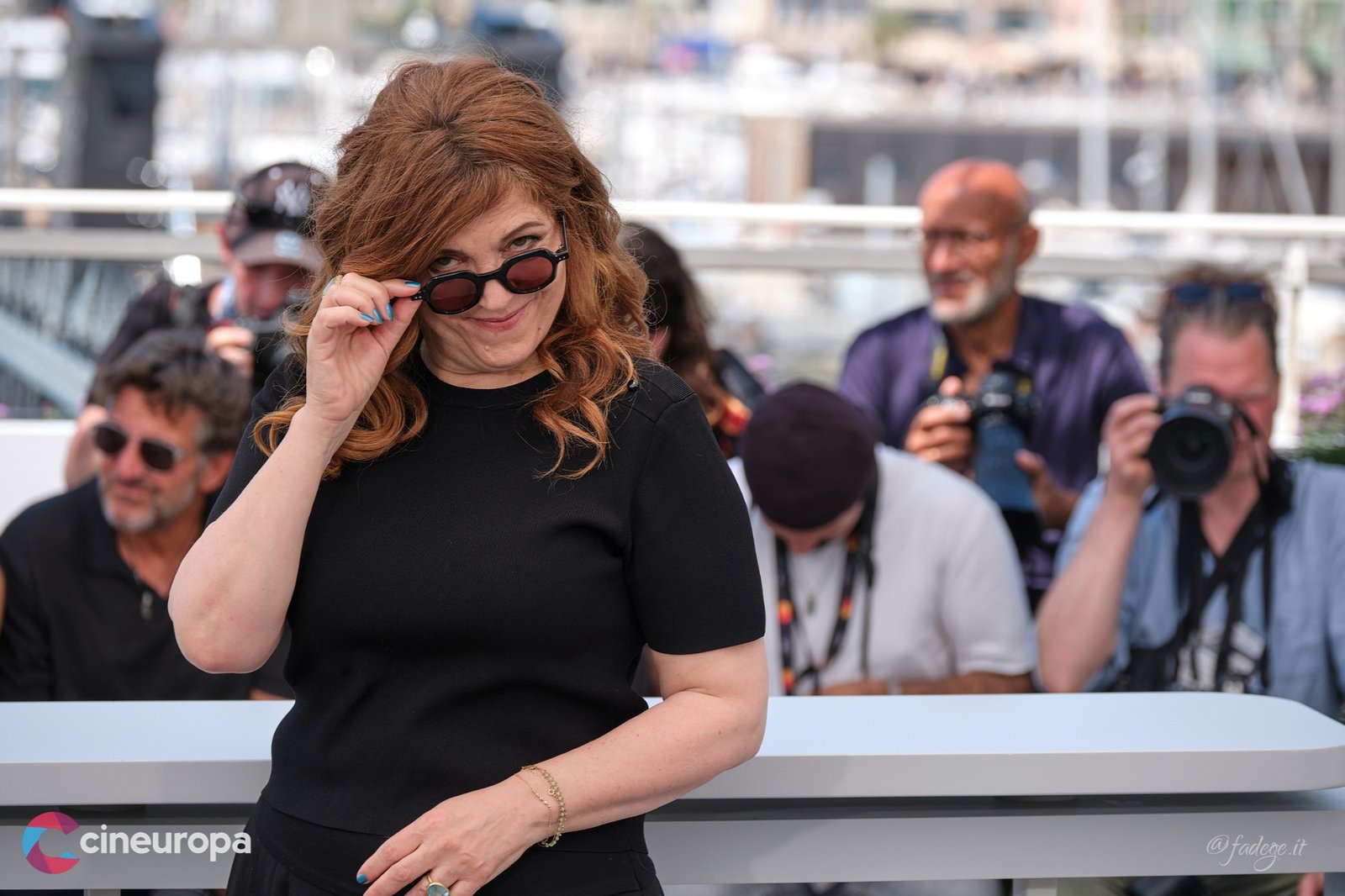
“I wanted to create a dialogue between these worlds, which in real life sometimes struggle to communicate at all”
– CANNES 2026: The director and actor looks back on her first film written without Jean-Pierre Bacri, in which she imagines an opera production disrupted by an allegation of sexual assault
(© 2026 Fabrizio de Gennaro for Cineuropa – fadege.it, @fadege.it)
A widely acclaimed and award-winning filmmaker and actor, Agnès Jaoui has long been supported in her writing – and occasionally in her directing – by the actor, writer and director Jean-Pierre Bacri, who passed away in 2021, with whom she formed a dynamic partnership. She returned to the Cannes Film Festival this year, out of competition, with her new film Crescendo, which opens in French cinemas on 27 May via StudioCanal, where she returns to the ensemble format that suits her so well to depict the production of a Mozart opera disrupted by an accusation of sexual assault.
Cineuropa: How did this project come about?
Agnès Jaoui: I’ve wanted to make a film set in the world of opera for a long time; I even had a plan for a TV series. When I first started thinking about it with Noé Debré, I recalled a few experiences and feelings related to what the #MeToo movement had triggered, mixed with a long-standing reflection I’ve had on why women’s rights struggle so much to make progress, and then to endure. I was interested in putting this into perspective with an 18th-century work that deals with the same themes. The character of Figaro could be a famous actor, or any business executive who thinks he has the right to sleep with his intern or his secretary. At the same time, it’s a joyful, jubilant work, where life triumphs, and where there are resolutely feminist passages. It’s also a precursor to the French Revolution, and I’m fascinated by this exploration of class struggle.
Speaking of which, how did you approach the ensemble aspect and the casting of the characters, each of whom has a different stance on the crime?
Often, with Jean-Pierre Bacri, we’d pick a subject — fame, the difficulty of changing — and then we’d introduce archetypes and have fun with them by having them interact. Here, I wanted to give a voice to younger women, more radical ones, older ones – some who speak the language of feminism whilst being in a kind of contradiction with their need to seduce – and I also wanted to give a voice to men. Men of a certain age who suddenly question their behaviour, and younger men who aren’t even aware that #MeToo exists. I wanted to create a dialogue between these worlds, which in real life sometimes struggle to communicate at all.
There is also a question around gender conflict, generational conflict and class conflict… This issue of male domination reveals other forms of domination.
Yes, that’s also why it’s titled L’objet du délit (the French title of Crescendo literally translates as “The Object of the Crime”); in fact, I’ve often wondered what the actual object of the crime was. There’s a form of intersectional feminism that speaks of this convergence of struggles, which we see in the character of Eye Haïdara, who finds herself at the crossroads of various forms of discrimination, which makes her stance more radical.
Opera is, in fact, a very hierarchical world, yet there’s a real sense of camaraderie within the company – was that an appealing angle to explore these issues?
Yes, of course. On the one hand, there’s the maestro and the famous tenors, but at the same time, nothing can be done without the singers – both male and female – who also wield a certain amount of power. And above all, it’s more gender-balanced than cinema; there are just as many sopranos as tenors, and so on. And the great operas often revolve around female characters. And then it’s a queer world ahead of its time, where men play women, where women’s voices are deeper than men’s. Work on gender has been going on in opera for a very long time.
Do you sense a particular thrill in talking about opera, in being able to make it popular and accessible to everyone through comedy?
Yes, simply in raising awareness of this very little-known world, my dream would be for it to make others fall in love with opera. I think it’s a more popular art form than people realise; when you hear a singer live, it can blow anyone away. Well, it’s true that they’re often long-form productions and you have to accept a certain amount of boredom or daydreaming, which isn’t very fashionable. And then it’s true that it’s often very expensive.
The film raises the question of how art is funded – in this case by a patron who knows very little about it – a highly topical issue.
Yes, how do we fund art when it isn’t always profitable? I think it’s worth remembering how difficult it is to find money and how important it is to have support – it’s vital. Without art, I’d be dead in the water. But these are very fragile models, at a time when the state is pulling back significantly from culture, whilst others are seizing control to impose their vision of society. It’s clear that what’s happening right now is cause for concern.
(Translated from French)
