
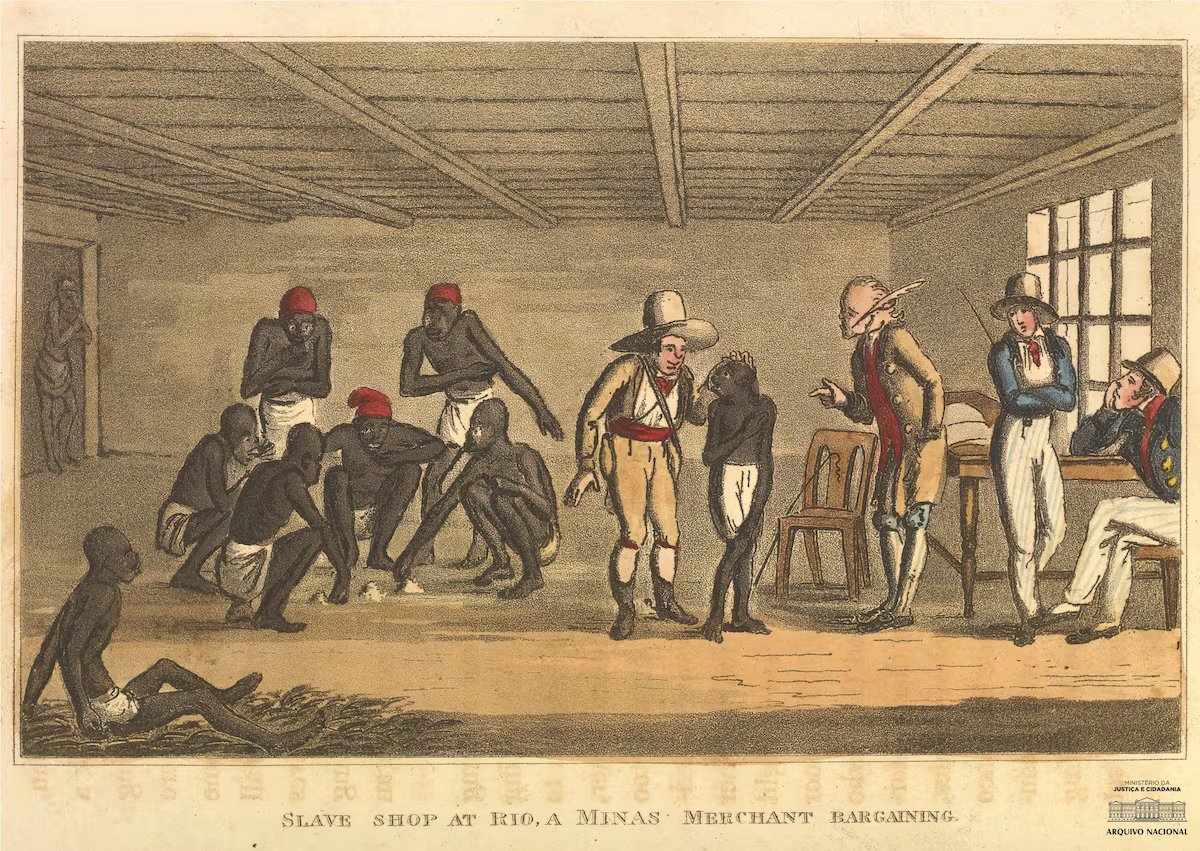
We know his name was Ambrozio, that he was a slave, and that in 1887 he personally signed the documents opening a savings account in his name at a Brazilian public bank: Caixa Econômica Federal. At that time, the debate on the abolition of slavery — a milestone that would come the following year — was very much alive in Brazil because, in the rest of the Americas, the children of the slave trade were already free men and women.
Like so many others, Ambrozio dreamed of one day buying his freedom. To achieve this, many slaves saved every cent. But he didn’t have to wait long. A few months later, the imperial princess Isabel signed the Golden Law, which granted freedom to the hundreds of thousands of people who — as had been the case for over three centuries — were mere merchandise that could be bought, sold, rented, or inherited.
Ambrozio returned to the bank as a free man, withdrew the 50,000 reais from his only deposit, and closed the account. Others, like Lidia, a laundress in Rio de Janeiro, “slave of Maria Carlota Fortuna,” according to her ledger, never recovered that money earned through their hard work, which went almost entirely into the pockets of their masters.
With the abolition of slavery in 1888, Lidia stopped making deposits at the Caixa Econômica Federal. Her money remained in the bank, growing thanks to a 6% semi-annual interest rate. By the turn of the 20th century, the account held 300,000 reais, which had tripled by 1931, according to research by historian Keila Grinberg of the Federal University of Rio and the University of Pittsburgh, who unearthed the stories of Ambrozio and Lidia from the bank’s archives.
Nearly a century and a half later, the Public Prosecutor’s Office of Rio de Janeiro wants to know what happened to the savings of enslaved people. “Knowing the whereabouts of those accounts is a long-standing demand, an issue that has been silenced, and we want it to be a priority for Caixa Econômica Federal and for the Brazilian state,” explains prosecutor Julio Araújo, by telephone from Rio. Brazil commemorated the 138th anniversary of the abolition of slavery last week.
The initial steps have led to the discovery of 158 slave accounts in the archives of this public bank, which was created in 1861 for the poorest workers and remains one of Brazil’s most important financial institutions. The Public Prosecutor’s investigation began following a complaint filed by Quilombo, Raza e Clase (Quilombo, Race and Class), an organization that demands reparations for the descendants of the five million Africans who arrived in Brazil from the 16th century onward — more than in any other country — after surviving the transatlantic crossing.
The issue remains relevant because it is the root of the inequality that still prevails in the South American country, and because more than half of Brazilians are descended from those slaves, according to the census, which shows that 55% of the population are of mixed race or Black. After gaining their freedom, the slaves were left utterly destitute, without jobs, education, or land, while the authorities encouraged immigration among Europeans, Asians, and Arabs, offering them farmland. A two-for-one deal: they replaced the labor lost through abolition and, incidentally, whitened the population. Afro-Brazilians continue to be poorer today, have worse jobs, and die earlier than their white compatriots.
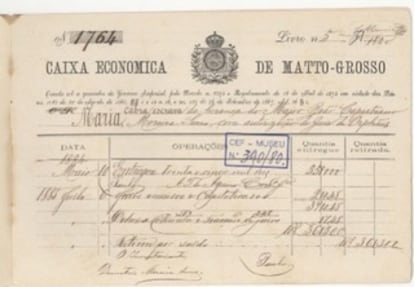
Historians investigating how Brazilian institutions profited from slavery, a system embedded in all structures, says Grinberg, estimate that the discovered bank accounts are only a small sample of those that exist, because many were opened in the interior of the country, thousands of kilometers from the cities with the largest slave populations, such as Rio or Salvador.
Therefore, Araújo is demanding that Caixa Econômica undertake a systematic and in-depth investigation of the thousands of documents it holds in its archives and make them publicly available. “The connection of these accounts to past, present, and future generations of Brazilians is evident. And it demonstrates the importance of debating reparations,” the prosecutor emphasizes. The investigation does not aim to bring anyone to trial, but rather to shed light on the past and achieve historical justice. Congress has been processing a proposal to create a reparations fund since 2024.
Araújo himself led another lawsuit with historical undertones that culminated in a powerful public gesture in 2023: the Bank of Brazil apologized for its complicity with slavery, which was in effect for three and a half centuries.
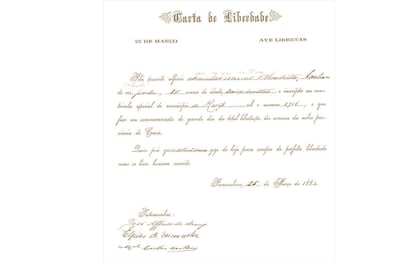
“It’s important to note that the money they managed to save was very little compared to the cost of the alforría [the letter of freedom granted by the master]. They earned it selling goods in markets or working as barbers, laundresses, seamstresses… They handed over most of the money to the master and, with what little remained, they saved to buy their own freedom or that of their families,” Grinberg explains in an exchange of messages from Senegal, where she is conducting research. This movement of historical redress and revision in which Brazil is engaged arose from the activist impetus of the Black movement, which historians like Professor Grinberg joined.
She emphasizes that “it is important to know what happened, after abolition, to those savings that yielded 6% interest every six months, and what impact this had on the bank’s capital.” “It is also important to know if their families have the right to restitution and to understand Caixa Econômica’s relationship with slavery.” She maintains that all institutions of the time benefited in one way or another from forced labor.
Last April, the UN approved a resolution declaring the trafficking of Africans and slavery as “the most serious crime against humanity,” with 123 countries voting in favor. Among the 52 abstentions in that vote were all the countries of the European Union. The only “no” votes came from the United States, Israel, and Argentina.
Slavery was a colossal industry that involved inhumane punishments, but it also implicated institutions such as banks, investors, and insurance companies. Traders reduced food rations during the transatlantic crossing to save money and lighten the load. Those who died were thrown overboard to the sharks. As they approached the coast, the slave traders improved the food because healthy, robust Africans could be sold for a better price.
The normalcy with which human beings were offered for sale in the Brazilian press of the 19th century is chilling. “For sale: Creole black woman, 25 years old, gave birth ten months ago, with milk, no child, cooks, makes sweets, irons and sews,” read an advertisement in the Diario de Pernambuco in 1859, cited in the Escravidão trilogy, published over the last five years.
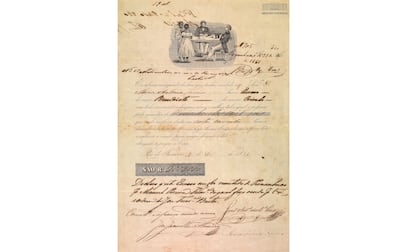
These books recount that, beyond forced labor, those Africans and their descendants served their masters in countless ways: as collateral for mortgages, to settle debts, as dowries for daughters, as gifts for friends or institutions… And the women, as concubines when they weren’t directly raped. Upon the master’s death, they became part of the inheritance, like any other property.
Experts argue that the possibility of earning some money and saving, with the hope of eventually buying one’s freedom, is one of the reasons why slavery lasted so long in Brazil, the last Western country to abolish it. While in the United States buying freedom was nearly impossible, in Brazil that dream reduced the risk of rebellions, divided Black people into slaves and free people, and helped to solidify and normalize this inhumane system.
Sign up for our weekly newsletter to get more English-language news coverage from EL PAÍS USA Edition
