
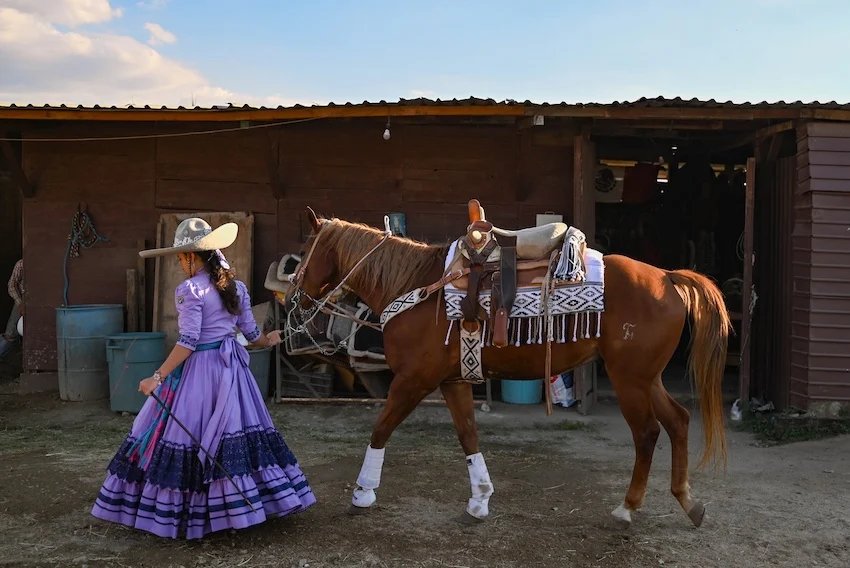
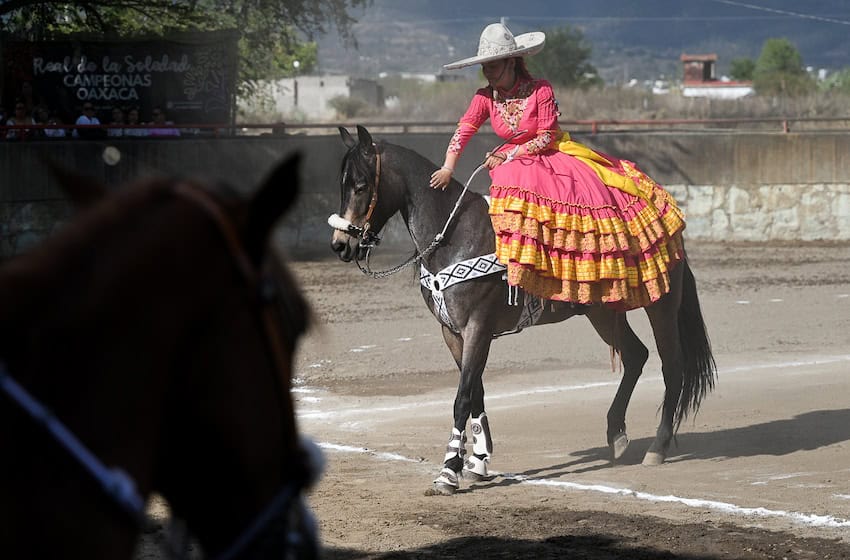
The sun blazed over Ex-Hacienda Soledad on April 26 as three all-female teams mounted their horses for the state championships of Escaramuzas, the exclusively female branch of charrería — Mexico’s national sport.
Riders wore bright, full-skirted dresses and petticoats as they competed in a tradition rooted in the 19th-century Mexican countryside, one that has survived revolution, cultural upheaval and modernity to earn recognition as a UNESCO Intangible Cultural Heritage of Humanity.
Charrería extends beyond horsemanship to encompass costume, music and the transmission of social values — trust, respect and equality. It arose from cattle herding and horse management on haciendas. After the Mexican Revolution dissolved those estates, charros formed associations to preserve the vanishing traditions.
In contemporary competition, male “charros” perform rodeo-style events while female “escaramuza charras” execute choreographed routines akin to dressage. The word escaramuza means skirmish — a nod to the Mexican adelitas, the women who fought in the Revolution.
A tradition takes shape
The Federación Nacional de Charros was founded Jan. 16, 1933, with the objective of unifying the sport, establishing rules and preserving the traditions and values of charrería. In 2016, UNESCO declared it an Intangible Cultural Heritage of Humanity. The Chamber of Deputies of the Congress of the Union recognized it as Mexico’s cultural heritage that same year.
Women did not officially begin participating until the 1950s, when they were admitted into the National Association of Charros. The escaramuza charra discipline was created in 1953, according to Trinidad Olvera Rodriguez, an author and competing charro.
“It was promoted by Amalia Hernández — founder of the Ballet Folklórico de México — who sought to incorporate women’s participation in charrería,” Rodriguez said.

During the 1960s, groups began regularly using the term escaramuza, and by the decade’s end, it was common to see them included in state charro association programs. A major milestone came in 1992 with the publication of the first Official Escaramuza Rulebook by the Mexican Federation of Charrería, which established team size, required maneuvers, attire and the scoring system still in use today.
In 2019, UNAM formed its own women’s charro escaramuza team, opening yet another chapter.
Alicia Guadalupe Jurado Peña, delegate of Escaramuzas at UNAM, traces the discipline’s origins to the daughters of charros who learned to ride alongside their fathers. “Then their wives joined in, and there came a point when the practice became exclusively for women.” Today, competitions run across age categories from children to adults, making escaramuza a lifelong pursuit.
The dress and the discipline
The escaramuza consists of eight women performing choreographed routines on a specialized sidesaddle called an albarda — a style of riding that traces back to the haciendas, when most women rode that way.
Riders wear Adelita or China Poblana outfits: hand-embroidered dresses and petticoats that serve as symbols of historical identity and resistance. Unlike charros, who wear individual outfits despite competing in teams, escaramuzas wear matching team colors. At the recent Oaxaca event, the local team, Real Soledad, wore bright pink; visiting teams competed in blue and red.
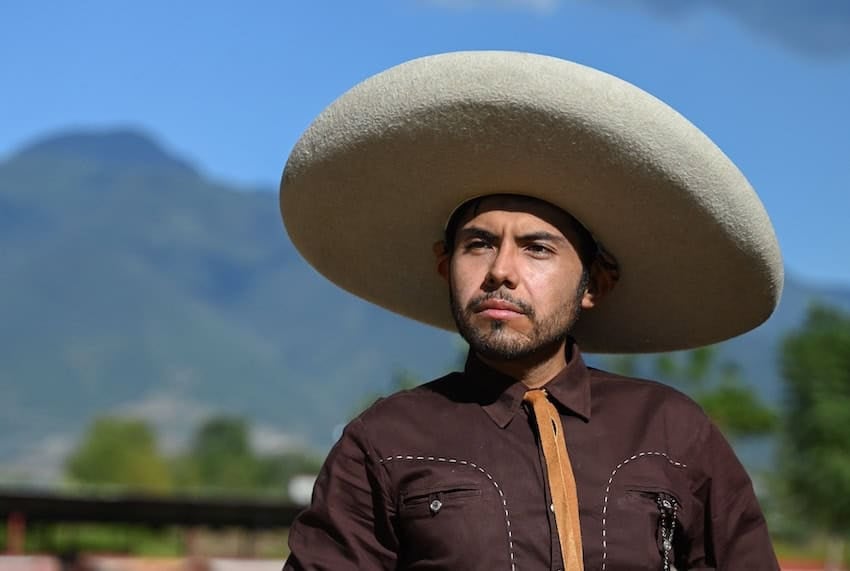
Male charros wear a closely fitted suit, chaps, boots and a wide-brimmed sombrero. The snug fit is practical as well as decorative — loose clothing can be caught by a bull’s horns.
Rodriguez says both charro and escaramuza “represent Mexican tradition, love for horses, discipline and national pride.”
Inside the competition
Charro competitions are divided into events called suertes, meaning luck. The scoring system applies both positive and negative points based on execution, synchronization and the proper use of traditional tack.
The opening event, the Cala de Caballo or Reining Test, is performed by both male and female teams. It demonstrates the bond between rider and horse: the horse sprints at full speed, then brakes instantly on its hind legs — a move known as the “tip” or pointe — before executing precise turns and walking backward, all within a 20-by-6-meter rectangle called the lienzo.
“In the past, it was used to demonstrate how well-broken a horse was and how skillfully the charro handled it,” Rodriguez said. “It is the foundation of charrería.”
The escaramuza team performs a version of the maneuver as well, though only the opening movement: galloping from the end of the chute until the horse enters the square.
The next generation
Maria Victoria Cortes Lopez, a young escaramuza training with Real de la Soledad in Oaxaca, was drawn to the sport after watching other women compete and being invited to ride in a local charreada, or parade. Her team competed in two categories at the state championship — open and youth. Though they fell short in the open division, they qualified for the National Charro Championship for Children, Youth and Escaramuzas, set for July 15 through Aug. 15 in the state of Puebla.
“It is a very beautiful sport because you connect with the horse, the horse connects with you,” Cortes Lopez said. She says she most loves “participating in events, being with my team, being with the other girls, being with the horses and enjoying the moment no matter what happens.”
Her aspirations, she says, are straightforward: “to have confidence in my horse, in myself, to have confidence in my colleagues, with my instructor, to be able to do the things that I know I am capable of doing.”
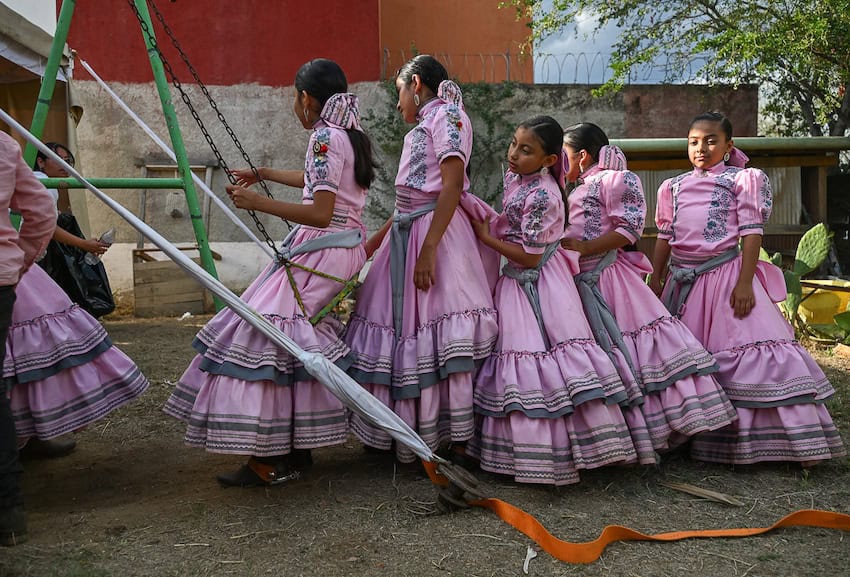
On the grounds of Ex-Hacienda La Soledad, between the competition rounds, young girls in escaramuza dresses took turns on a swing set — pumping high, then planting their feet hard in the sand, the motion echoing the dramatic stop of the Cala de Caballo.
Watching them, Cortes Lopez smiled. “It is nice to see the little girls doing that — that they are not afraid of it, that they ride a packsaddle, that they can make the horses gallop, do turns with the horses, do pointe with the horses.”
The love for the tradition, Rodriguez says, often begins with music. His own started with the songs of José Alfredo Jiménez and the world of Mexican cinema that made the charro an enduring cultural icon. He has since channeled that devotion into a novel narrated by a charro in love with an escaramuza.
“Amidst horses, charrería and the fields of flowers surrounding the remains of an old hacienda,” he writes, “a story of absence, love and tragedy unfolds.”
Anna Bruce is an award-winning British photojournalist based in Oaxaca, Mexico. Just some of the media outlets she has worked with include Vice, The Financial Times, Time Out, Huffington Post, The Times of London, the BBC and Sony TV. Find out more about her work at her website or visit her on social media on Instagram or on Facebook.
