
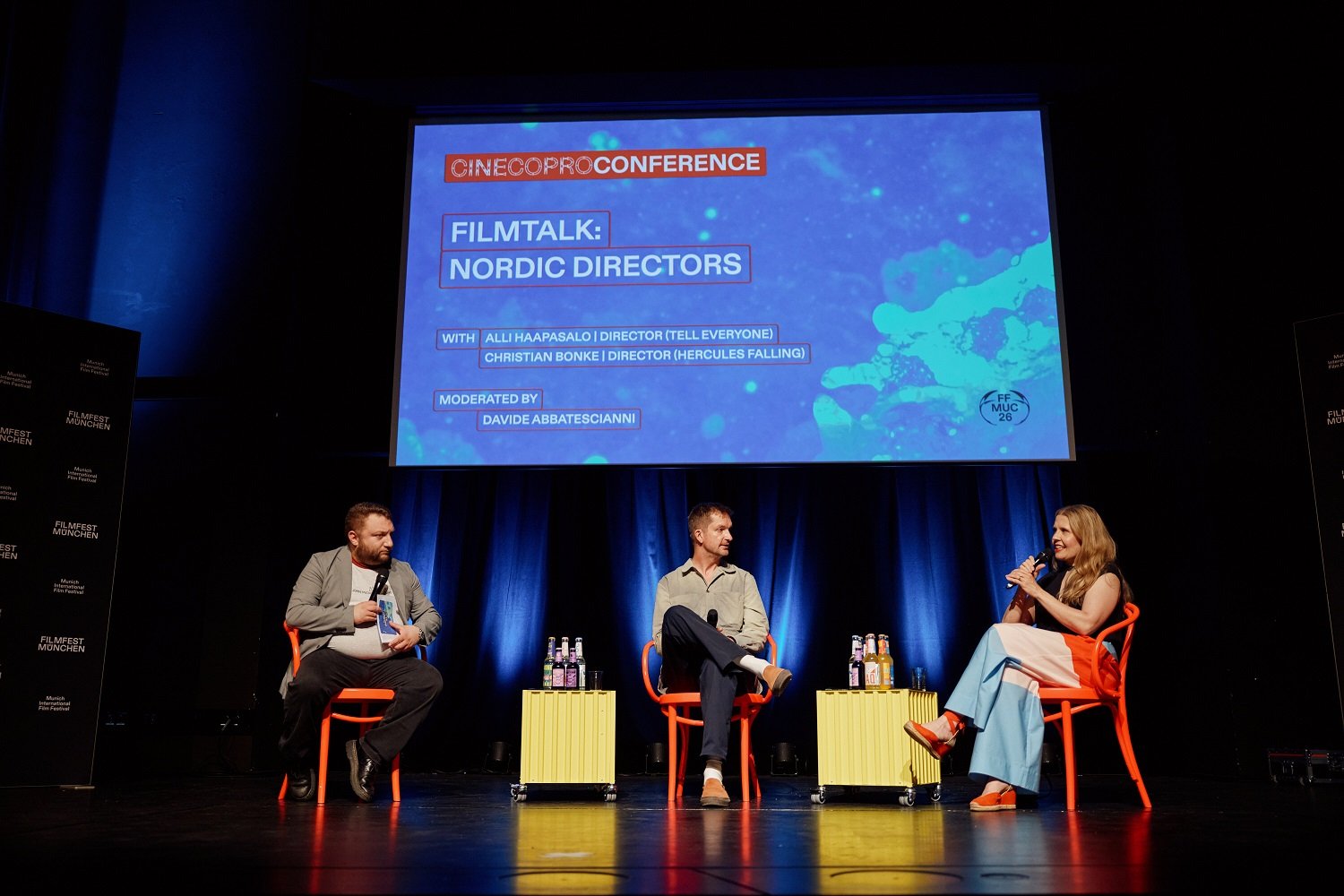
– The helmers unpacked the creative processes behind Tell Everyone and Hercules Falling, two island-set dramas shaped by trauma, community and the search for freedom
l-r: Davide Abbatescianni, Christian Bonke and Alli Haapasalo (© Bojan Ritan/Munich Film Festival)
Two Nordic films, two enclosed island worlds and two very different forms of captivity came into dialogue during the FilmTalk “Nordic Directors of the CineCoPro Conference”, hosted by Munich Film Festival and moderated by Cineuropa’s Davide Abbatescianni. The conversation brought together Finland’s Alli Haapasalo, director of Tell Everyone, and Denmark’s Christian Bonke, helmer of Hercules Falling, to discuss research, vulnerability, work with actors and the current state of Nordic film production.

Haapasalo introduced Tell Everyone as the story of Amanda Aaltonen, a woman who, in 1898 Finland, is sent to Seili, an asylum island for women considered “unfit for society”. Some of these women were dealing with mental illness, while others were neuroatypical, poor, rebellious or simply unwilling to conform to the roles imposed on them. Amanda, Haapasalo explained, is “a rebellious woman” who “refuses to surrender to authority” and “believes very stubbornly in equality of all people”.
The film is based on a book by Katja Kallio, who approached Haapasalo with the idea of adapting it for the screen. What immediately drew the director in was not only Amanda’s fate, but the wider community of women around her. “I call these the ancient women’s stories,” she said, referring to stories of rape, infanticide, depression, poverty and social exclusion that have too often been dismissed as marginal. The project became increasingly urgent as Haapasalo understood how contemporary its concerns remained. “It’s about the place given to women,” she said, describing the narrow framework in which women are still expected to behave: “You have to have a voice, but not too much.”
She also underlined the film’s connection to women’s health, an area she described as still marked by “an enormous black hole” in medical knowledge. Amanda’s condition, PMDD, would have been understood at the time simply as madness. For Haapasalo, the film is therefore also about lives shaped by a lack of understanding: “We’re putting them in an asylum rather than understanding them.”
Bonke traced Hercules Falling back to a personal crisis. Seven years ago, he said, he went through “a deep depression”, after which he began reflecting on aggression, isolation and the ways men deal with collapse. “I look at myself like a modern, very sensitive modern guy,” he said, “but how do the more stereotypical macho men in society deal with crisis when they’ve been hit by it?” This led him to veterans, whom he initially saw as “the archetypal males of our society”.
The decisive encounter came during a veterans’ parade in Copenhagen. Bonke followed a group to a bar, approached “the most frightening-looking guy” and was invited to his apartment the following week. The man’s story changed the project. “He had risked his life for numerous deployments for Denmark and now he was just left sitting in his apartment dealing with his PTSD by himself, which society wouldn’t even recognise,” said Bonke. From that moment, he felt there was “an untold story that needed to be told”.
Both directors found their films’ entry points through place. For Bonke, the rehabilitation centre on a remote Danish island became “the arena of the film”: beautiful nature set against the dark backdrop of war experiences and damaged men. The place functioned, he said, as “a laboratory” in which to study them. For Haapasalo, Seili’s paradox was crucial. Rather than a gloomy asylum, the real island is beautiful. “They’re basically imprisoned in paradise,” she said. The challenge was to balance the beauty of the environment with the structural misogyny of the institution.
That balance led her to develop a spatial dramaturgy based on zones: Amanda’s cell, the hospital interiors, the courtyard, the forest, and finally the cliffs and horizon, representing the unattainable outside world. This structure helped determine camera placement and emotional intimacy. “Where to put the camera is always the biggest question,” she noted.
Next, the conversation focused on working with actors and non-professionals. Bonke’s film features real veterans, many of them playing versions of themselves, and his method was deliberately open. “The harder you direct them, it doesn’t get any better,” he said. Instead, he would ask them how they would normally behave in a given situation, building the scene from their instincts and language. The process also raised ethical concerns: some funders withdrew because they were unsure whether such vulnerable participants could be properly protected on a film set. Bonke said the team took extensive precautions, talking through boundaries with each participant and debriefing after shooting days.
Haapasalo’s process was different, as she worked with professional actors, but trust remained central. “It’s never about pushing,” she said. “Everybody’s always giving everything.” For her, the work depends on presence, instinct and honesty. “When I say it was great, I never lie about it,” she underscored. “Presence is everything. Just being there.”
Asked about the broader state of Nordic cinema, both directors called for greater courage from funding systems. Haapasalo argued that Finland is “not the greatest risk-taker”, warning that too many projects become trapped in development or emerge as “lukewarm films” after being overworked. Bonke saw a similar issue in Denmark, where long funding processes can make filmmakers nervous and encourage them to tweak projects in search of approval. Still, he argued that cinema is finding renewed strength precisely because it can confront urgent subjects more directly than polished streaming series. “Cinema films have to break through the barrier,” he signed off, “and get really certain important issues on the headlines.”
