
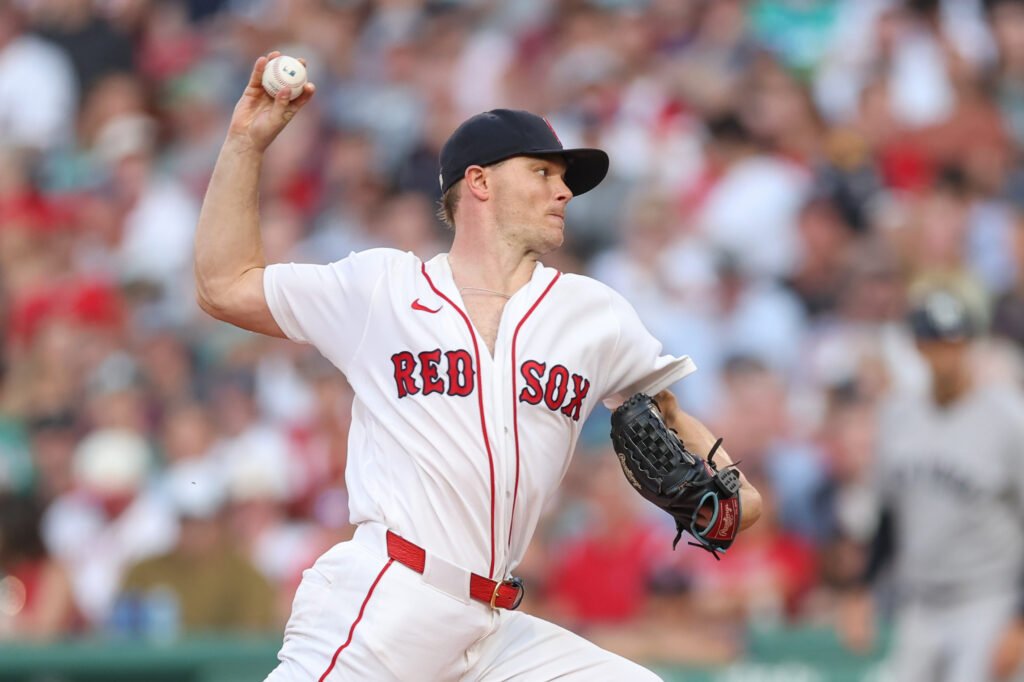
The Braves are among the many clubs that have reached out to the Red Sox about the possible availability of right-hander Sonny Gray, per Ken Rosenthal and Will Sammon of The Athletic. Nothing is close to coming together at this time, and it’s not even fully clear Boston will end up selling ahead of the Aug. 3 trade deadline. The Sox have won five straight and 10 of their past 12, moving them to within three games in the crowded American League Wild Card hunt.
Still, given where the Sox have spent most of the season (standings-wise) and the fact that Gray is an impending free agent, it’s only natural for pitching-needy teams to be checking in. As noted in a recent mailbag piece here at MLBTR, the Braves will probably be the most commonly connected team to Gray. The 36-year-old righty, who has a full no-trade clause, is a Nashville resident and has prioritized proximity to his home in past decisions of this nature. Atlanta is about a four and a half hour drive from Nashville, making it one of the closest drives of any team for Gray’s family.
The Braves have endured several key pitching injuries and have seen several stopgaps begin to falter. Bryce Elder entered today’s game with an 8.70 ERA over his past six starts. Martín Pérez just landed on the injured list. Reynaldo López is just stretching back out after a stint in the bullpen. Hurston Waldrep, who just returned from a spring elbow procedure, has given up 10 runs in his first 10 2/3 innings. Spencer Schwellenbach has yet to pitch this year after undergoing surgery to remove loose bodies from his elbow during spring training. Spencer Strider has been out nearly a month due to elbow inflammation and will miss at least one more month, as he’s on the 60-day IL.
It was inevitable that Atlanta would at least check in with Boston on Gray. Beyond all of the points already laid out here, Braves president of baseball operations Alex Anthopoulos tends to prefer shorter-term commitments for veteran players. Nearly all of the long-term deals brokered by Atlanta during his tenure there have been extensions for players still in their early-to-mid 20s.
Gray is playing out the final season of a three-year, $75MM deal originally signed with the Cardinals. He restructured the deal slightly upon approving a trade from St. Louis to Boston over the winter. Gray is earning a $31MM salary this season, but the Cards are paying $20MM of that sum as part of the trade that sent him to Boston. That leaves the Sox on the hook for $11MM in salary and a $10MM buyout on a mutual option that obviously won’t be picked up by both parties. (It’s been more than a decade since a mutual option was picked up by both sides.) There’ll be about $3.31MM of that $11MM in salary still to be paid out, plus that $10MM option buyout.
That makes Gray a pricey rental acquisition, but he’s justified that price tag with his performance thus far. Gray has pitched 89 2/3 innings over 16 starts (5 2/3 innings per outing, on average). The former All-Star has recorded a 2.61 ERA with a solid 22.8% strikeout rate, a strong 6.4% walk rate and a 47.6% ground-ball rate that stands as his highest mark since 2020.
Atlanta currently has a cash payroll just over $259MM. Their luxury-tax number sits at about $252MM, placing them firmly over the $244MM threshold but nowhere close to the second penalty tier (which would kick in at $264MM). Bringing Gray into the fold alongside Chris Sale would solidify the rotation by teaming up two of the more successful pitchers of the current generation. Sale and Gray would be surefire playoff starters, health permitting.
It bears repeating, however, that Atlanta is only one of many teams who has surely inquired. Most big-budget playoff hopefuls with a need in the rotation — e.g. Cubs, Blue Jays, Phillies, Padres, Rangers — have probably at least taken the Red Sox’ temperature on whether Gray will be moved or not. The Sox themselves are probably slow-playing the decision, hoping that their recent hot streak can push them into a buyer’s mentality more than the seller’s mindset we expected them to have throughout much of the season’s first half.
If the Sox do end up selling, there’s little incentive to hold onto Gray. The mutual option isn’t going to be picked up. He’s a rental who can’t receive a qualifying offer due to the fact that he received a QO from the Twins upon reaching free agency after the 2023 season. Boston’s options with Gray are to trade him for some future value or ride out the season in hopes of reaching the playoffs. They’re on the bubble for such a decision right now, but the next two to three weeks ought to provide some much-needed clarity.
