
Popular scientific lore has Archimedes, 22 centuries ago, shouting “Eureka!” as he watched water spill over the edge of his bath. From that moment of revelation supposedly came the principle that a body immersed in a fluid experiences an upward force equal to the weight of the fluid it displaces. At the dawn of the Scientific Revolution, a falling apple is said to have led Isaac Newton to grasp the attraction between celestial bodies, planting the seed of the idea of universal gravitation.
But before the great ideas came the techniques needed to measure reality with precision and test flashes of genius against it. Archimedes developed a method for measuring the volume of irregular objects, while Newton devised powerful mathematical tools such as calculus. As Nobel laureate Sydney Brenner once put it: “Progress depends on the interplay of techniques, discoveries, and ideas, probably in that order of decreasing importance.”
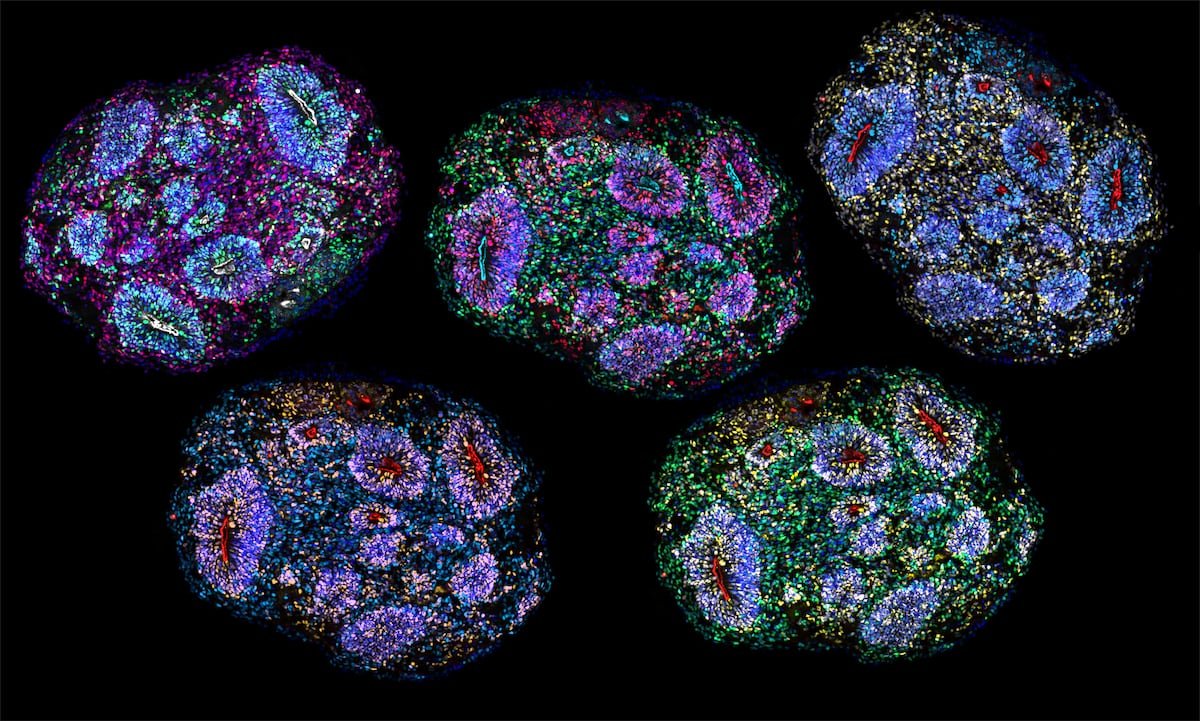
On Wednesday, Nature published an achievement that belongs to that tradition. Rather than a single discovery, it presents a technique that opens the door to countless others. A team led by Paola Arlotta at Harvard University describes how it has managed to keep human brain organoids alive in culture for up to five years, far longer than previously reported.
These organoids do not have the shape of a real brain, but they reproduce the brain’s cell types, gene expression and some stages of its organization, and are an essential tool for studying it. The breakthrough extends the period over which brain development can be observed through organoids and shows that time passes at the same rate for cells in the model as it does in humans. This has the potential not only to improve our basic understanding of the brain, but also our knowledge of neurological diseases and their treatment.
Organoids are designed to overcome two major limitations: the differences between humans and the animals used in laboratory research, and the impossibility of probing the brains of living people. Noelia Antón-Bolaños, a co-author of the study, notes that “we have made enormous progress in cancer, cardiovascular disease and other conditions, but much less in the brain.” She argues that this is “because the brain is far more complex, but also because it is uniquely human.” In our species, the organ takes two decades to fully develop.
“Psychiatric and neurodegenerative diseases have a very significant genetic component. How are we going to understand that if we are not using a human system?” the Spanish scientist asks.
Organoids are a tool to tackle the brain’s complexity, but until now they could only recreate embryonic stages of human brain development — the equivalent of the first months of life in the womb — because cells in culture, particularly vulnerable ones such as neurons, deteriorated before they could progress further.
Arlotta’s team developed a new culture method that allowed neurons to continue maturing for years instead of months. In a separate experiment, they combined young and mature brain cells within the same organoid. The results showed that cells remember the elapsed time. Much as the injection of young blood into an old animal can rejuvenate aspects of its circulation, the younger cells reprogrammed the older ones, causing them to skip intermediate stages of development and produce, within two weeks, the type of neuron that would naturally take months to emerge.
Extending the period of brain development that can be studied also has practical implications, as many signs of neurological disease appear only after birth.
Antón-Bolaños, who did this work in Arlotta’s lab at Harvard and now runs her own laboratory at Utrecht University in the Netherlands, explains that it was recently discovered that Huntington’s disease, a neurodegenerative disorder, has a developmental component. “Previously this could not be studied because, although a person is born with the mutated gene, symptoms do not appear until adulthood, so there was no way to observe what happened at the cellular level during early developmental stages,” she says. “Organoids that develop over years now allow us to observe those early stages directly, where certain cell types could already be altered from development itself, long before clinical symptoms appear.”
Beyond its value for accelerating human brain models, Antón-Bolaños speculates that the findings published in Nature could one day have medical implications that extend beyond the insights provided by the models themselves. “We thought certain cells were biologically fixed, but we saw that when exposed to young cells they were able to generate neurons again,” she explains. “Imagine discovering the cocktail of signals that young cells give these cells to produce neurons. We could begin producing neurons much faster.” She suggests that such a capacity could eventually help slow neurodegenerative processes.
The model’s potential also stems from another key finding. The researchers showed that the cells used in the organoids, despite existing outside the environment of a living body and lacking access to the rest of the organism, still followed the same species-specific internal cellular clock. That clock can be measured through epigenetics, which examines the chemical marks that accumulate on DNA as we age.
It is this clock that dictates that human neurons take years to mature fully and makes the process hard to replicate in animals. It also records both a cell’s chronological age and how long it has been developing. These organoids faithfully date the passage of time at the epigenetic level, meaning that a two-year-old organoid can reasonably be expected to be undergoing changes in its genes, neuronal composition and connections similar to those occurring in the brain of a two-year-old child.
The work by Arlotta, Antón-Bolaños and their collaborators will make all generated data available to the scientific community: more than 424,000 cells analyzed, 110 organoids and records of DNA aging over five years. “We are giving the scientific community a large amount of data so other researchers can continue exploring these questions without having to invest all the resources to generate the data from scratch,” says Arlotta.
Sandra Acosta, a professor at the University of Barcelona and head of the Research Group on Models of Neurological Diseases, highlights the quality and breadth of the new research. The critical point, she says, is that “the timing of brain development is preserved, just as it is in the human brain.” This is important because it shows that human cells retain their capacity even outside the brain system, which supports confidence in organoids’ value as a model.
That has implications for studying diseases in which timing is crucial. Acosta offers the example of a laboratory investigating epilepsy. One of the key neuronal types involved is the callosal neuron, which connects the brain’s two hemispheres. “If I can’t generate those neurons at the right moment within my organoid, the condition I’m reproducing won’t be exactly the same as the one affecting that child with epilepsy,” she says. “That is why it is crucial to do it right.”
“With this kind of technology we will be able to reproduce it almost perfectly, because we will be able to time very precisely when that construction of the brain’s electrical wiring must be coordinated, so that, for example, epilepsy does not appear,” adds Acosta.
In time, the technical details of this culture system, like the techniques that first made organoids possible, will probably be forgotten, just as few people remember the instruments Archimedes used to measure volume. But such tools are the prelude to discoveries that change the world. Organoids have not yet revealed the secrets of the human brain, but they have expanded the territory in which scientists can search for answers.
Sign up for our weekly newsletter to get more English-language news coverage from EL PAÍS USA Edition
