
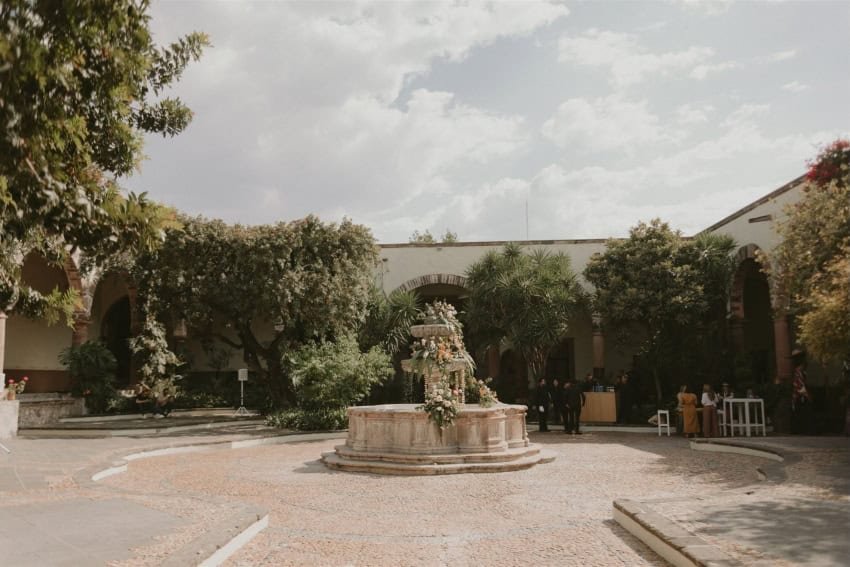
When San Miguel de Allende comes to mind, so does the cultural and artistic richness that has long defined this UNESCO World Heritage city. That legacy is embodied by spaces that have existed for decades and helped forge the city’s cultural identity — none more so than Instituto Allende.
Instituto Allende’s roots are with the family of the Conde de la Canal, one of the most influential families in San Miguel de Allende’s history. The 18th-century mansion that houses it today once belonged to the Count, whose hacienda helped shape the city’s development. In 1951, American writer and adventurer Stirling Dickinson, alongside Mexican painter Alfredo Campanella and with the support of the Hernández Macías family, transformed the space into an art school affiliated with the University of Guanajuato.
The concept was radical for its time: a bohemian, open and multicultural environment in the heart of El Bajío. The school gained international recognition when it began welcoming World War II veterans using the G.I. Bill to study art abroad at low cost — turning the Instituto into a creative haven where Mexican and foreign artists lived and worked side by side, laying the groundwork for the cosmopolitan identity San Miguel de Allende carries to this day.
For years, Instituto Allende has served as both an art school and a venue for social events. This year, it opens a new chapter in its history with the launch of the Centro Cultural Instituto Allende.
A new project for a cultural touchstone in San Miguel
Eva Fernández Martínez Borden leads this new project, guided by the vision of her father, Rodolfo Fernández Martínez Harris, who devoted years of his life to maintaining the space as a cultural landmark — continuing, in turn, the legacy of his own father. Those now at the helm of this initiative aim to reclaim its open, community-focused spirit for the people of San Miguel.
The Centro Cultural Instituto Allende officially launched on a rainy Thursday in June, marked by live jazz saxophone from Rodrigo, a local San Miguel musician, and the opening of a visual exhibition titled “Autonomía del Vuelo” (“Autonomy of Flight”) by artist Erika Harrsch, who spent part of her artistic training at the Instituto. Eva’s remarks — heartfelt as she reflected on this new phase — were received by a large community that has closely followed the artistic life unfolding within the building and its gardens. The inaugural exhibition became a genuine gathering point for the local public: media outlets, artists, enthusiasts and art professionals came together to mark the beginning of a new era for the space.
The strength of a cultural center lies in its multidisciplinarity, and that is precisely what this space offers. The combination of areas for artistic education and professional development, an exhibition space — the gallery led by Cartografía Cultural — and the new Rodolfo Fernández Martínez auditorium seeks to unite artistic spirit with discipline, creative freedom and a renewed sense of the creative soul that sets San Miguel de Allende apart.
What does this mean for the World Heritage city?
Art permeates San Miguel de Allende at every level — from its picturesque streets and murals by local artists to its galleries and theaters. Independent cultural initiatives like this one require enormous effort, a commitment to the human spirit, and a passion sustained daily by the people behind them. It is work that deserves recognition, because everyone who calls a city home deserves places where they can create and belong.
This increasingly gentrified city faces a challenge that is growing quietly: spaces that once belonged to locals now cater primarily to tourism and the real estate market. San Miguel welcomes thousands of visitors and new residents each year, drawn by the very artistic and bohemian atmosphere its own community has built over decades. Yet that same appeal drives up the cost of living and gradually pushes out the local creators who give the city its soul. Initiatives like the Centro Cultural Instituto Allende offer a concrete response: accessible spaces where art is not a consumer product, but an act of community and belonging — a place where locals and the foreign residents who now call the city home can coexist around art.
That coexistence takes concrete shape through initiatives like the Lifelong Learning Program, led by John Wimberly, who has lived intermittently in San Miguel for several years. The program welcomes the foreign community that comes to San Miguel each spring and shares space with Visual Arts undergraduate students and other workshop participants at the Instituto — all of which are actively taking place within the Instituto Allende today. Together, these programs create an environment where foreigners and locals connect through a shared passion for art and learning, making the Instituto a living, breathing hub of creative exchange.
Providing artistic expression with a spiritual dimension
This diversity of experiences, voices and perspectives is precisely what makes cultural spaces indispensable. Cultural spaces in cities are not a basic necessity, but they are a spiritual one — much like art itself, which seeks to give meaning to human existence. Their value lies in being creative, social and communal gathering points. Whether a gallery, theater, cinema, library or cultural center, these are the places where art is born and communities with shared interests in personal and collective well-being come together. A city’s cultural richness is nourished daily by its creators and the spaces where creativity lives: worlds of possibility where disciplines intersect and communal visions elevate the artistic spirit of the city.
The Centro Cultural Instituto Allende embraces that vision from the very start. While the full events and exhibitions calendar is still taking shape, local artists will begin joining the Instituto’s community this fall, finding a space to develop and present their work under the curatorial direction of Mary Paz Cervera, coordinator of Cartografía Cultural.
The Centro Cultural Instituto Allende opens its doors at a pivotal moment for the city — one in which the question of who San Miguel de Allende truly belongs to has never felt more urgent. As Eva Fernández puts it: whether you live here permanently or are just passing through, the art and culture of this space welcome you to live your own artistic story. Because the answer, at least from within these walls, is clear: San Miguel belongs to those who create it, inhabit it and feel it as their own.
Nayelli Sánchez is a contributor to Mexico News Daily.
