
Listen to this article
Estimated 3 minutes
The audio version of this article is generated by AI-based technology. Mispronunciations can occur. We are working with our partners to continually review and improve the results.
The outgoing community co-ordinator of Wildsafe B.C. Nelson is calling for change, after she says “multiple failures … on many levels” led to the killing of a grizzly sow and two of her three yearlings this month.
“Personally, I’m heartbroken,” Lisa Thomson told CBC’s Radio West. Thomson announced her resignation from the role earlier this month in the wake of the killings.
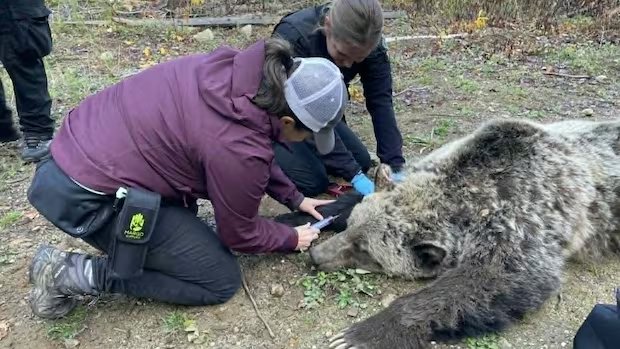
The four bears had attracted attention as they travelled through the Nelson area. The mother was killed after it was relocated but returned to the West Kootenay community.
Radio West16:51Reaction after another grizzly was killed in the West Kootenay on Thursday
Lisa Thomson, community coordinator for WildSafe BC in Nelson, is sad about the recent killings of three grizzly bears in the West Kootenay.
According to the B.C. Conservation Officer Service (BCCOS), one of the yearlings was killed because it wasn’t a good candidate for relocation due to age and health issues. A second yearling was killed this week after it was relocated but turned up near Christina Lake eating garbage.
“The bear was coming into close proximity of people, showed no fear of these people, and unfortunately the animal was able to access non-natural food sources,” said Andrew Milne, deputy chief of the BCCOS.
“Because of that, that animal wouldn’t leave, and it’s with a heavy heart that the officers had to to respond and then dispatch the animal.”
Thomson said she understands the policies and protocols involved in the decision to terminate wildlife, but was “just not able to accept them” in this case.
She said the bears had been in and around the Nelson area for some time and repeatedly returned due to the abundance of feral fruit trees.

It’s a problem she said can’t simply be managed by relocating bears.
Instead, she said, there needs to be concerted and coordinated efforts by residents, municipalities and businesses to bear smart their communities.
She pointed to Canmore and Banff in Alberta which have replaced individual curbside trash bins with centralized, animal-proof community bins as an example.
“There’s no such thing as roadside garbage collection in these towns. You’re not allowed to plant any fruit trees or any food bearing plants in that community,” she said.
“Can we have a look at that and enforce that somehow? Find the funding for that?”
Thomson said residents also need to do more, both by policing potential wildlife attractants and by not allowing them to get comfortable in human environments.
“Coexistence is not allowing … a backcountry apex predator to hang out in your backyard next to your barbeque,” she said.
“We kind of killed them with kindness by allowing them to do so. We’re not instilling boundaries and try to haze this family away.”
Thomson said she also wanted to dispel misinformation circulating in the wake of the killings that Wildsafe B.C. was working as agents of the BCCOS.
While the group does receive some funding from the province and municipalities, it is a non-profit organization whose role is purely to educate the public, she said.
The grizzly sow’s fourth and final yearling was also relocated, and while it did initially turn up in Christina Lake, it has since moved on and is being monitored.
