
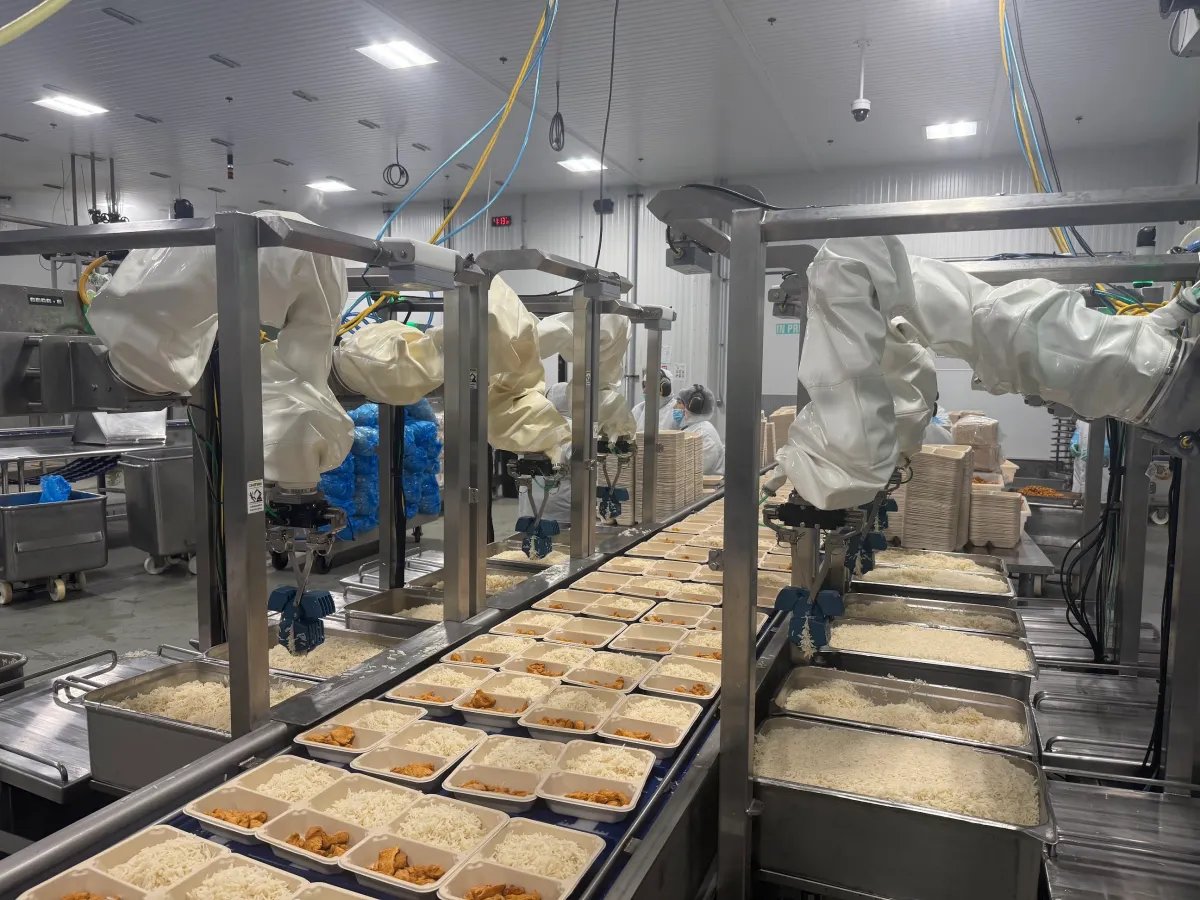
Chef Robotics CEO Rajat Bhageria likes to tell people — correctly — that his industry is a veritable startup graveyard. Whether you’re talking about Chowbotics, a salad-making startup that was acquired and later shut down by DoorDash, or Zume, a $400 million attempt to “disrupt” pizza delivery that collapsed in 2023, the effort to automate a process that has heretofore required opposable thumbs and a sentient brain has not always gone so smoothly.
Bhageria thinks he’s figured out the workaround. The premise is simple, even if the execution isn’t: use AI-powered robot arms to take the labor out of large-scale food production. Originally, Chef sought to do that in fast casual restaurants, the kind that litter America’s cities. But the company pivoted early, finding success instead in food manufacturing, where it now serves enterprise customers like Amy’s Kitchen and Chef Bombay, and works with one of the largest school lunch providers in the country.
Now, the company says that it has passed an important milestone: 100 million servings. What’s a “serving,” exactly? A company spokesperson defines it as “a portion of food that our robots deposit into a meal tray.” So it’s not a meal, per se, but instead it represents “one component” of a full meal, the rep says. The takeaway: having ditched more traditional dining venues and instead courted larger, institutional-scale customers, Chef is busier than ever.
Bhageria says that the company’s next move is to expand into what it calls “smaller kitchens.” As for what those kitchens look like, the definition might surprise you. He tells me that one of Chef’s recently signed smaller customers is “one of the largest airline catering companies in the world.”
Other types of venues are also being pursued. The company said it has plans to expand into “ghost kitchens” — operations without any actual restaurant that supply meals for the likes of DoorDash. Eventually, the company would like to expand further into fast casual restaurants, stadiums, and prisons, Bhageria adds.
Bhageria also says that the data being generated from its 100 million servings is being fed into its AI models for food handling and packaging, which help those models to become smarter and more capable. The “inherent nature of food” — a slippery and malleable product without predictable proportions — makes it difficult for robots to handle it, he offers. With its models, Chef hopes to continue to improve the technology so that the robots get progressively better at their job, which will help the business to scale.
Techcrunch event
San Francisco, CA
|
October 13-15, 2026
