
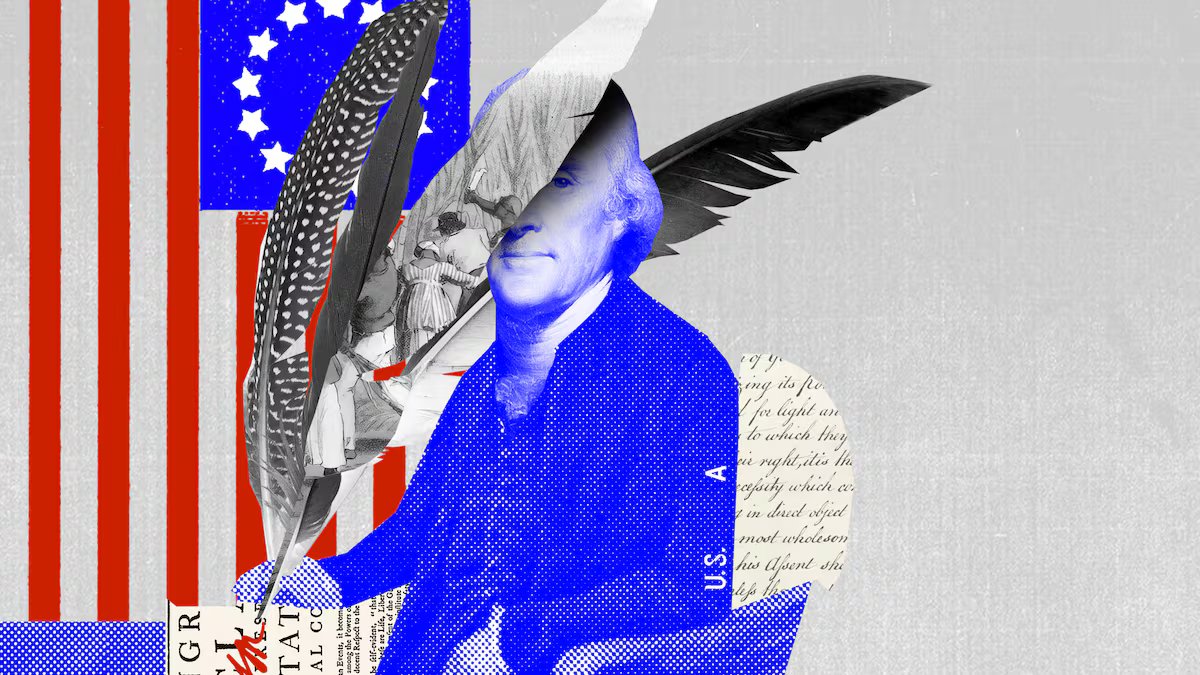
The Declaration of Independence is rife with moral contradictions, much like the nation its drafters founded. The Preamble asserts that “all Men are created equal” and that the powers of government should derive from “the Consent of the Governed.” But a majority of the signers owned either a few or many of their fellow men and women. During his lifetime, Thomas Jefferson, the document’s principal author, compelled over six hundred Black slaves to toil at his estate in central Virginia.
The Declaration condemns King George III of Britain for “a History of repeated Injuries and Usurpations” whose “Object” was “the Establishment of an absolute Tyranny over these States.” Most of the grievances it cites were attempts by the monarch (and Parliament) to limit or do away with popular rule in the thirteen colonies. But the document also blames the King for allowing “the merciless Indian savages” on the frontier to murder “all Ages, Sexes and Conditions” of the Americans who, after all, had invaded their lands. Thus, from the beginning, the United States was a nation dedicated to liberty for most of its inhabitants yet also one that encouraged white people to grab Indigenous lands and resources and expand the institution of slavery.
Yet the ideals expressed in the Declaration became an essential resource for Americans struggling to build a republic that would live up to its stated promise and correct its serious flaws. Those ideals gave reformers and radicals a foundation of patriotic legitimacy for their work. As the political theorist Danielle Allen has argued, the Declaration “makes a cogent philosophical case for political equality.” By detailing how King George III lied to and mistreated the American colonists, it established the principle that governments should protect and advance the well-being of their citizens. The signers were making that case not just to their fellow Americans but to “a candid world.” Independence for the 13 colonies should be in the interest of anyone, anywhere, who believed the only remedy for tyrannical authority was for people to govern themselves.
Armed with democratic zeal, insurgent Americans would deploy the words of the founding document to advance their own progressive causes. In 1848, a Woman’s Rights convention in Seneca Falls, New York issued a Declaration of Sentiments and Resolutions that read, “We hold these truths to be self – evident: that all men and women are created equal” (italics added). They went on to demand the right for women to control their own property, vote, and run for office.
On Independence Day in 1852, the Black abolitionist Frederick Douglass delivered an angry, eloquent address in which he asked, “What to the slave is the Fourth of July?” A fugitive from bondage himself, Douglass spoke a hard truth to his mostly white audience: “Your celebration is a sham; your boasted liberty, an unholy license; your national greatness, swelling vanity; your sounds of rejoicing are empty and heartless; your denunciations of tyrants, brass fronted impudence; your shouts of liberty and equality, hollow mockery.” But at the end of his speech, Douglass predicted slavery’s demise – and drew his “encouragement from the Declaration of Independence, the great principles it contains, and the genius of American Institutions,” as well as from a spirit of enlightenment he hoped was growing on both sides of the Atlantic, despite the brutal repression in Europe of the democratic revolutions of 1848.
For the next century and more, American social movements motivated their members and sought to persuade a broader public with orations and statements inspired by the one Jefferson wrote in 1776. On its centennial in 1876, a Black Political Union issued a “Negro Declaration of Independence,” while a Workingmen’s Party published a manifesto highlighting the “repeated injuries” done to wage-earners. In 1895, Eugene V. Debs, the most popular socialist in U.S. history (until Bernie Sanders, at least), assured a crowd of supporters, that “the spirit of ’76 still survives. The fires of liberty and noble aspirations are not yet extinguished. The vindication and glorification of American principles of government, as proclaimed to the world in the Declaration of Independence, is the high purpose of this convocation.”
In 1933, at the pit of the Great Depression, Unemployed Leagues led by the Dutch-born socialist A.J. Muste rewrote Jefferson’s words to highlight the economic woes besetting ordinary Americans: “When, in a nation possessing unlimited resources, along with the greatest industrial and transportation equipment the world has ever known, there develops a condition wherein millions of citizens are forced into dire destitution and starvation … it becomes their duty to organize to change these conditions.”
The influence of the original Declaration of Independence was not limited to the nation it helped create. Around the globe, people affected by what the historian David Armitage calls “a contagion of sovereignty” issued their own declarations to herald their liberation from foreign rule. The tradition began in Haiti in 1804, caught fire in the Central and South American nations that broke away from Spain, and spread to many of the nations in Asia and Africa that celebrated gaining freedom from colonial empires after the Second World War. On the day that conflict ended in 1945, Ho Chi Minh stood before a huge gathering in Hanoi and repeated, verbatim, the famous phrases that had fired the spirits of American patriots in 1776: “All men are created equal. They are endowed by their creator with certain alienable rights, among these are Life, Liberty and the pursuit of happiness.” It would not be long before Ho would lead his Democratic Republic of Viet Nam in long and bloody conflict against the same nation where those words originated.
In recent decades, many activists and intellectuals on the American left have ceased quoting the Declaration to justify the fundamental changes they seek to make in the nation’s politics and culture. To call on the better angels of the nation’s birth, they believe, denies the reality that the United States was created on the bodies of Indigenous people, enslaved Africans, and poor immigrants. Why praise the founding ideals of a “settler-colonial” leviathan whose zeal for conquest was checked only by military defeat, as in Vietnam?
But most Americans are proud of what their nation stands for, and there remains no better statement of that creed than the manifesto drafted in Philadelphia 250 years ago, whatever the hypocrisy of Jefferson and the leaders who came after him. As Todd Gitlin, an erstwhile leader of the New Left, wrote earlier this century: “It is time for the patriotism of mutual aid, not just symbolic displays, not catechisms or self-congratulation. It is time to diminish the gap between the nation we love and the justice we also love. It is time for the real America to stand up.”
