
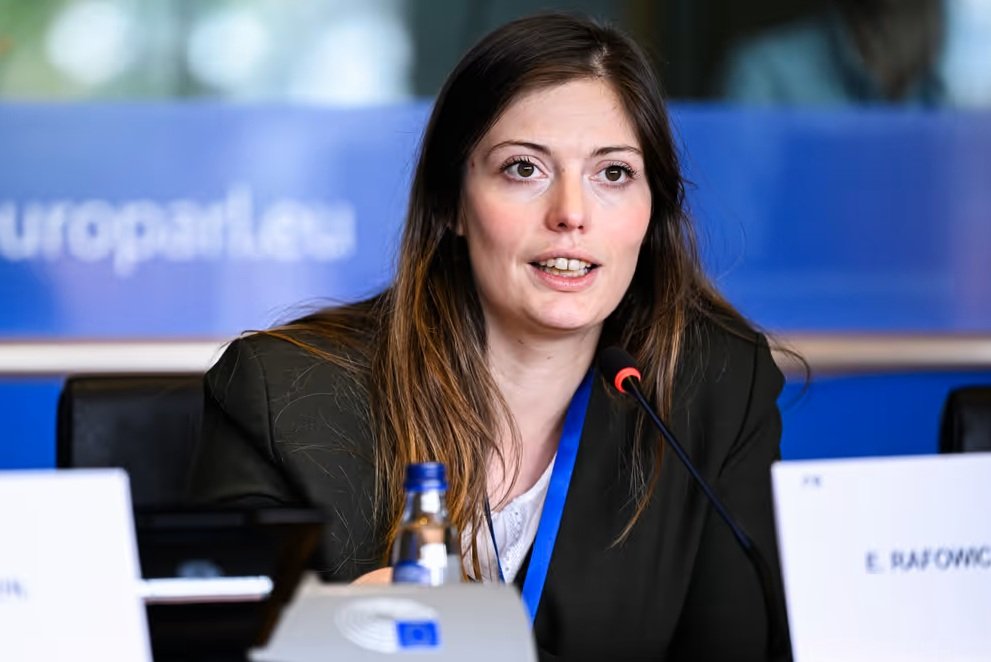
– At the CULT Committee’s presentation of the Agora EU draft report, the MEP and rapporteur has laid down its political line
MEP and S&D rapporteur for Agora EU Emma Rafowicz (© European Union 2026/Source: EP)
MEP Emma Rafowicz, S&D rapporteur for Agora EU, the programme set to succeed Creative Europe and thus define European cultural, audiovisual and information policy for the next funding period, made it clear at the CULT Committee’s draft report presentation exactly what is at stake. “Yes, defending culture to defend democracy means assuming a political line,” she told the committee. “When we defend European cultural sovereignty, we defend culture and democracy, we defend artists and, ultimately, we defend European citizens who have the right to be free.”
That framing, defining culture as a democratic instrument, runs through the entire architecture of the draft report. It is the answer that Rafowicz gives to the question of why Agora EU matters at a moment when “never before have culture and information occupied such a central place in global power dynamics, nor been so exposed to illiberal forces, whether Russian revisionism, US nationalism or illiberal movements within Europe itself”. The report’s ambition, as per her presentation, is inseparable from that diagnosis: Europe must assert itself as a cultural power, and guarantee the sovereignty of its media and information ecosystem in order to protect its model of democracy.
On the audiovisual side, Rafowicz was adamant that the MEDIA strand’s logic should not be tampered with. “You don’t change a winning team,” she said. Since 1991, MEDIA has financed every link in the value chain, with support reserved for independent producers, enabling them to make works that would otherwise never have been made. In the draft report, distribution, sales, export and cinemas are placed at the core of the text. Video games are recognised as an integral part of MEDIA, a cultural influence and an economic driving force.
The three cross-cutting principles of the draft report flow from that premise. The first is predictability, through dedicated strands with ring-fenced budget envelopes, with clearer indicators, monitoring mechanisms and annexes specifying funded actions. The question of journalism and news media is also crucial. Rafowicz and co-rapporteur Alice Kuhnke (Greens, LIBE Committee) propose a new, separate strand for information and journalism, distinct from MEDIA and audiovisual content. The second principle is a commitment to supporting those who need it the most, with social conditionality and the defence of workers as the guiding criteria. The third is responsiveness to the current situation, with a new dedicated strand for journalism and information, a sector facing multiple simultaneous crises, and a clear rule on generative AI: any project receiving Agora EU funding must demonstrate a substantial, identifiable, and always human creative contribution.
Furthermore, a new chapter on music, modelled on the example of the European Audiovisual Observatory, would be aimed at establishing a European Music Observatory to track market concentration, digital transformation and the impact of AI on the sector.
The timeline is tight. The deadline for tabling amendments is 18 June. The committee vote is scheduled for 19 October, with a plenary adoption expected in late October. For the European audiovisual sector, the coming months represent a window to shape a programme that will define the European funding conditions for independent production, distribution and international sales, as well as festivals and training programmes, for years to come.
