
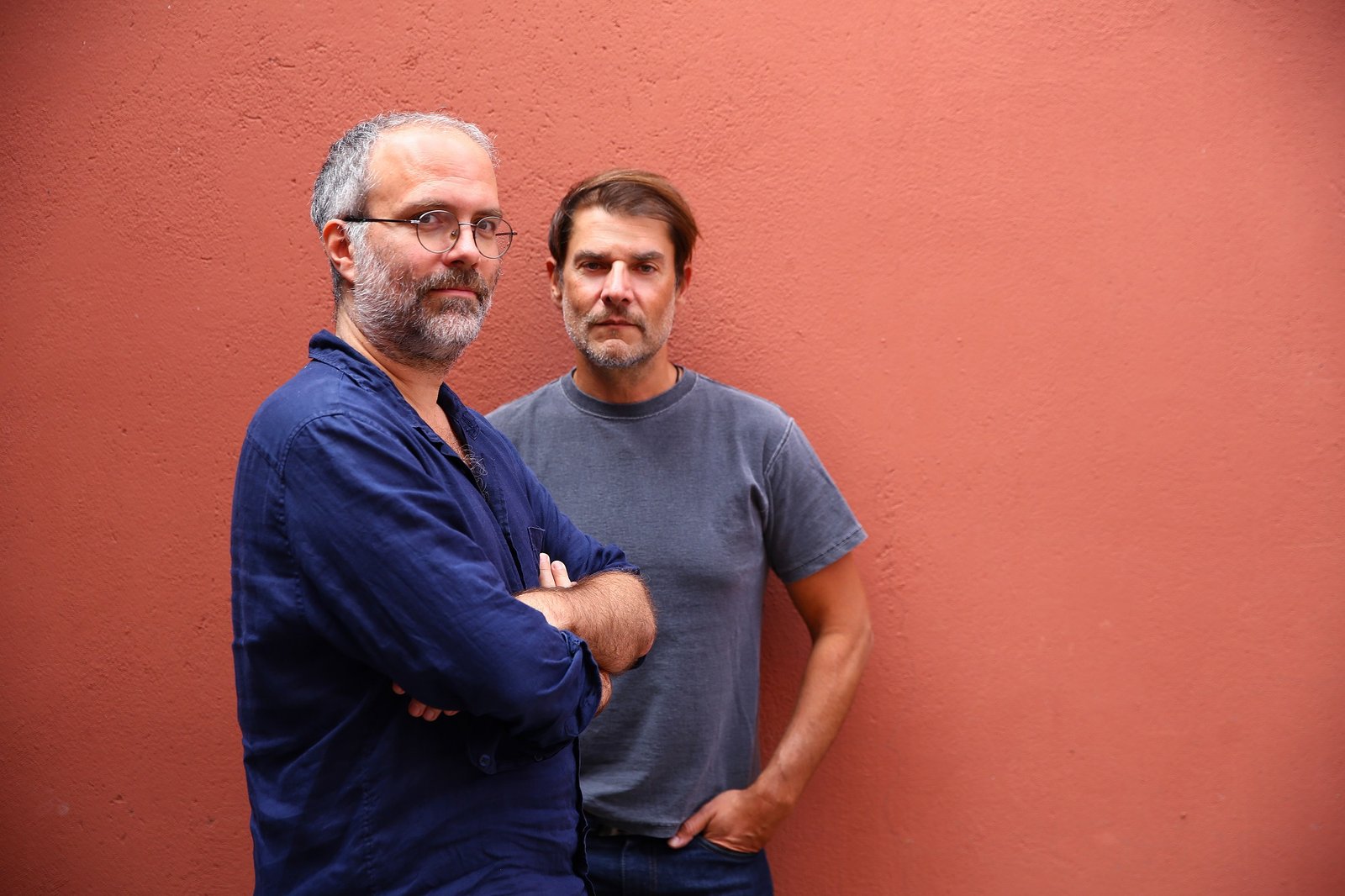
“We like our characters; when we laugh at them, we’re also laughing at ourselves because we share their neuroses”
– The directorial duo chatted with us about the adventure involved in making a highly original feature film using cut-paper animation and bursting with offbeat humour around social conformism
Unveiled in Cannes’ ACID line-up and showcasing in the 45th Annecy Animated Film Festival’s Contrechamp competition this week, Blaise is Dimitri Planchon’s first feature film and Jean-Paul Guigue’s second (the latter having co-directed Silex & the City – The Movie).
Cineuropa: How did the idea for a feature film based on a comic book and a short animated series come about?
Dimitri Planchon: Originally, it was a comic book that I made for Fluide Glacial and which I started twenty or so years ago. Producer Alexandre Gavras (KG Productions) later sought me out with the idea of turning it into an animated series and we made contact with the animation studio Je Suis Bien Content where Jean-Paul worked. But it wasn’t recommissioned for a second series. We were a little frustrated at the thought of leaving things there, and Alexandre wanted us to make a film. Just like in the comic book and the series, the characters’ neuroses – which revolve around communication, their slightly dysfunctional relationships with others, and their own self-image – were just a pretext for cutaway gags; I really liked the idea of writing something which would become a spiral, drawing the characters further and further in.
How did the transition from series to feature film impact your very specific cut-paper technique?
Jean-Paul Guigue: We didn’t have much time for the series. In six months, we released thirty 3-minute episodes while simultaneously developing our slightly strange 2D technique, which gives an impression of depth in order to lend some kind of perspective to the faces while still keeping things very flat. So we did a few tests between the end of the series and the feature film, primarily with 3D, but. in the end, it felt like we were losing a part of ourselves. It reassured us that the technique we’d originally chosen was definitely the right one. Those characters who can’t really turn their bodies or heads are our style, our identity. Cut-paper technique involves constant shot/reverse shot cutting, because the characters can’t turn around or look at one another. But that limiting, almost clinical side of things serves to reinforce the story we’re telling, that the characters are constantly restricted by some kind of straightjacket.
How did you strike a balance between a caustic criticism of social conformism and showing affection for your characters?
DP: We love our characters. When we laugh at them, we’re also laughing at ourselves because we share their neuroses. We’re not here to judge them, we’re here to make fun of our own neuroses. They have a slightly dysfunctional relationship with other people because they’re fixated with the idea of not displeasing anyone, so they always swim with the tide. But given that the tide can move in lots of different directions, the way they move forwards by following the people they’re talking with leads them to places they really don’t want to end up in.
Misunderstandings are the driving force behind the film’s narrative.
DP: Any kind of dialogue involves misunderstanding, on some level. It allows communication but we’re never in full symbiosis. We pushed that idea a little further by exaggerating things and making them funny, but it’s just another way of exploring the complexity of language and human relationships.
JPG: It’s a non-stop, almost clinical study of cognitive biases, because all the characters think other people can understand them whereas they’re actually totally wrapped up in their own objectives. That can lead to misunderstandings and mix-ups. All the characters have their own slightly quirky little worlds which more or less interact with others.
DP: The father, Jacques, is almost the most tragic of all of them, because he has a very precise view of the way he wants people to see him and he refuses to budge on it, which means he’s doomed to failure. Carole, the mother, needs to be liked. As for Blaise, he’d almost like to be invisible, and it was fun to turn a kid with no opinions on anything and whose only desire is not to be noticed, into a borderline terrorist, a bandwagon revolutionary.
On that note, what about the film’s political side?
JPG: We depict a harsh and divided society, but what we were most interested in was showing just how much Blaise struggles to find his place in that society. The whole family is lost in that world. They’re middle-class people who observe that world without getting involved in it and without it having any real impact on them. But owing to their relationship with others, they’re expected to position themselves in relation to it – in relation to work in the case of the mother, in relation to a politicised environment for Blaise. When, ultimately, they could leave the world to collapse around them. It’s a small irony that we really like in the film.
You’ve mentioned filmmakers like Roy Andersson and Luis Buñuel as your reference points…
DP: One of my all-time favourite films is The Exterminating Angel by Buñuel, a director who plays with human relationships to the point of absurdity, which I really like. With Roy Andersson, it’s more about the characters being like a box of dolls, which we also use a lot, but there’s also his dry humour, communication difficulties between characters, and micro-societies like the one Blaise inhabits. He’s not really the main character in our film; he’s a repository for the small world around him.
(Translated from French)
