
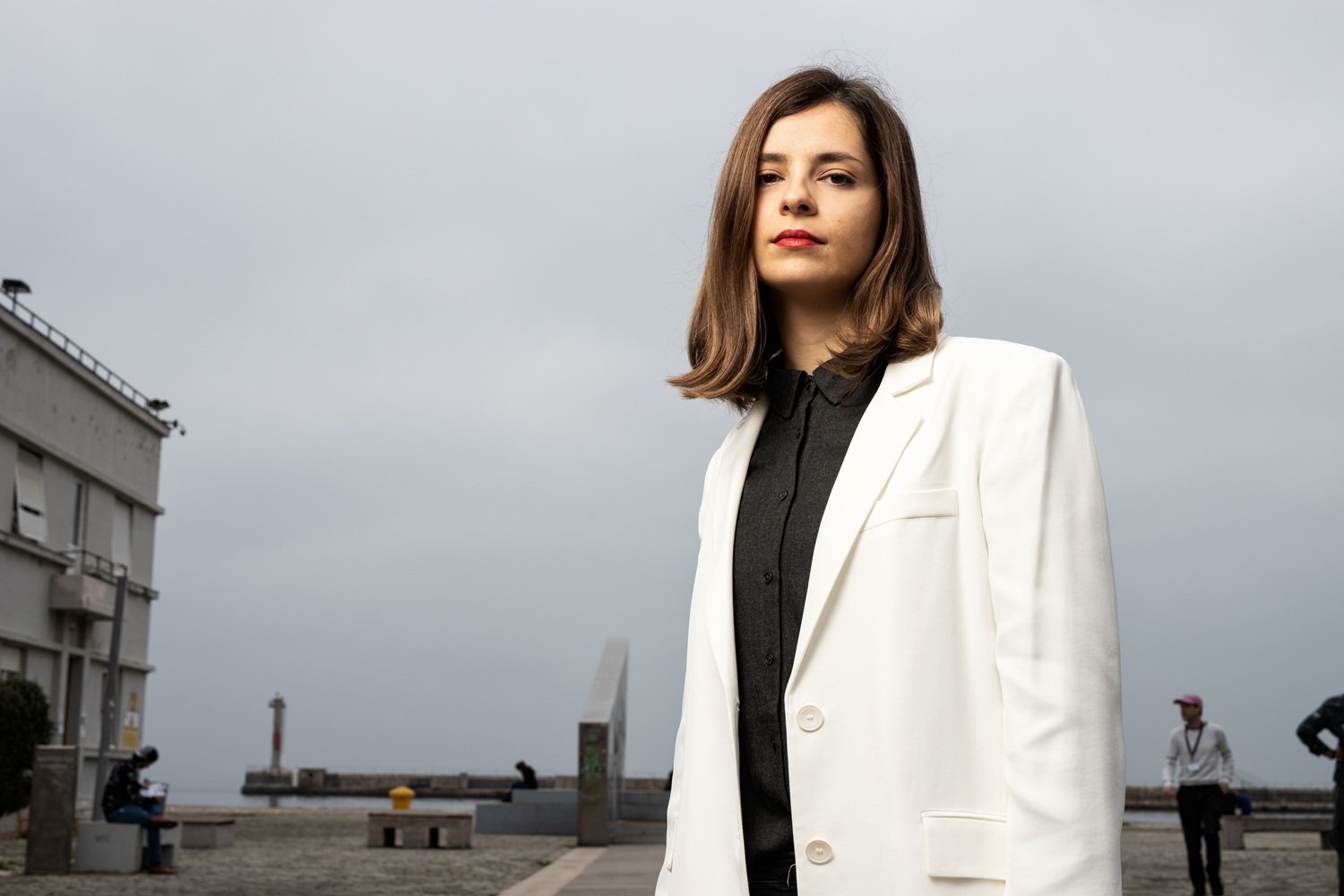
“I quickly realised how important and sensitive the topic was, so approaching it ethically became a priority”
– The Macedonian director delves into the personal inspirations behind her latest feature, shaped by community research and non-professional casting
(© Aris Rammos)
At the Tribeca Film Festival, where her second feature, Skateboarding Is Not for Girls, has screened, Macedonian director Dina Duma spoke to Cineuropa about the origins of the project and the casting process that led to the final film.
Cineuropa: Could you talk about the experiences or encounters that inspired your movie? What kind of research did you conduct?
Dina Duma: I grew up in Skopje, which has a large Roma community, so throughout my life, I have had many friends from that community. The initial inspiration came from a pal I had in primary school. One day, while looking through an old yearbook, I came across a photograph of her. It struck me that I hadn’t seen or heard from her in many years. She got married and was already pregnant at 16, or perhaps even younger. Seeing her photo brought back memories of her and everything she went through. She had to leave school, and her life changed completely. I started trying to find her, but I couldn’t. To this day, I don’t know where she is.
That was the seed of the idea. From there, I found myself thinking more and more about it. One day, when I was riding my bike along the riverbank, I saw a girl on a skateboard, dressed in a beautiful Roma shalwar dress. This was another sign that prompted me to start thinking about how I could speak about these things: this girl was a child, but somehow, you could see in her eyes that she was mature, and she understood more than you’d imagine. It’s striking because when you meet these young girls, you see how smart and mature they are.
After that, I began researching and speaking with my Roma friends, and I quickly realised how important and sensitive the topic was, so approaching it ethically became a priority. I worked closely with the Roma community, sharing the script and discussing it extensively. Over the course of a year, we revised it together, including during the casting with the lead and younger actresses. Their experiences, as well as stories from their families and friends, helped mould the script.
So, the skateboarding idea was also triggered by that girl on the riverbank?
Yes, it was directly inspired by what I saw because I was obsessed with how these little things, like a girl skateboarding, could be something the characters could think of as a small source of freedom and expression, or a way not to obey the rules. It was important to have this as an element because it’s real. I also wanted to show how the body moves when the young girl is on the skateboard, and how she feels in the abandoned skating park. It’s like her secret place: she feels free there, and she can be herself and not have someone else determine what she does with her body.
How did the casting go?
It was a very long process. We cast for almost a year trying to find the right girls. We saw loads, many of them very talented. We actually did it in a school, in a Roma settlement. But in the end, we settled on these two girls. We chose Efkjar Abaz, who plays Adela, first. I think she’s a rebel both without a cause and with a cause. She was extraordinary, even from the first image, and I was really happy that we found her. Then, after choosing her, we started looking for her sister. It was interesting how the two girls connected because they knew each other from before, as they are cousins. Somehow, when we paired Adela and Zara, it was magic.
The casting was also very interesting when it came to the grandmother because she’s not an actress either. She’s a person living in Shutka. It was the first time in my life that this had happened: I wrote a script and gave the lines to someone to read, and when I saw her, I said: “Okay, this is it, you don’t have to change a thing.” The way she spoke was completely her own, and she immediately got the part. Simonida Selimovič, who plays the mother fantastically, is a professional actress. She’s also an activist for Roma rights and for Roma women’s rights. She gave some very good input to the whole story and to the character as well. I’m very grateful for that.
Are you working on anything else at the moment?
I’m working on a new script together with Labina Mitevska, the producer of this film. Again, the main protagonist is a woman, but this time, I chose not to stay in the Gen Z teenage world. I’m now moving into the world of a 65-year-old woman living in North Macedonia. It’s a dark comedy, and I’m exploring this world. It was inspired to a certain extent by the grandmother’s character. Unfortunately, I cannot say any more about the story, because it is still at an early stage, but I am very excited about it.
