
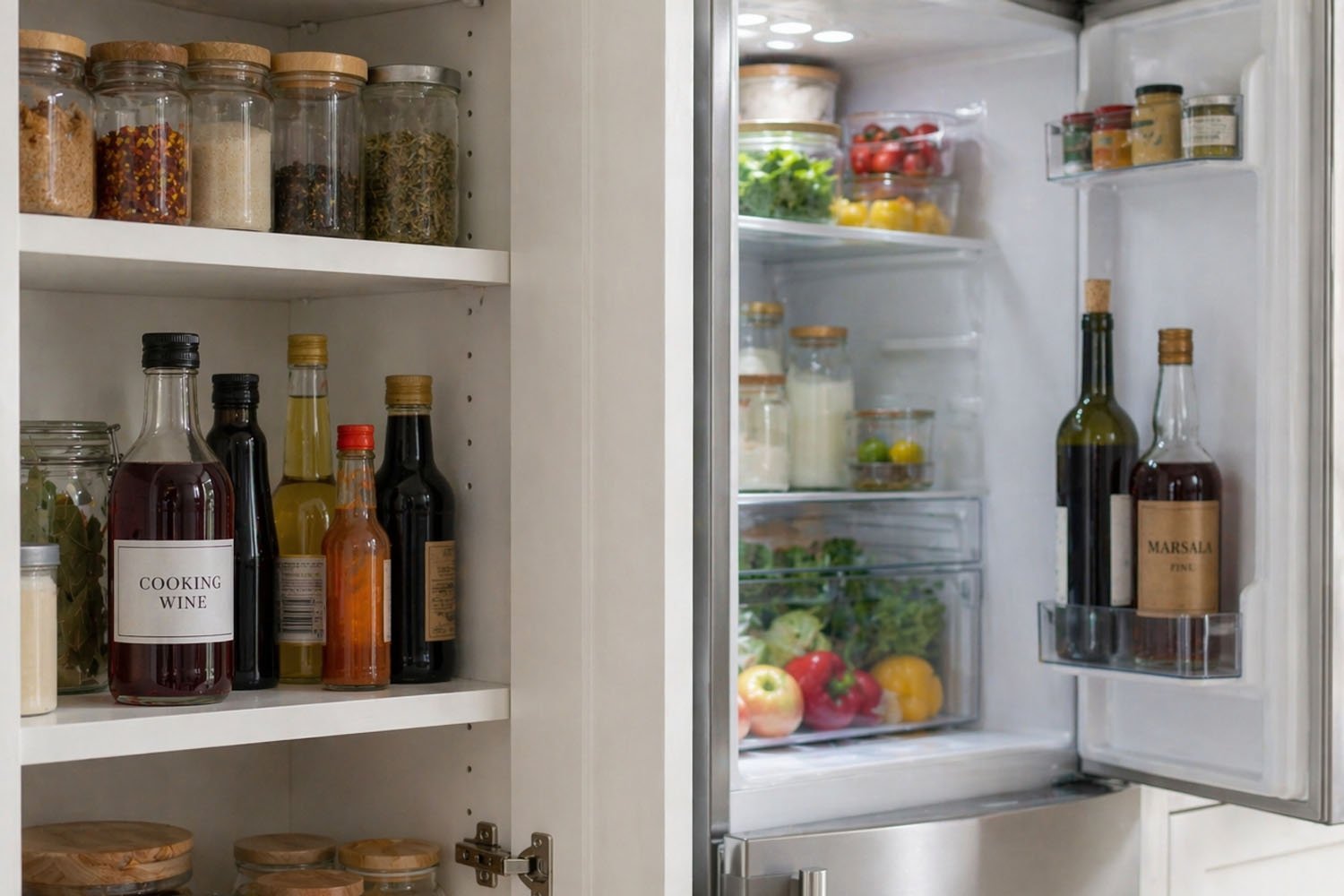
You just finished a recipe that called for cooking wine and have leftover in the bottle. Does it go back on the shelf or in the fridge? The answer is not the same for every bottle, and getting it wrong means wasting wine or using wine that has gone off in your next dish. Does cooking wine need to be refrigerated?
The short answer: It depends on the type. Shelf-stable cooking wine (Holland House, Goya) does not need refrigeration. The manufacturer says so directly on the label. Real wine or fortified wine used in cooking should be refrigerated immediately after opening. The crucial first step is knowing which type you have.
For a full overview of how pantry staples compare on shelf life, visit our Complete Food Storage Guide.
Key Takeaways
- Shelf-stable cooking wine (Holland House, Goya): no refrigeration needed before or after opening. Pantry-stable; follow the best-by date.
- Real table wine used for cooking: refrigerate immediately after opening. Use within 3 to 5 days for best quality.
- Marsala and Sherry: refrigerate after opening. Higher alcohol content means they last 4 to 6 weeks to months refrigerated.
- Vermouth: refrigerate after opening. Lasts 1 to 3 months refrigerated.
- Never leave real wine at room temperature after opening. Oxidation is immediate and degrades flavor within a day or two.
How to Know Which Type You Have
The easiest way to identify which product you have: look at where it was sold and what the label says.
Shelf-stable cooking wine is sold on the shelf at room temperature, typically in the vinegar and condiment aisle alongside balsamic vinegar and soy sauce. The label will list salt among the ingredients and will likely say “cooking wine” prominently. Holland House and Goya are the most common brands in American supermarkets. These products are not meant for drinking and do not need refrigeration.
Real wine for cooking is sold in the wine aisle at room temperature (wine does not need refrigeration before opening either). It is a regular bottle of wine, dry Marsala, cooking Sherry, or Vermouth. It has no added salt. Once opened, it needs the refrigerator.
If you see “salt” or “sodium” in the ingredient list of a wine product, it is a shelf-stable cooking wine. If the ingredient list says only “wine” or grape varieties, it is real wine.
What Holland House Actually Says
Straight from the Manufacturer
Holland House is the most widely available shelf-stable cooking wine brand in the United States. Their official FAQ answers the refrigeration question directly: “Holland House Cooking Wines do not require refrigeration.” The explanation: the added salt “makes it stable in your pantry” from the first time you open it to the last drop.
Their guidance on shelf life after opening is simply to follow the best-by date printed on the shoulder of the bottle. The combination of salt and added preservatives (potassium sorbate and potassium metabisulfite) makes their product shelf-stable in a way that regular wine is not.
If you have a bottle of Holland House, Goya, or similar shelf-stable cooking wine, you can store it in your pantry after opening. Reseal the cap tightly and keep it in a cool, dark place away from heat sources.
The Full Refrigeration Guide by Type
| Type | Refrigerate After Opening? | Lasts After Opening |
|---|---|---|
| Holland House, Goya (shelf-stable cooking wine) | No — pantry is fine | Follow best-by date |
| Red or white table wine | Yes — immediately | 3 to 5 days best quality; up to 2 weeks usable |
| Dry or sweet Marsala | Yes — refrigerate | 4 to 6 months refrigerated |
| Dry Sherry (for cooking) | Yes — refrigerate | 4 to 6 weeks refrigerated |
| Vermouth (dry, for cooking) | Yes — refrigerate | 1 to 3 months refrigerated |
Why Real Wine Goes Bad Faster
The moment you pull the cork on a bottle of real wine, oxygen begins reacting with the wine’s chemical compounds in a process called oxidation. The alcohol slowly converts to acetic acid (vinegar). The delicate flavor compounds that make wine taste like wine begin to break down. At room temperature this process accelerates significantly. In the refrigerator the cold slows oxidation, which is why refrigerating extends the life of opened table wine from one or two days to three to five.
Fortified wines like Marsala, Sherry, and Vermouth contain significantly more alcohol than table wine (typically 16 to 22 percent ABV versus 12 to 14 percent for regular wine). The higher alcohol content slows oxidation and provides more protection against bacterial growth, which is why a refrigerated bottle of Marsala can last months rather than days. This makes fortified wines practical for home cooks who use them occasionally rather than regularly.
The Refrigerator Trick for Occasional Wine Cooks
Maximize Your Leftover Wine
If you cook with real wine infrequently and do not want to waste opened bottles, refrigeration paired with minimal air contact is the key. After pouring what you need for a recipe, recork or use a wine stopper immediately, store the bottle upright in the refrigerator, and use it within the week. The sooner you use it the better, as flavor continues to fade even in the fridge.
For longer-term storage, freeze it. Pour leftover wine into an ice cube tray (roughly 1 to 2 tablespoons per cube), freeze until solid, and transfer the cubes to a sealed freezer bag. Label with the wine type and date. Frozen wine keeps up to 3 months and can be used directly from frozen in sauces, braises, and soups without thawing.
If you choose Vermouth as your dry white wine substitute, this is particularly practical: Vermouth keeps refrigerated for 1 to 3 months, significantly longer than a standard bottle of Sauvignon Blanc or Pinot Grigio, making it the ideal choice for cooks who use white wine in cooking only occasionally.
Storage Best Practices
How to Store Cooking Wine Properly
Identify your type first. Check the ingredient list. Salt present means shelf-stable cooking wine. No salt means real wine that needs refrigeration after opening.
Shelf-stable cooking wine: pantry, tightly sealed. Store in a cool, dark cabinet away from the stove and other heat sources. No refrigeration needed. Reseal the cap firmly after every use.
Real wine for cooking: fridge immediately, tightly recorked. The original cork or a wine stopper works. Store upright to minimize the wine’s surface area exposed to air. Use within 3 to 5 days for best flavor.
Fortified wines (Marsala, Sherry, Vermouth): fridge after opening. These last significantly longer than table wine due to higher alcohol content. Keep tightly corked and refrigerated.
Freeze excess for later use. Ice cube trays portioned with 1 to 2 tablespoons each make it easy to use just what a recipe needs without opening a fresh bottle. Freeze, transfer to a bag, label with type and date.
Label bottles with the opening date. A simple date marked on the label removes the guesswork about how long a bottle has been open.
Keep away from light and heat. Both accelerate oxidation in all wine types, even shelf-stable cooking wine. The pantry cabinet away from the stove is the right location for shelf-stable cooking wine; the back of a main fridge shelf is right for opened real wine.
Recipes That Use Cooking Wine
Frequently Asked Questions
Can I leave an open bottle of wine for cooking at room temperature?
Only for a few hours if you plan to use it the same day. Opened table wine left at room temperature begins degrading through oxidation within hours. By the next day it will be noticeably less flavorful and within two to three days it will begin to taste sharply acidic. If you are not using the wine the same day, refrigerate it immediately after opening. For shelf-stable cooking wine (the kind with salt in the ingredients), room temperature storage is fine long-term.
Does Marsala wine need to be refrigerated after opening?
Yes. Although Marsala’s higher alcohol content makes it significantly more shelf-stable than table wine, it still benefits from refrigeration after opening. Stored in the refrigerator tightly recorked, Marsala maintains good quality for 4 to 6 months. At room temperature after opening, quality degrades much faster. Marsala is one of the most practical wines to keep on hand for cooking precisely because of its long refrigerated shelf life after opening.
What is the best wine to keep on hand for occasional cooking?
Vermouth is one of the most practical choices for occasional cooks. It functions as a dry white wine substitute in most recipes, refrigerates for 1 to 3 months after opening (far longer than table wine), and is inexpensive. For red wine cooking needs, a dry Marsala covers many Italian and French recipes and lasts even longer refrigerated. If you prefer real table wine, buy small 375ml half-bottles so you use the entire bottle in one or two cooking sessions rather than leaving a large bottle to go off in the fridge.
Further Reading
Better Living may earn commissions through affiliate links and may occasionally feature sponsored or partner content. If you make a purchase through our links, we may receive a small commission at no cost to you.
