
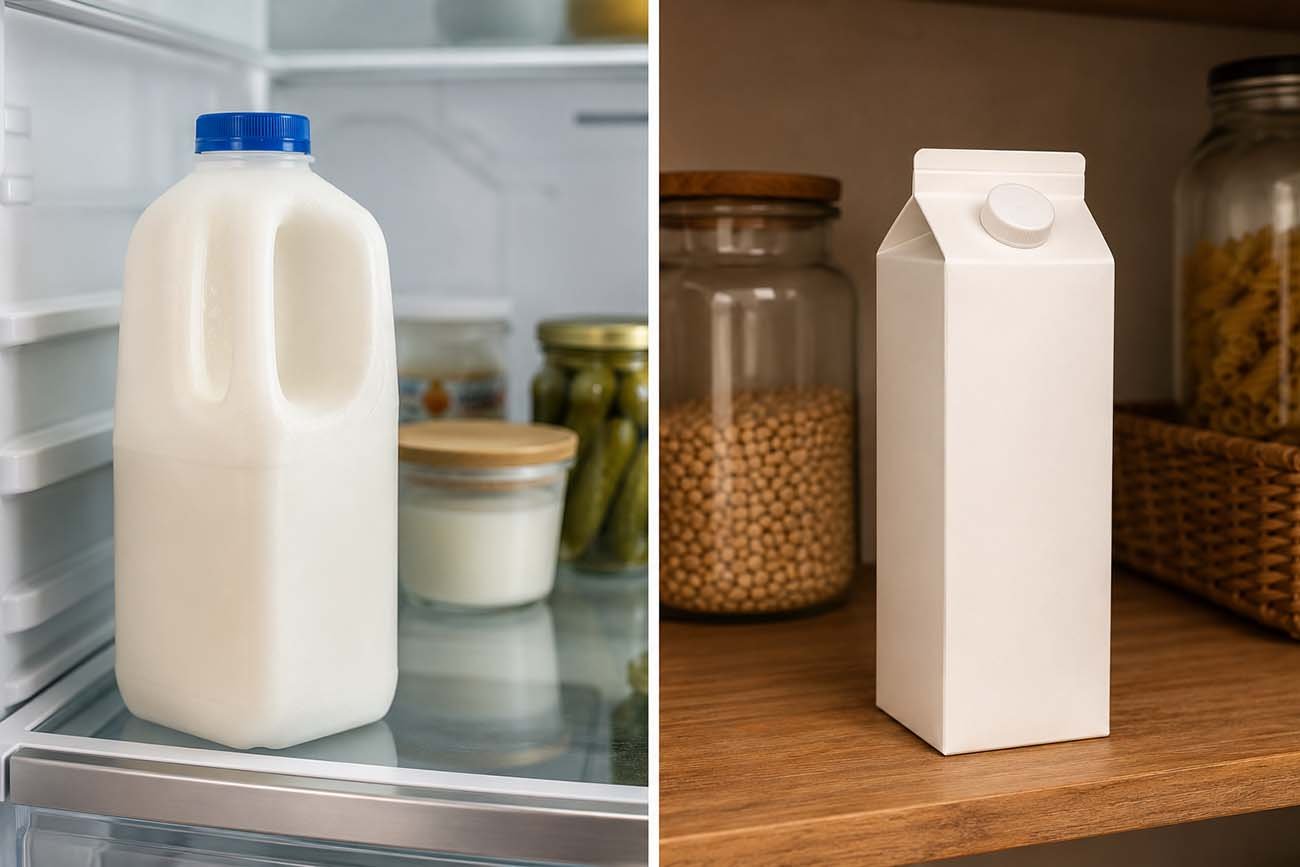
If you have ever traveled to Europe and noticed milk sitting on unrefrigerated grocery store shelves, you probably had the same confused reaction most Americans do. Is that safe? And if it is, why do we always refrigerate milk here? The answer comes down entirely to how the milk was processed, not where it is stored.
The short answer: Regular pasteurized milk (the kind sold cold in US grocery stores) must always be refrigerated and should never be left out for more than 2 hours. UHT or shelf-stable milk, the kind sold in aseptic boxes at room temperature, does not need refrigeration until it is opened. The difference is the pasteurization method. Once opened, all milk needs to be refrigerated regardless of type.
For a complete dairy storage reference, see our Food Storage Guide.
📋 Milk Refrigeration: At a Glance
- Regular pasteurized (HTST): Always refrigerate at 38 to 40°F. Never leave out more than 2 hours.
- UHT / shelf-stable, unopened: No refrigeration needed. Up to 6 months at room temperature (varies by brand).
- UHT / shelf-stable, opened: Refrigerate immediately. Use within 7 to 10 days.
- Best fridge spot: Back of a middle or bottom shelf. Never the door.
- Why Europe doesn’t refrigerate: Nearly all European milk is UHT. Nearly all US milk is HTST.
- Raw milk: Must be refrigerated and carries significantly higher risk than any pasteurized milk.
🔑 Key Takeaways
- Regular pasteurized milk sold cold in the US must be refrigerated at 38 to 40°F at all times. By law, Grade A milk must be maintained at 45°F or below per FDA regulations.
- UHT or shelf-stable milk does not require refrigeration until opened because ultra-high temperature processing eliminates all bacteria, not just pathogens.
- The vast majority of milk sold in Europe is UHT processed and requires no refrigeration until opening. Nearly all US milk is HTST processed and requires continuous refrigeration.
- Once opened, all milk including UHT must be refrigerated and used within 7 to 10 days.
- The refrigerator door is the worst place to store milk. The back of a middle or bottom shelf is the coldest, most consistent spot.
- Never leave milk out at room temperature for more than 2 hours (1 hour above 90°F) per USDA guidelines.
- Milk is sensitive to light. Light exposure causes oxidation and an off-flavor even before bacterial spoilage occurs. Keep it in its opaque carton and return it to the fridge promptly.
Why Regular Pasteurized Milk Must Be Refrigerated
The pasteurization method used for nearly all US milk is called High Temperature Short Time (HTST) pasteurization. It is very effective at killing dangerous pathogens but does not sterilize milk completely.
🔬 HTST Pasteurization: What It Does and Doesn’t Do
HTST pasteurization heats milk to 161°F (72°C) for 15 seconds, then rapidly cools it. This kills all dangerous pathogens including Salmonella, E. coli, and Listeria, making the milk safe to drink. However, some non-pathogenic bacteria survive the process. These bacteria do not cause foodborne illness, but they slowly consume the lactose and proteins in milk, producing lactic acid as a byproduct. That lactic acid is what makes milk go sour over time. Without refrigeration, these surviving bacteria multiply rapidly. In the USDA temperature danger zone of 40 to 140°F, bacteria can double approximately every 20 minutes. At room temperature, HTST pasteurized milk can spoil within hours, which is why the 2-hour rule exists. Refrigeration at 38 to 40°F slows bacterial activity dramatically and is what gives pasteurized milk its 5 to 7 day shelf life after opening.
By law in the United States, Grade A milk must be maintained at a temperature of 45°F or below throughout the distribution chain per FDA regulations. Retailers are legally required to keep it refrigerated through the point of sale. The same temperature requirements apply to other fluid dairy products: heavy cream, half and half, buttermilk, and coffee creamer all require the same continuous cold chain.
Why UHT Milk Does NOT Need Refrigeration
UHT (Ultra-High Temperature) milk is processed at a far higher temperature than HTST, and that difference is what allows it to sit on an unrefrigerated shelf for months.
🔬 UHT Pasteurization: Why It Changes Everything
UHT processing heats milk to approximately 280 to 290°F (138 to 143°C) for just 2 to 4 seconds, then immediately cools it and seals it in a sterile aseptic package. At that temperature, every microorganism is destroyed: not just pathogens, but all bacteria including the non-pathogenic spoilage bacteria that HTST leaves behind. The milk is then sealed in aseptic packaging in a sterile environment, meaning no new bacteria can enter. With no living organisms remaining and no way for new ones to get in, there is nothing to cause spoilage. UHT milk can sit at room temperature for up to 6 months unopened, though actual timelines vary by brand and packaging. Once opened and exposed to air, normal refrigerated storage rules apply immediately. Opened UHT milk must be refrigerated and used within 7 to 10 days.
Why Europeans Don’t Refrigerate Milk (and Americans Do)
This is one of the most common food questions for people traveling between the US and Europe. The answer is simple: they are using different milk.
The vast majority of milk sold in European grocery stores is UHT processed and packaged in sterile aseptic cartons, which is why it is stacked at room temperature on regular shelves. In the United States, nearly all milk sold in grocery stores is HTST pasteurized and sold cold because it cannot safely be stored at room temperature.
📋 HTST vs. UHT vs. UP: The Three Methods
- HTST (US standard): 161°F for 15 seconds. Kills pathogens. Some spoilage bacteria survive. Must be refrigerated at all times. 5 to 7 days after opening. Closest flavor to fresh milk.
- UHT (European and shelf-stable standard): 280 to 290°F for 2 to 4 seconds. Kills all bacteria. No refrigeration until opened. Up to 6 months unopened. Slight “cooked” or caramelized flavor note from high heat treatment.
- Ultra-pasteurized (UP): A middle-ground method common in US organic and specialty brands including Horizon and Organic Valley. Higher temperature than HTST but not full UHT. Sold refrigerated but with a much longer shelf life of 30 to 60 days unopened. 7 to 10 days after opening.
The US dairy industry has preferred HTST historically because it handles larger production volumes, preserves fresh milk flavor better (UHT’s very high heat slightly caramelizes milk sugars), and does not require specialized aseptic packaging.
UHT milk exists in the US as shelf-stable single-serve boxes, organic aseptic cartons, and specialty products. These follow the same rules as European UHT: no refrigeration until opened, refrigerate immediately after.
The Right and Wrong Places to Store Milk in Your Fridge
The most common milk storage mistake is keeping it in the refrigerator door. The door is the warmest and most temperature-variable location, exposed to room temperature air every time it opens. Temperature in the door can run 5 to 10 degrees warmer than the back of the main compartment. The Dairy Council of California recommends milk be stored at 34 to 38°F. Store milk at the back of a middle or bottom shelf, not the door. This matters for all refrigerated dairy: yogurt, sour cream, cream cheese, and cottage cheese all last longer stored in the back of the fridge than in the door.
How to Store Milk Properly
✅ Storage Best Practices
- Back of the fridge, not the door. Coldest and most consistent temperature.
- Keep fridge at 38 to 40°F. Storing above 45°F shortens shelf life significantly and is a food safety concern per FDA guidelines.
- Keep milk in its opaque carton. Milk is sensitive to light. Light exposure causes oxidation and an off-flavor. Never store it in a clear container on a sunny counter.
- Seal tightly after every use. Air exposure accelerates spoilage and allows milk to absorb odors from nearby foods.
- Do not drink directly from the carton. Bacteria from your mouth shortens the remaining milk’s shelf life.
- Never pour unused milk back into the carton. Cross-contamination from a poured glass accelerates spoilage.
- 2-hour rule at room temperature. Discard any milk left out longer than 2 hours. 1 hour if above 90°F.
- Add milk to your cart last at the grocery store and refrigerate immediately when you get home.
Milk in Cooking: Does Refrigeration Affect Recipes?
Properly stored cold milk performs better in most recipes than milk that has been left out. Temperature matters in baking: cold milk added to batters keeps fat structures intact, which affects rise and texture in cakes, muffins, and quick breads. Our banana bread, crustless veggie quiche, and French macarons all call for cold milk. Our clam corn chowder and spinach artichoke dip use milk in cooked applications where temperature at the point of adding matters less, but starting from properly refrigerated milk ensures freshness throughout.
If you drink milk in coffee daily, coffee creamer follows the same refrigeration rules as milk, with some shelf-stable versions available that mirror the UHT pattern.
What About Raw Milk?
Raw milk, which has not been pasteurized, must always be refrigerated and carries significantly higher food safety risk than any pasteurized milk.
⚠️ Raw Milk and Food Safety
Raw milk can contain dangerous pathogens including Salmonella, E. coli O157:H7, Campylobacter, and Listeria monocytogenes. The FDA tracked more than 1,500 illnesses linked to raw milk or raw milk cheeses between 1993 and 2006 in the US. Raw milk should be kept at 38 to 40°F, used within a few days of purchase, and never left at room temperature. The sale of raw milk is banned in many US states and restricted in others. Children, pregnant women, elderly individuals, and immunocompromised people are at significantly higher risk of serious illness from raw milk and should avoid it.
Frequently Asked Questions
Regular pasteurized milk (HTST) must always be refrigerated at 38 to 40°F and cannot safely be left at room temperature for more than 2 hours. UHT or shelf-stable milk does not need refrigeration until it is opened. Once opened, all milk must be refrigerated and used within 7 to 10 days. For the full spoilage and shelf life breakdown, see does milk go bad.
Non-pathogenic bacteria already present in pasteurized milk multiply rapidly at room temperature. In the temperature danger zone of 40 to 140°F, bacteria can double every 20 minutes. Within a few hours, bacterial levels cause rapid souring and curdling. Beyond 2 hours at room temperature, milk should be discarded even if it smells acceptable. This same principle applies to yogurt, sour cream, and ricotta.
Why do Europeans not refrigerate milk?
Because the vast majority of European milk is processed using UHT pasteurization, which heats milk to 280 to 290°F for 2 to 4 seconds and destroys all bacteria, then packages it in sterile aseptic containers. With no bacteria remaining and no way for new ones to enter, there is no spoilage and no need for refrigeration until opening. US milk is almost all HTST pasteurized, which leaves some bacteria alive and requires continuous refrigeration.
Is it safe to drink milk left out overnight?
No. Milk left out overnight should be discarded. The USDA 2-hour rule applies: perishable food left in the temperature danger zone for more than 2 hours should not be consumed. Even if the milk smells acceptable, bacterial levels may be too high to be safe, particularly for children, elderly, pregnant women, and immunocompromised individuals.
Does organic milk need to be refrigerated?
It depends on the processing. Many US organic milk brands including Horizon and Organic Valley use ultra-pasteurization (UP), giving their milk a longer refrigerated shelf life of 30 to 60 days unopened. Some are sold shelf-stable and require no refrigeration until opened. Check whether the carton was sold cold or at room temperature and follow those storage rules.
At the back of a middle or bottom shelf, not the door. The door is the warmest part of the refrigerator, with temperatures 5 to 10 degrees above the back of the main compartment. This matters for all cold dairy: cream cheese, cottage cheese, mozzarella, and cheddar all last longer in the back of the fridge.
How long can milk sit out before it goes bad?
No more than 2 hours at room temperature per USDA guidelines. If the ambient temperature is above 90°F, reduce that to 1 hour. Discard it after 2 hours even if it smells fine. Bacterial multiplication in the temperature danger zone is too rapid to risk beyond that window.
Does evaporated or condensed milk need to be refrigerated?
Unopened canned evaporated milk and condensed milk are shelf-stable and do not require refrigeration. Once opened, both must be transferred to an airtight container, refrigerated immediately, and used within 5 to 7 days for evaporated milk and within 1 to 2 weeks for condensed milk. The high sugar content in condensed milk provides additional preservation but does not eliminate the need for refrigeration after opening.
It depends on the type. Plant-based milks sold in the refrigerated section must be refrigerated and used within 7 to 10 days of opening. Plant-based milks sold in shelf-stable aseptic cartons (almost all UHT processed) do not need refrigeration until opened, then must be refrigerated and used within 7 to 10 days. Separation is normal. Shake before using. For comparison, coconut milk follows the same refrigerate-after-opening rule.
Yes. Milk can be frozen for up to 3 months. Leave room for expansion, freeze before it spoils, and thaw in the refrigerator. Texture may change after freezing as fat separates, so frozen and thawed milk is best used for cooking and baking. See does milk go bad for the full spoilage and shelf life breakdown.
Does lactose-free milk need to be refrigerated?
It depends on the processing. Lactose-free milk sold cold must be refrigerated and used within 5 to 7 days of opening. Many lactose-free milks are UHT processed and may have a longer refrigerated shelf life or be sold shelf-stable. Check the label. If sold cold, treat it like regular pasteurized milk. If sold shelf-stable, treat it like UHT.
Further Reading
Better Living may earn commissions through affiliate links and may occasionally feature sponsored or partner content. If you make a purchase through our links, we may receive a small commission at no cost to you.
