
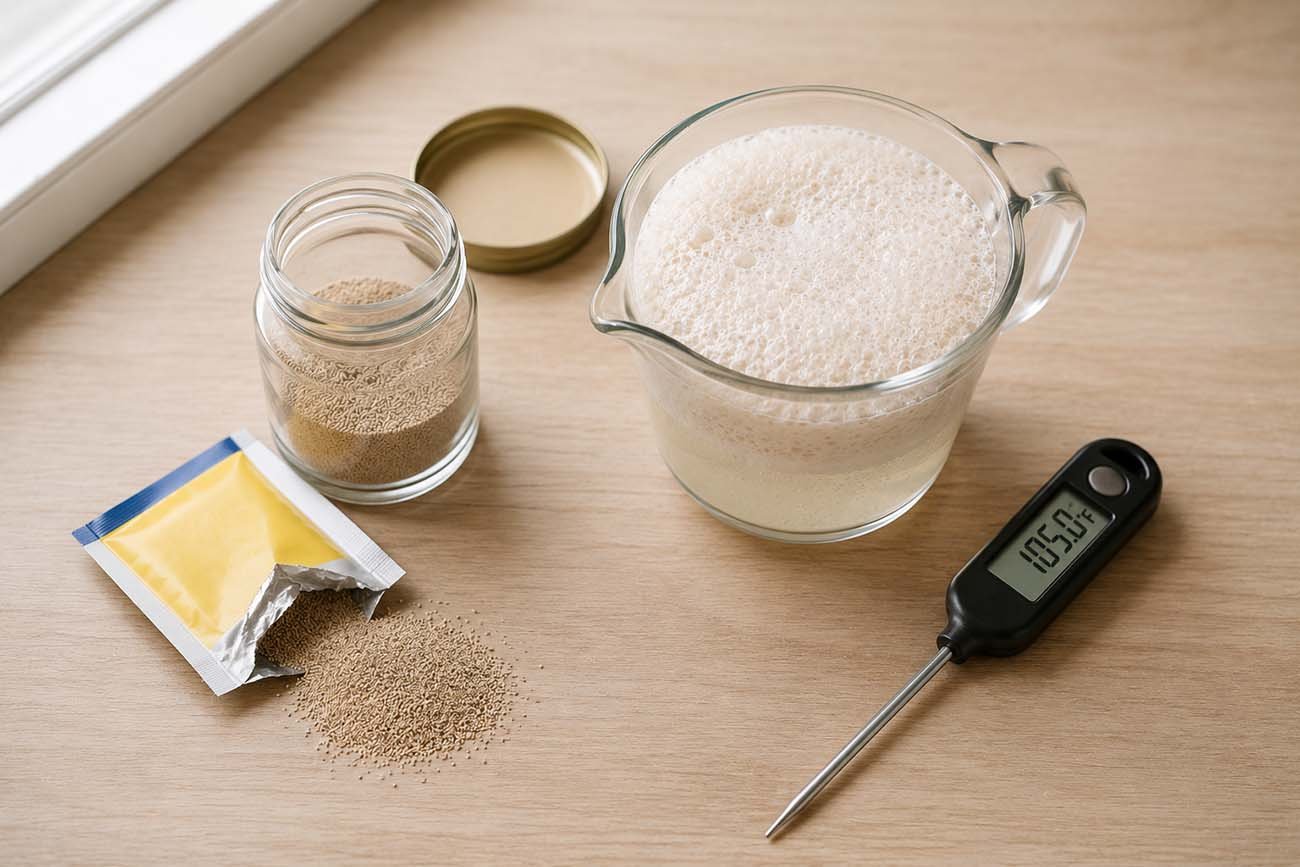
You reach for the yeast to make bread and wonder if the packet that has been sitting in the pantry for a year is still alive. Or you find an opened jar in the back of the refrigerator and have no idea how long it has been there. Does yeast go bad?
The short answer: Yes, yeast goes bad, but not in the way most foods spoil. Yeast is a living organism, and when it goes bad, the cells die. Dead yeast looks identical to active yeast but will not leaven your dough. The shelf life varies significantly by type: unopened dry yeast (active dry or instant) lasts about 2 years at room temperature per Fleischmann’s and Red Star. Opened dry yeast lasts up to 4 months in the refrigerator per Red Star. Fresh cake yeast lasts only 1 to 2 weeks refrigerated. A simple proofing test in warm water tells you definitively whether your yeast is still alive before you commit to a full recipe.
For a full overview of how baking staples compare on shelf life, visit our Complete Food Storage Guide.
📋 Yeast: At a Glance
- Active dry yeast (unopened): up to 2 years at room temperature per Fleischmann’s. Refrigerator or freezer extends this further.
- Active dry yeast (opened): up to 4 months in the refrigerator per Red Star. Freezer preferred for longer storage.
- Instant yeast (unopened): same as active dry, about 2 years. Red Star and Fleischmann’s both confirm this.
- Instant yeast (opened): up to 4 months refrigerated. Use within 2 weeks per Fleischmann’s if kept at room temperature.
- Fresh cake yeast: 1 to 2 weeks refrigerated per Fleischmann’s. Always refrigerate. Do not freeze.
- The proofing test is definitive. Warm water plus sugar plus yeast equals foam in 10 minutes if the yeast is still alive. No foam means discard.
Key Takeaways
- Yeast is a living organism. When it goes bad, the cells die. Dead yeast looks, smells, and feels identical to live yeast. Only a proofing test confirms viability.
- Dry yeast is far more shelf-stable than fresh yeast because freeze-drying puts the cells into dormancy. Fresh cake yeast is perishable and lasts only 1 to 2 weeks.
- Opened dry yeast must be refrigerated. Both Fleischmann’s and Red Star require this. Room temperature storage after opening significantly shortens viability.
- Heat, moisture, and air are the three enemies of yeast. Any of these in excess will kill yeast cells faster than the calendar will.
- Active dry yeast and instant yeast are not the same and have different proofing requirements. Instant yeast does not need to be dissolved in water first and works at higher temperatures.
- Always test yeast before committing to a recipe. A failed loaf of bread costs far more than the 10 minutes the proofing test takes.
How Long Does Yeast Last?
Yeast shelf life is more variable than almost any other baking staple because yeast is alive. Storage conditions, not just time, determine whether your yeast is still viable. A newer packet stored near the oven may be deader than an older packet kept sealed in the freezer.
| Yeast Type | Unopened (Room Temp) | Opened (Refrigerator) | Opened (Freezer) |
|---|---|---|---|
| Active dry yeast | Up to 2 years | Up to 4 months | Up to 6 months (Red Star) |
| Instant (rapid-rise) yeast | Up to 2 years | Up to 4 months | Up to 6 months |
| Fresh cake yeast | Not applicable (must refrigerate) | 1 to 2 weeks | Not recommended (Fleischmann’s) |
| Bread machine yeast | Up to 2 years | Up to 4 months | Up to 6 months |
Shelf life guidance per Fleischmann’s Yeast 101 and Red Star Yeast product guidance. Opened jar storage per Red Star: refrigerator or freezer required, freezer preferred, use within 4 months. Always proof yeast before using in any recipe regardless of the date.
Why Yeast Goes Bad: The Biology
Yeast Is a Living Organism
Baking yeast (Saccharomyces cerevisiae) is a single-celled fungus. When it is active and healthy, it feeds on sugars and produces carbon dioxide and alcohol through fermentation. That carbon dioxide is what inflates the gluten network in your dough and makes bread rise.
Dry yeast, both active dry and instant, is dehydrated to put the cells into a dormant state. In dormancy, the yeast is alive but metabolically inactive. It can stay that way for months or years if kept cool, dry, and sealed. The moment it contacts warm water and sugar, the surviving cells rehydrate, wake up, and begin feeding and producing CO2 again.
Active dry yeast is dried to a moisture content of around 8%, which kills roughly a quarter of the yeast cells in the process. Those dead cells form a protective coating around the surviving living cells, which is why active dry yeast has larger granules and requires pre-dissolving in water. The proofing step both rehydrates the cells and washes away the dead coating. Instant yeast is dried to an even lower moisture content and milled into finer granules, which is why it can be added directly to dry ingredients without the pre-dissolving step.
Over time, even dormant yeast cells die off. Heat accelerates cell death by denaturing the proteins the cells depend on. Moisture triggers premature fermentation, burning through the cells’ food supply in the package rather than in your dough. Air introduces oxygen and humidity that further deplete viability.
What dead yeast looks like: identical to live yeast. Dry yeast granules do not change color, texture, or smell when the cells die. This is why the proofing test is not optional for old or questionable yeast. There is no visual shortcut.
Fresh cake yeast is not dried. It is alive in its fully active state, with all its moisture intact. This is why it is so perishable: without the protection of desiccation, the cells have no dormancy buffer against time or warmth.
How to Test If Yeast Is Still Good: The Proofing Test
The Proofing Test (Active Dry Yeast)
This is the standard test recommended by both Fleischmann’s and Red Star before using any dry yeast you are uncertain about.
What you need: 1/4 cup warm water (100 to 110°F), 1 teaspoon granulated sugar, 2 1/4 teaspoons (one standard packet) of active dry yeast, a liquid measuring cup.
Temperature matters: Water that is too cold (below 100°F) will not activate the yeast. Water that is too hot (above 115°F) will kill it. If you do not have a thermometer, the water should feel warm on your wrist but not hot, similar to comfortable bathwater.
What to do: Dissolve the sugar in the warm water, then stir in the yeast. Wait 10 minutes without stirring.
What to look for: Active yeast produces a thick, foamy layer on top and the mixture rises noticeably in the cup. Red Star recommends looking for the mixture to rise toward the one-cup mark. If you see vigorous foam and volume increase, the yeast is alive and ready to use.
What weak or no foam means: If the mixture stays flat or produces only a thin surface film, the yeast has lost viability. Do not use it in a recipe. Replace the yeast.
For instant yeast: Instant yeast is finely granulated and formulated to be added directly to dry ingredients without pre-dissolving. According to Fleischmann’s, it activates at a higher temperature range (120 to 130°F). You can still test it by proofing in warm water as above, but it will dissolve faster and may foam more quickly than active dry yeast.
A note on tap water: Heavily chlorinated municipal tap water can inhibit or slow yeast activity. If you live in an area with highly chlorinated water and your yeast consistently underperforms despite correct temperature and fresh stock, try filtered or bottled water for proofing. This is a known issue among sourdough bakers and applies to commercial yeast proofing as well.
Subtract the test water from your recipe: If you run the proof test and the yeast passes, use that proofing liquid (water plus yeast plus sugar) as part of the liquid called for in your recipe. No wasted yeast.
Signs That Yeast Has Gone Bad
What to Check Before You Bake
The proofing test fails: This is the only reliable indicator for dry yeast. No other visual or smell test is dependable. If the yeast does not foam vigorously in warm sugar water within 10 minutes, it is dead. Discard it.
Clumping in the jar: Dry yeast granules should be loose and free-flowing. Hard clumps or a solid mass at the bottom of the jar indicate moisture exposure. The yeast cells have likely already fermented prematurely and died. Test it before using if clumps are present; discard if the proof test fails.
Strong off smell from fresh cake yeast: Fresh yeast has a pleasant, mild yeasty smell. A sour, alcoholic, or otherwise sharp off odor from fresh cake yeast is a sign it has begun to ferment and degrade. Fresh yeast that smells wrong should be discarded without testing.
Discoloration in fresh cake yeast: Fresh cake yeast should be a uniform pale gray or cream color. Any pink, brown, or yellow discoloration indicates spoilage. Discard.
Dough that will not rise: If you use yeast without testing and the dough sits for its full rise time without significant expansion, dead or weak yeast is the most likely cause. Other causes include water that was too hot during mixing (which kills yeast cells on contact), too much salt added directly to the yeast before the flour was incorporated, or dough that is too cold. But yeast viability is the first thing to check.
Note on safety: Dead yeast or degraded yeast is not dangerous to consume. It simply will not leaven your bread. There is no food safety risk from using spent yeast, only the disappointment of a flat loaf.
Active Dry vs. Instant vs. Fresh Yeast: Key Differences
Which Type Are You Working With?
Active dry yeast is the most common variety for home bakers. It consists of larger granules that must be dissolved in warm liquid (100 to 110°F) before adding to dry ingredients per Fleischmann’s. Active dry yeast provides a moderate, steady rise and is well suited to most bread recipes. It requires proofing in liquid before use.
Instant yeast (also called rapid-rise, quick-rise, or bread machine yeast) is more finely ground and can be added directly to dry ingredients without pre-dissolving, per Fleischmann’s. Instant yeast activates at a higher temperature range (120 to 130°F) and generally produces a faster first rise. Fleischmann’s RapidRise and Red Star Quick-Rise are common examples. It’s interchangeable with active dry yeast in most recipes, though the rise time may be shorter.
Fresh cake yeast (also called compressed yeast) is fully active, undried yeast sold in foil-wrapped cakes. It must be refrigerated from the moment of purchase and used within 1 to 2 weeks. It’s highly perishable compared to dry varieties and Fleischmann’s explicitly warns against freezing it. Fresh cake yeast can be crumbled directly into dry ingredients or softened in warm water. One small 0.6-ounce cake equals one standard packet (2 1/4 teaspoons) of dry yeast per Fleischmann’s.
The bottom line on shelf life: active dry and instant yeast behave identically in storage. Fresh cake yeast is in a completely different category and should be treated like a perishable dairy product.
How to Store Yeast to Maximize Shelf Life
Storage Best Practices by Yeast Type
Unopened dry yeast packets or jars: Store in a cool, dry place away from heat. Most manufacturers allow room temperature storage for unopened packages. A pantry shelf away from the stove or oven is fine. Do not store above the oven or dishwasher. Refrigerator or freezer storage for unopened packages extends shelf life beyond the 2-year window.
Opened dry yeast (jar or bulk package): Refrigerator or freezer storage is required after opening per both Fleischmann’s and Red Star. Red Star recommends the freezer as the preferred option for opened jars. Transfer to an airtight container before refrigerating or freezing. Label with the opening date. Use within 4 months refrigerated.
Before using refrigerated or frozen dry yeast: Bring to room temperature for 20 to 30 minutes before using, per Red Star. Cold yeast added directly to dough can slow fermentation and affect rise time. Take out only the amount you need and return the container to the refrigerator or freezer immediately.
Fresh cake yeast: Always store in the refrigerator from purchase. Use within 1 to 2 weeks. Do not freeze, per Fleischmann’s guidance. Fresh cake yeast should be slightly moist and crumble easily. If it is dry, crumbly, or off-colored, it has degraded.
Airtight container is essential for bulk yeast: Red Star nitrogen-flushes their jars at packaging to remove oxygen. Once opened, that protection is gone. An airtight container with a proper seal, not just a zip-close bag, is the correct storage vessel for any opened yeast. Minimizing headroom in the container reduces the amount of air in contact with the yeast.
Do not store with oxygen absorbers: Do not use oxygen absorbers with yeast for the same reason as with baking soda and sugar: yeast requires trace oxygen for dormancy and reactivation. Removing all oxygen can damage cell viability.
Label every container. Opened yeast granules are visually indistinguishable from each other. Label with the type, the brand, and the date opened. This is essential for anyone baking with multiple yeast varieties.
Yeast Substitution: Active Dry vs. Instant
Active dry yeast and instant yeast can be substituted 1:1 in most recipes per Fleischmann’s and Red Star, with one adjustment: active dry yeast needs to be dissolved in warm water before adding to dry ingredients. Instant yeast can be mixed directly into the flour. If substituting active dry for instant, expect the dough may take slightly longer to rise. If substituting instant for active dry, the first rise may be faster.
Fresh cake yeast substitution: one small 0.6-ounce cake of fresh yeast equals one standard packet (2 1/4 teaspoons) of dry yeast per Fleischmann’s.
Baking Staples and Recipes
Yeast is most often used in yeasted breads, pizza dough, rolls, and enriched doughs. While the site’s recipe collection skews toward quick breads and no-yeast baking, understanding how yeast works alongside the other staples in your pantry makes you a better baker across all of them.
- Banana Bread: uses baking powder and baking soda rather than yeast, a good reference for how chemical leaveners differ from biological ones
- Pumpkin Spice Bread: another quick bread that relies on baking powder, useful contrast when deciding which leavener a recipe needs
- Pumpkin Pecan Muffins: baking powder-leavened, showing how muffin texture differs from yeasted rolls
- French Macarons: no leavener at all, relying entirely on whipped egg whites, a useful reference for how different leavening mechanisms produce different textures
- Gluten-Free Bread Pudding: a practical use for bread that did not rise properly due to spent yeast
- Easy Homemade Sauerkraut: a good companion post for understanding wild fermentation, which relies on naturally occurring yeast and bacteria rather than commercial yeast
- Health Benefits of Sauerkraut: more on fermentation and how yeast plays a role in fermented foods beyond bread
Frequently Asked Questions
How do I know if my yeast is still good?
Proof it. Dissolve 1 teaspoon of sugar in 1/4 cup of warm water (100 to 110°F), stir in 2 1/4 teaspoons of dry yeast, and wait 10 minutes without stirring. Active yeast produces a thick, foamy layer and the liquid rises noticeably in the cup. If it stays flat or produces only a thin surface film, the yeast is dead. No visual inspection of the dry granules can substitute for this test, because dead yeast looks identical to live yeast.
Can I use yeast past its expiration date?
Yes, if it passes the proofing test. The best-by date on dry yeast reflects peak quality under ideal storage conditions. Yeast stored in a cool, dry, airtight container in the refrigerator or freezer often remains viable well past its printed date. Yeast stored at room temperature near a heat source may fail before its date. The proofing test is the only reliable way to know. Test before you use, and trust the foam, not the date.
What kills yeast?
Heat is the most common cause of yeast death in baking. Water above approximately 115°F kills yeast cells on contact. This is why temperature control during proofing and mixing matters. Outside of baking, prolonged exposure to warm pantry temperatures gradually kills dormant cells over months. Moisture triggers premature fermentation, burning through the cells’ viability. Air introduces humidity and oxygen that accelerate degradation. Salt added directly to yeast before flour is mixed in can also draw out moisture and damage cells, which is why most recipes call for adding salt to the flour before combining with the yeast mixture.
What is the difference between active dry yeast and instant yeast?
Active dry yeast has larger granules and must be dissolved in warm liquid (100 to 110°F) before adding to dry ingredients. Instant yeast (also called rapid-rise or quick-rise) is more finely milled and can be mixed directly into dry ingredients without pre-dissolving per Fleischmann’s, and activates at a higher temperature range (120 to 130°F). Instant yeast generally produces a faster first rise. They can be substituted 1:1 in most recipes with minor adjustments to technique and rise time.
Does yeast need to be refrigerated?
Unopened dry yeast does not need refrigeration and can be stored at room temperature in a cool, dry pantry until the best-by date per Fleischmann’s. Once opened, refrigeration is required per both Fleischmann’s and Red Star. Fresh cake yeast must always be refrigerated from the moment of purchase and used within 1 to 2 weeks. For opened dry yeast, Red Star recommends the freezer as the preferred storage location, with use within 4 months.
Can you freeze yeast?
Yes, for dry yeast. Red Star recommends the freezer as the preferred storage location for opened dry yeast, with a use window of up to 6 months. Transfer to an airtight container before freezing and label with the date. Bring to room temperature for 20 to 30 minutes before using. Do not freeze fresh cake yeast. Fleischmann’s explicitly advises against freezing fresh yeast, as the moisture in undried yeast causes ice crystal damage to the cells.
How long does fresh yeast last?
Fresh cake yeast lasts 1 to 2 weeks in the refrigerator per Fleischmann’s. It is highly perishable and should be treated like a fresh dairy product: always refrigerated, never frozen, and used promptly. Signs of spoiled fresh yeast include discoloration (pink, brown, or yellow instead of pale gray-cream), a sour or sharp off smell, and a dry, crumbly texture that does not soften easily in warm water. If fresh cake yeast smells or looks wrong, discard it.
Why did my yeast not foam?
Four things cause yeast not to foam during proofing: the yeast is dead or significantly depleted; the water was too hot (above 115°F) and killed the cells; the water was too cold (below 100°F) and the cells did not activate; or there was not enough sugar to give the yeast something to feed on. If the water temperature was correct and sugar was present and the yeast still did not foam, it is dead. Replace it. If temperature or sugar may have been the issue, try again with fresh warm water at the correct temperature before writing off the yeast entirely.
Can dead yeast make you sick?
No. Dead yeast is not dangerous to consume. It will not make you sick. The only consequence of using dead yeast is that your dough will not rise, resulting in a dense, flat loaf. The yeast cells themselves are non-toxic whether alive or dead. Spent yeast is sometimes used as a nutritional supplement (nutritional yeast is a deactivated form of Saccharomyces cerevisiae) which illustrates that the cells themselves are safe regardless of their activity level.
How much yeast is in a packet?
One standard packet of dry yeast contains 2 1/4 teaspoons (7 grams) of yeast per Fleischmann’s. This is equivalent to one small 0.6-ounce cake of fresh yeast. One large 2-ounce cake of fresh yeast equals three standard dry yeast packets. Most bread recipes in American cookbooks are written around one standard packet as the baseline unit.
What is the ideal water temperature for yeast?
For active dry yeast, Fleischmann’s and Red Star both specify 100 to 110°F as the ideal temperature range for dissolving and proofing. For instant (rapid-rise) yeast added to dry ingredients, Fleischmann’s specifies 120 to 130°F for the liquid added to the flour mixture. Water above 115°F will begin to kill active dry yeast cells. Water below 95°F may be too cool to activate them reliably. A kitchen thermometer is the most reliable way to hit the right range; without one, the water should feel comfortably warm on the inside of your wrist, not hot.
Does chlorine in tap water kill yeast?
Yes, heavily chlorinated tap water can inhibit or kill yeast. Chlorine is added to municipal water supplies to kill microorganisms, and yeast cells are not exempt from that effect. In small amounts the impact is usually minor, but in highly chlorinated water it can slow proofing significantly or prevent it entirely. If your yeast proofing tests keep failing despite correct temperature and fresh stock, try filtered or bottled water. Letting tap water sit uncovered for 30 minutes before using it can also allow some chlorine to off-gas, reducing the effect.
What does bad yeast smell like?
Dead dry yeast has no distinguishable smell difference from active dry yeast. The granules look, feel, and smell identical whether the cells are alive or dead, which is precisely why a proofing test is necessary. Fresh cake yeast is different: it has a mild, pleasant yeasty aroma when fresh, and a sour, sharp, or distinctly off smell when it has spoiled. For dry yeast, smell is not a useful indicator of viability. Only the proofing foam test tells you the truth.
Can you revive dead yeast?
No. Dead yeast cells cannot be revived. Once the cells have died, no amount of warmer water, more sugar, or longer waiting time will restore their activity. If the proofing test fails, replace the yeast. However, if you have already mixed dough using dead yeast and it is sitting flat, you can sometimes rescue it by making a small batch of active yeast proofed in warm water and incorporating it into the existing dough. Fleischmann’s provides instructions for this on their FAQ page: combine the new yeast with a small amount of warm water and sugar, then slowly beat in small pieces of the dough until about half is incorporated before adding the rest.
What happens if you use too much yeast?
Using too much yeast causes the dough to rise too quickly, which prevents the gluten network from developing properly and produces bread with a coarser crumb, weaker structure, and a pronounced yeasty or alcoholic flavor. Over-risen dough can collapse in the oven. The dough may also exhaust its food supply before baking is complete, leaving a flat or dense final loaf. More yeast is not better for flavor or texture: standard recipes are calibrated to the packet amount for a reason, and the proofing test is a much better solution than adding extra yeast to compensate for suspected weakness.
Why does active dry yeast sometimes die before its expiration date?
Active dry yeast is more susceptible to early failure than instant yeast because of how it is processed. The drying process that produces active dry yeast kills roughly a quarter of the cells, leaving the surviving cells coated with a layer of dead cell material. This coating makes the granules less stable in adverse conditions. Heat exposure during shipping or pantry storage, moisture from humidity or a poorly sealed container, or simply age accelerates cell death in the remaining live cells. The expiration date assumes ideal storage conditions. If yeast has spent time in a warm pantry, near a heat source, or in a loosely sealed container, it can fail well before the printed date. Always test, regardless of the date.
Further Reading
Better Living may earn commissions through affiliate links and may occasionally feature sponsored or partner content. If you make a purchase through our links, we may receive a small commission at no cost to you.
