
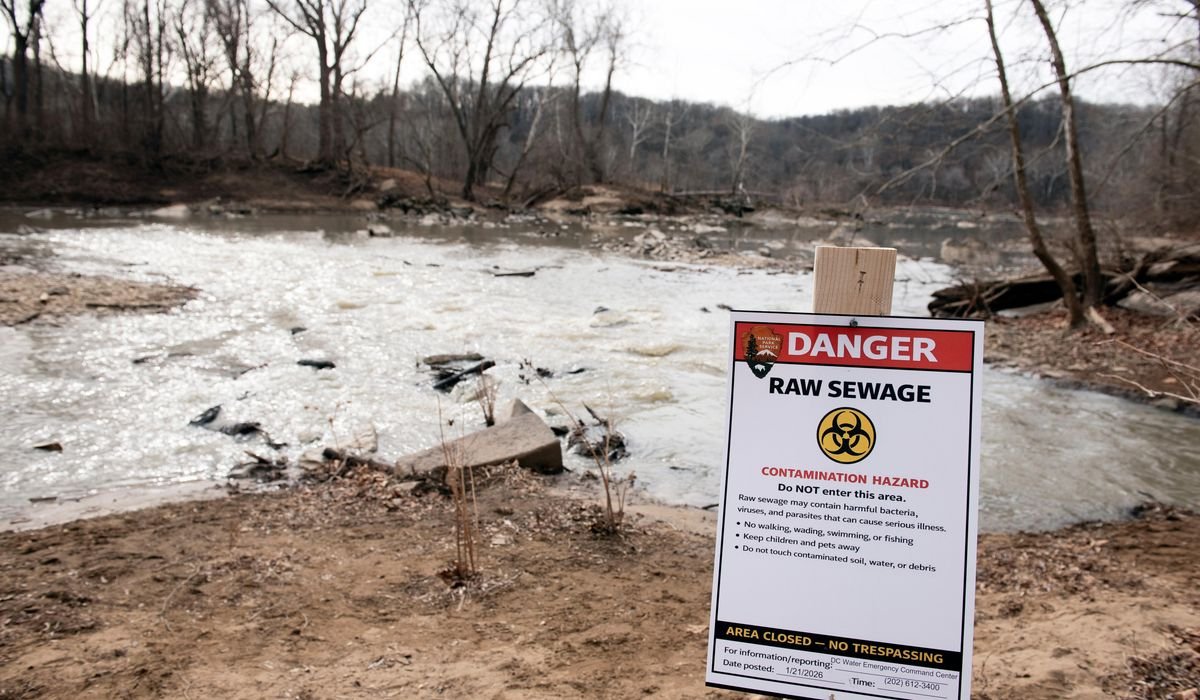
The Department of Justice and the state of Maryland have filed lawsuits against the District and its water/sewage utility over a January pipe rupture that caused a historic sewage spill and contaminated the Potomac River.
Maryland’s lawsuit, filed Monday by state Attorney General Anthony Brown, says DC Water was negligent in repairing the Potomac Interceptor pipe that “showed signs of corrosion yet failed to properly assess the risks and delayed initiating capital improvements.”
The Justice Department’s complaint, also filed Monday, says DC Water violated the Clean Water Act when the 60-year-old sewer line cracked open and allowed disease-carrying bacteria to flow into the river, a key source of the region’s drinking water.
“DC Water’s failure to maintain the Potomac Interceptor resulted in raw sewage flowing into the Potomac River and surrounding environment, posing a direct threat to public health,” said Adam Gustafson, the principal deputy assistant attorney general for the DOJ’s Environment and Natural Resources Division.
“As cities grow and infrastructure ages, cities must invest in their wastewater system to prevent such catastrophes. This complaint seeks to secure DC Water’s commitment to properly maintain its foundational sewage infrastructure.”
The January rupture created an ecological disaster that shut down recreational activities on the Potomac for two months and forced a massive cleanup of the river.
Several tests found volatile levels of E. Coli and bacteria associated with MRSA and Staph infections in the water, particularly near the rupture site in Montgomery County.
The pipe break also ignited a political brouhaha about who was responsible for the fiasco, with President Trump pointing the finger at the D.C. area’s Democrat-heavy leadership.
About 250 million gallons of raw sewage entered the river during the initial pipe break. The Potomac was recently named the nation’s most endangered river, in large part because of the sewage spill — which is thought to be one of the largest in U.S. history.
The state of Maryland is seeking $10,000 in damages for each cleanup day on the river. DC Water said that process lasted 55 days, so it could owe more than $500,000 to the state.
Mr. Brown’s office accused DC Water of running afoul of state water pollution laws by allowing the wastewater discharges to happen in the first place.
“The Potomac River belongs to the people of Maryland, and we expect it to be fully restored to health,” Maryland Department of the Environment Secretary Serena McIlwain said in a statement about the lawsuit. “The utility must take full responsibility for the damage caused and take immediate and lasting action to prevent future spills. The river is part of our identity, our economy, and our way of life.”
Last month, DC Water CEO David Gadis testified to the D.C. Council that a 2024 review of the Potomac Interceptor determined the doomed section of the pipeline was not at a high risk of collapsing.
The utility company reportedly had plans to replace the decades-old sewer line in 2019, but procedural delays kept pushing the project timeline back. DC Water said it will replace the troubled section of the pipeline by the end of this year.
DC Water responded to the lawsuits by noting that the National Park Service has not supported its expedited pipe repairs on federal land due to the agency’s environmental review process.
“DC Water will renew its requests for streamlined environmental reviews to allow rehabilitation of the interceptor to move forward more quickly,” the statement read. “DC Water previously requested a categorical exclusion for this section of the pipe previously, but it was not approved.”
