
He grew up under the name Guarocuya. This Taíno Indigenous man, born in 1498 in Santo Domingo, married Mencía, the daughter of the Spaniard Hernando de Guevara, and together they became one of the first examples of mixed-race marriage on the continent. This highly intelligent young man converted to Catholicism and was baptized as Enrique Bejo (“Enriquillo”), but he never stopped denouncing the abuses committed by his “master,” exhausting all available legal channels.
His critical thinking landed him in prison. Upon his release, he retreated to the Bahoruco Mountains and organized armed resistance until a peace agreement was reached with Charles I of Spain. This was the first rebel army in the Caribbean, and Enriquillo was the region’s first guerrilla leader. Five centuries after a life that went largely unnoticed, a group of archaeologists is searching for his remains in order to give him the place he deserves in the history of the Dominican Republic and Spain.
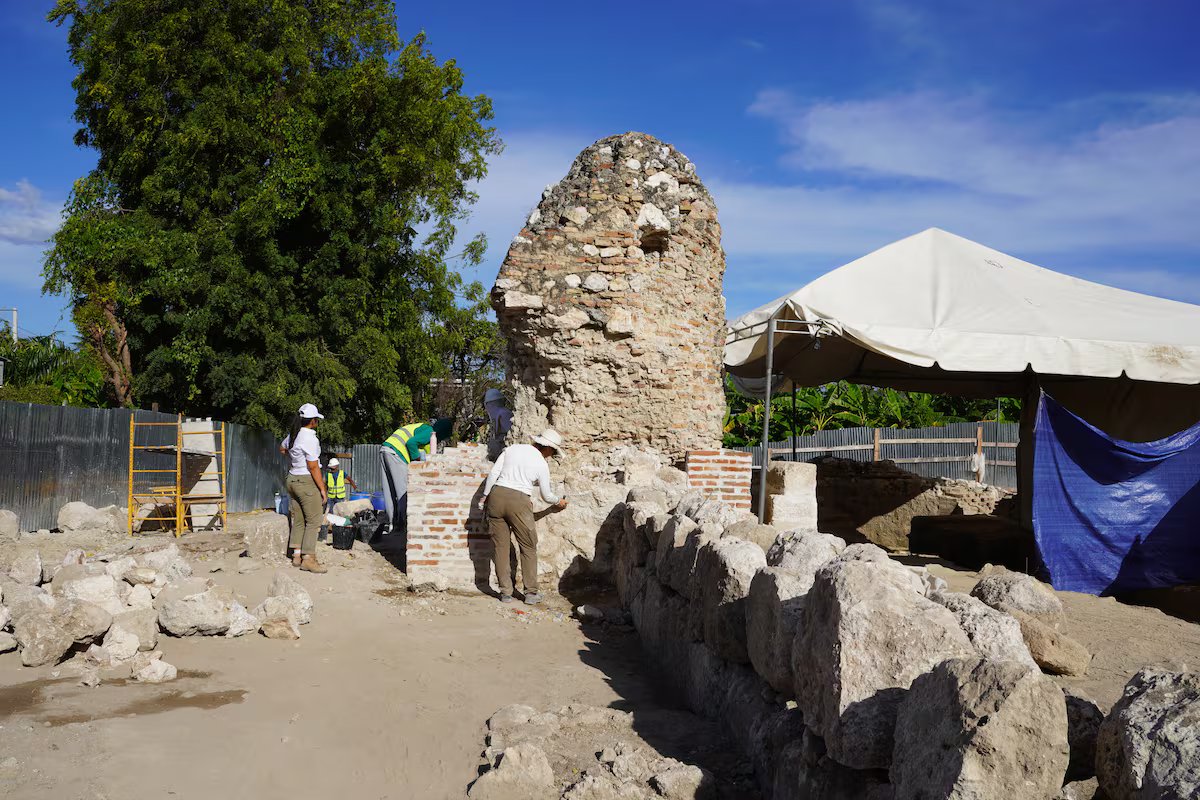
The trail of Enriquillo’s remains was lost centuries ago, although according to historical accounts, he requested to be buried in the church of Las Mercedes, in the town of Azua (in the southwest of the country). The church was largely destroyed by an earthquake in the 18th century. Blocks of the walls and roof collapsed, and the rubble was left practically abandoned.
In 2021, Israeli scientists conducted a radar survey of the ruins of this church and found three points where skeletal remains could be located. Based on these indications, a group of international archaeologists (from Spain, the Dominican Republic, and Egypt) began initial excavations in February, where they found remains of the original pavement, bricks with the inscription “Judería” (the Jewish quarter), and the crown jewel: 35 complete skeletons and another 50 that had been disturbed by recent burials.
Among the skeletal remains found, one in particular caught the researchers’ attention, as the bones lay alongside a necklace of beads, emblematic of the Taíno Indigenous community. The collected evidence is now in the United States and Spain, where DNA tests are being conducted to scientifically verify the researchers’ suspicion: that they have found Enriquillo’s remains.
The DNA test results are expected in six months. Antonio Guio, a Spanish archaeologist, explains that this timeframe is “normal” for this type of testing (which will be compared against established “racial” standards). “Archaeology is a very patient endeavor. This work is like leafing through a book that reveals information as you peel back layers of earth.”
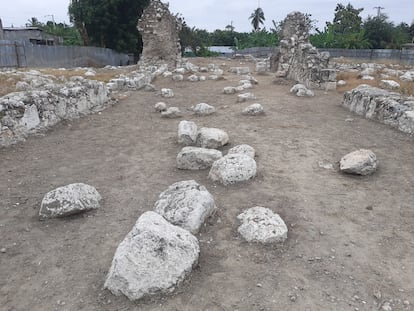
According to Guio, another piece of evidence supporting the hypothesis is the location where the remains were found. “He wasn’t in the center of the church, where the most noble figures are usually buried, but rather in an annex to the temple. This indicates his second-class status because he was a converted Indigenous person,” says Guio.
Kathleen Martínez, the Dominican archaeologist in charge, adds: “We know that cacique [Indigenous leader] Enriquillo suffered from several illnesses, and perhaps with modern technology, if we are indeed in the presence of the cacique‘s remains, we can reconstruct his story.”
“For the dignity of the Taíno people”
Martínez, the Dominican archaeologist who has spent 20 years searching for Cleopatra’s tomb, led this project from its beginnings through the 30 days of excavation. Together, the team meticulously examined a site of great historical value and managed to excavate one sixth of it.
“This is only the first stage,” Martínez explains. “It is the first step of many. Enriquillo deserves, for his struggle for freedom and dignity, to be known and honored by our people — and I believe by the entire Caribbean and all of Latin America — because he was a great fighter for freedom and for the dignity of his people.”
For both Martínez and Guio, confirming that Enriquillo’s remains have been found would provide the opportunity to restore a cultural and historical heritage forgotten by Dominican institutions, such as the Church of Las Mercedes. “We want to turn it into a museum open to the public. Ultimately, it’s a link between our two peoples. A little piece of Spain in the Dominican Republic.”
Sign up for our weekly newsletter to get more English-language news coverage from EL PAÍS USA Edition
