
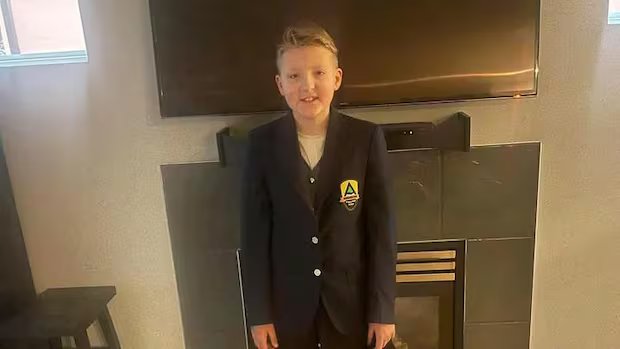
An Edmonton judge has found a dog owner guilty of criminal negligence causing death after a dog attack two years ago killed an 11-year-old boy.
Kache Grist was killed on April 1, 2024, at the south Edmonton home of Crystal Jean MacDonald, 46, after her two Cane Corsos attacked him.
Following the death, an autopsy found Kache died from a dog bite injury to the neck. The autopsy also documented injuries to his upper back, shoulders and arms.
Justice Eric Macklin said the Crown needed to prove three elements beyond a reasonable doubt for this offence: that the accused failed to take the reasonable steps to ensure Kache would not be harmed, that her conduct showed a wanton or reckless disregard for Kache’s safety, and that her conduct resulted in the death.
Macklin found that the Crown was able to prove all three elements.
At one point during the hearing, the defence stood up to request a break because MacDonald was suffering a medical episode. After a brief break, the hearing resumed.
Macklin said he did not believe MacDonald’s testimony that she left the dogs kennelled before leaving the home on April 1.
“I found the accused to be evasive. … She was cavalier in suggesting she could rely on others to follow her rules,” Macklin said.
Two years after a pair of Cane Corsos killed an 11-year-old boy in south Edmonton, the criminal trial for their owner is wrapping up. As Jesmeen Gill reports, court heard several examples of the dogs’ violent past.
He said MacDonald took steps to ensure her goddaughter would no longer visit the home, but did not do the same for Grist. He added that she could have prohibited Kache from staying at the home, noting that “she had that choice.”
Macklin added that he believes MacDonald could have taken reasonable precautions, such as using leashes and chains that could be tethered to the yard.
Macklin noted that trusted handlers were present during the dogs’ prior attacks but could not prevent them.
He said MacDonald acknowledged during her testimony that she knew the two dogs posed a significant risk.
Kache’s father, Wesley Grist, lived in MacDonald’s home. Kache, who lived in Osoyoos, B.C., was visiting his father at the time of the attack.
Macklin said Wesley, who was working in the garage at the time of the attack, bore no responsibility for what happened.
Macklin said he was satisfied that the most significant causes of Kache’s death were the failure of MacDonald to take steps to ensure his safety, and the continued presence of the dogs in the house.
After the hearing, Crown prosecutor Anders Quist said MacDonald “could have — should have — put the dogs down, boarded them somewhere else, made sure that Kache wasn’t boarding with her or taken other physical steps in the house.”
“MacDonald didn’t change the physical circumstances of the house at all, but simply just told people to follow her directions in a more stringent manner when there was clear evidence that people weren’t following her directions,” Quist said.
“And even if her directions had been followed, they wouldn’t have been enough.”
MacDonald’s lawyer, Evan McIntyre, said his client “was put in a very difficult position when … [Kache’s] father showed up with him, and took steps that … [she] reasonably believed would protect the child the week that he was staying there.”
“We’re disappointed it wasn’t seen that way by the court. We don’t believe that Kache’s death was Ms. MacDonald’s responsibility.”
A sentencing hearing is expected to take place on Sept. 2. McIntyre said he and his client are “strongly considering” filing an appeal.
Closing arguments
During closing arguments on Tuesday, Quist argued MacDonald knew her dogs were prone to attacking suddenly and without warning because of several prior violent incidents.
Throughout the trial, the Crown called a series of witnesses who described the dogs’ history of aggression and their own interactions with them.
This included a former basement tenant who was attacked and had his cat killed, a woman who was attacked in the backyard while MacDonald was away, and a man whose 10-pound Pomeranian was killed.
The Crown argued the dogs were attacking with increasing frequency and that MacDonald failed to properly inform Kache or his father about the seriousness of the prior incidents.
Quist argued MacDonald understood the severity of the attacks and knew Wesley would leave the dogs out of their kennels contrary to her instructions.
Court heard on the day of the attack, Wesley was working in the garage when Kache was inside playing video games. It was almost 45 minutes later when Wesley discovered his son lying on the kitchen floor with the dogs circling him.
Quist also argued that during previous attacks, other adults were present but were unable to stop the dogs. Most crucially, he said, MacDonald knew the dogs were capable of killing an 11-year-old boy.
The defence called MacDonald as its only witness. Quist argued the judge should place limited weight on her testimony because it was contradicted by other witnesses and evidence.
He said there were times when she was evasive, did not directly answer questions and instead appeared to take questions personally.
In closing submissions, McIntyre argued the Crown failed to prove beyond a reasonable doubt that MacDonald’s actions amounted to criminal negligence.
McIntyre argued MacDonald recognized the risks posed by the dogs and that she took steps she believed would keep Kache safe, including implementing rules requiring the dogs to be kennelled unless supervised by trusted handlers and prohibiting the child from being left alone with them.
He argued that had those rules been followed, the outcome might have been different and that the failure of those rules did not justify finding her criminally liable.
During MacDonald’s testimony, she said she told Wesley not to bring Kache over for his spring break, until she was able to get the dogs trained.
The defence also argued there was no expert evidence presented linking the dogs’ behaviour to alleged mistreatment or inadequate care, and said witnesses could only testify to their observations of the animals’ conduct.
McIntyre further argued several prior incidents involving the dogs occurred after specific triggers or failures by others to follow instructions around the animals.
The defence maintained MacDonald loved Kache “like a nephew” and wanted to keep him safe but that the precautions she implemented ultimately failed.
The court heard MacDonald is currently unemployed and living in British Columbia, where she grew up and returned to about a year ago.
