
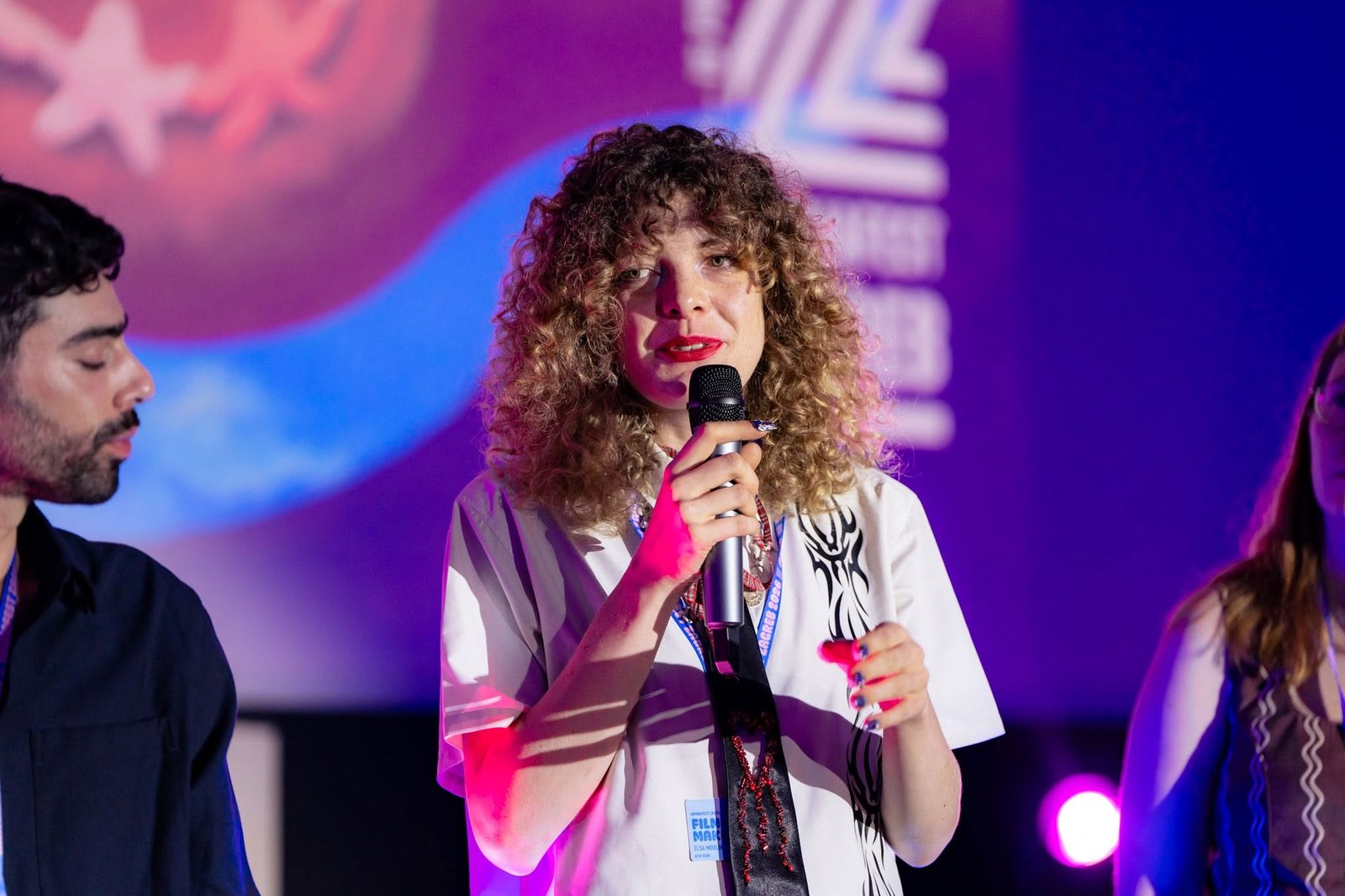
– The French animator tells us about her graduation work at the École des Métiers du Cinéma d’Animation in Angoulême
(© Animafest Zagreb)
Each year, Animafest, the World Festival of Animated Film in Zagreb, includes the Student Film Competition, dedicated to showcasing the work of emerging animators. Here is where French director Elsa Moulin presented Acid Echo, an intimate and experimental short drawn from her personal memories. Within the context of a rave, the film depicts the inner journey of Aimée, a young woman, as she confronts the trauma of sexual assault. The portrayal of Aimée’s introspection is accompanied by the use of various kinds of animation techniques, blurring the lines between reality and illusion.
GoCritic!: You used various animation techniques, including 3D computer animation, charcoal, watercolour and rotoscoping. What brought you to that approach?
Elsa Moulin: When I wrote the story, I wasn’t thinking about technique. But once I realized the film needed crowd scenes and floating camera shots, I knew I had to learn 3D. I come from 2D animation, but for this film, it wasn’t enough. I was also drawn to the strange effect you get from scanning real environments. So I travelled to Grenoble, a French city with brutalist architecture that felt right for the film. I would scan small fragments of buildings and bring them together in Blender, reconstructing them into much larger scenes and spaces. From there, I used traditional techniques, charcoal and watercolour, and layered them on top. I used charcoal for the moments when the character is reliving her trauma or when something takes her over and she loses control. Watercolour came last, representing the dissociation of the body.
Are you more comfortable with one specific technique?
Each technique feels very different to work with. I love all of them, but animation can sometimes feel tedious because you are making so many drawings that it ends up becoming repetitive. Working across different techniques keeps it alive for me. When I get bored of one, I can just switch to another: watercolour, charcoal or whatever feels right. But it’s also a deliberate creative choice. Using only watercolour throughout the entire film, for instance, wouldn’t achieve that sense of dissociation. For me, mixing techniques creates a kind of abstraction, and that is very intentional.
How did you build the structure including the voice over and dialogue in the film?
Writing is hard for me, and this was the first time I made a film with text. At first I didn’t realize how much text there was, so when we got to the sound design, I felt some moments needed more silence. I built the film like a puzzle. I had a beginning, a few fragments in the middle and assembled the rest from there without planning every scene. One scene, one movement, one colour, would inspire the next.
How did your personal experience shape the film’s portrayal of trauma and the body?
It came from my own introspection. Making this film was itself a form of therapy, which is why I was able to speak about this trauma so specifically. It’s something I have gone through and grown out of. The theme of sexual assault is present in many other movies, but what makes this one different is its approach. I wanted to move beyond the narration and pay more attention to sensations, focusing on what’s happening inside the body. In this sense, the film is both a conclusion of a healing journey and an expression of what I like about cinema. The story is essentially my own life. I made changes for the film to work cinematically. But its inspiration is personal, and I think that’s exactly why working organically felt so natural. When it comes from you, it’s easier to trust the pr
