
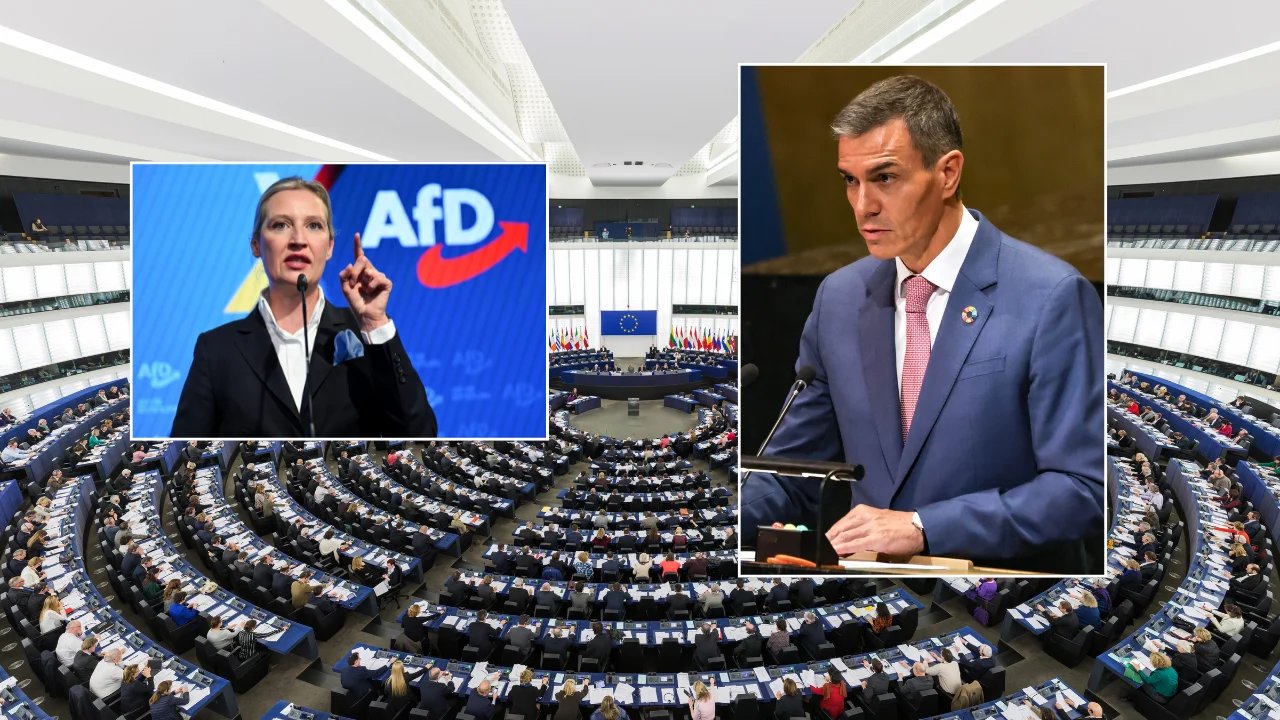
SPAIN’S public spending is set to come under the microscope after a host of European allies questioned whether Pedro Sanchez’s government misused billions of euros dished out as part of a huge post-Covid support package.
A report released in May by Spain’s audit watchdog suggested that officials in Madrid spent around €10 billion in EU recovery funds on plugging gaps in the social security budget, rather than on investments the money was supposed to be used for, such as green or digital projects designed to enhance economic recovery.
The revelation has angered politicians across the EU, who say the money will have to be repaid by an increase in taxes across the bloc.
Leading the uproar is Alice Weidel, the leader of the far-right Alternative for Germany (AfD) party, who wrote on X: “German taxpayers’ money is financing socialist mismanagement in Europe. The madness of EU joint debt must end – an AfD government will ensure that!”
Several other key figures have also expressed their dismay at Spain’s alleged misuse of EU funding.
Dirk Gotink, a Dutch conservative EU lawmaker, told POLITICO: “This emphasises the point that the RRF [Recovery and Resilience Facility] is budget support. What we were doing with developing countries, we’re now doing with EU countries.”
Meanwhile, Andreas Schwab, the chairman of the European parliament’s budgetary control committee, told El Mundo: “It is absolutely unacceptable to use EU funds from the RRF to cover up budgetary problems in the national pension system.”
Spain has firmly denied any allegations of wrongdoing.
“Not a single euro […] has been used for any purpose other than the Recovery Plan. It is categorically false that, as some reports claim, resources from the Recovery Plan were diverted to finance pensions,” a government official said.
“As for the repurposing of funds across different spending lines within the budget, these are routine and fully lawful and consistent with domestic and EU regulation,” another official from the economy ministry told POLITICO.
“They in no way compromise the achievement of Resilience Plan commitments undertaken by the Spanish government.”
Spain’s stance was also defended by Raffaele Fitto, the European Commission’s executive vice-president for Cohesion and Reforms.
“While the payment of pensions and other forms of current expenditure is not eligible for NextGenEU or RRF funds, it could be possible for member states to temporarily use some of the liquidity from RRF disbursements to cover other budgetary outlays,” he said.
He added: “Such cash management operations by member states are temporary and have no impact on the protection of EU funds.”
The saga has reignited age-old debates about the distribution of funds across the 27-member bloc.
Officials in frugal northern countries, such as Germany and the Netherlands, say Spain’s alleged misuse is evidence of careless spending across the south.
They want the way EU debt is structured to change on the premise that the current rules are unfair to countries who spend within their limits.
Spain currently ranks as the second-largest recipient of EU post-pandemic funds.
So far, the country has received €60.5 billion in grants and €17.3 billion in loans out of a total recovery package worth an eye-watering €724 billion.
