
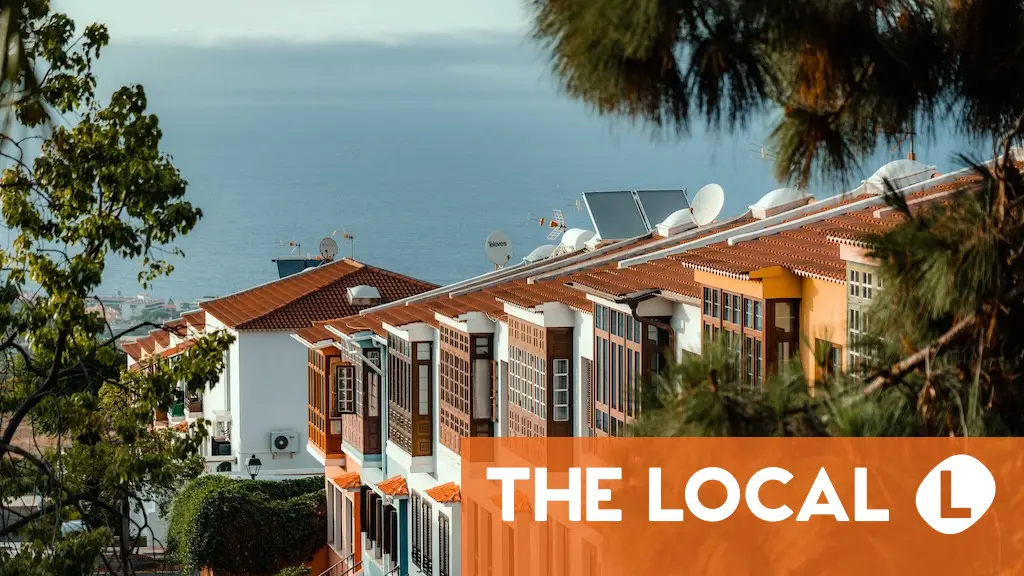
Do you require a building permit to install solar panels in Spain? What steps do you need to follow and what certificates do you need? Here’s everything you need to know.
With the ongoing climate crisis and high electricity prices, more and more people are considering installing solar panels in their homes to save money, or simply to switch to greener electricity.
For a long time, installing solar panels in private homes was made extremely difficult and expensive due to what was known as ‘the sun tax’, as well as the various administrative procedures it required.
Luckily, the controversial law was scrapped in 2019 and other measures were introduced to make energy self-sufficiency easier. Since 2021, further changes to permit requirements making it easier still.
That’s not to say, however, that the process is now streamlined and you won’t face issues, it’s just now less restrictive than it once was.
You no longer need a building permit to install a solar panel in most of Spain, unless your home is considered to be a heritage property designated as Bien de Interés Cultural or has some other type of protected status.
You may still need one, however, if need to make any structural alterations during the installation process.
Otherwise, in all likelihood, you won’t need one.
Step 1:
Firstly, you will need to apply for a municipal licence or submit a responsible declaration to your municipal authorities or town hall. For this you will need:
- A technical project of what’s being installed by a professional
- Site plans including the exact location of the panels on your building
- Technical specifications of the panel
- Proof of payment of the municipal fees
Processing for this should only take 1-3 business days as opposed to 1-3 months for the building licence.
Discounts for solar panel installations
When you apply for the permit to install a solar panel, you automatically qualify for a discount on the ICIO (Tax on Construction, Installations and Works). Depending on your local council, this discount can range from 50 to 95 percent.
For example, it’s 95 percent in Malaga, Madrid and Barcelona, and 50 percent in Valencia.
READ ALSO: What you should know before building a swimming pool at your Spanish home
Step 2:
Once the solar panel installation has been completed, there are several more steps you’ll need to go through to get an installation certificate and sign up to the Self-Consumption Registry.
The CIE or Electrical Certificate shows that your installation complies with the Low Voltage Electrotechnical Regulations. Without this certificate, your installation is illegal and you cannot connect to the grid or get any compensation for surplus energy.
To get it you need to:
- Get it signed by a certified installer
- Include certain measurements of resistance, insulation, and continuity
- Verify that the panel complies with safety standards
This information has to be submitted to the Industry Department of your region within 1-2 weeks after completion in order to get the certificate.
READ ALSO: What to know before installing an air-conditioner in your home in Spain
Step 3:
Once you have this certificate, you will need to sign up to the Self-Consumption Registry.
To do this you will need:
- Your CIE certificate
- The technical project of what was installed
- A simple graphic or diagram of the installation
- Your CUPS number, which is found on your electricity bills
If everything is submitted correctly, you will receive your Unified Self-Consumption Code (CAU). This is a unique 26-digit number that certifies your installation is legal.
Step 4:
The final step is connecting your installation to the electricity grid and activating surplus compensation. This should be done within two months of installation.
For this you will need to contact your local distribution company and your energy supplier.
The distribution company must modify your supply point to allow for self-consumption and your meter will also need adjusting, measuring what you generate and what you consume.
Your energy company will then also need to update your CUPS data and change it to ‘self-consumption with surplus’.
For all of this you will need:
- Your CIE certificate
- Your self-consumption CAU code
- Signed access contract
- The diagram of your installation
- Details of your authorised installer
- A technical verification may also be needed meaning they will send someone round to your property to view the solar panel.
You will also need to sign a compensation agreement with your energy supplier. This agreement dictates the price you will be paid for each kWh you feed into the grid.
READ ALSO: How to get up to €5,000 in aid to install air conditioning in your property in Spain
What if I live in an apartment block?
If you live in an apartment, you may be able to install smaller individual solar panels on your balcony or on your terrace and follow a similar pathway as above.
If you want to install bigger ones on the shared rooftop, you will need to bring this up at one of your community of owners’ meetings. According to the Horizontal Property Law, this must be approved by at least one third of the owners.
As a building, you will have to negotiate all the steps similar to above and the energy companies will also have to work out how electricity generation and consumption is divided between all the flats.
Regulations allow the energy produced by the panels to be divided among several homes, establishing a quota or percentage of the energy that corresponds to each resident.
For this, the installation must be connected to a common meter, and then the energy is distributed to the neighbours, according to what has been agreed on.
