
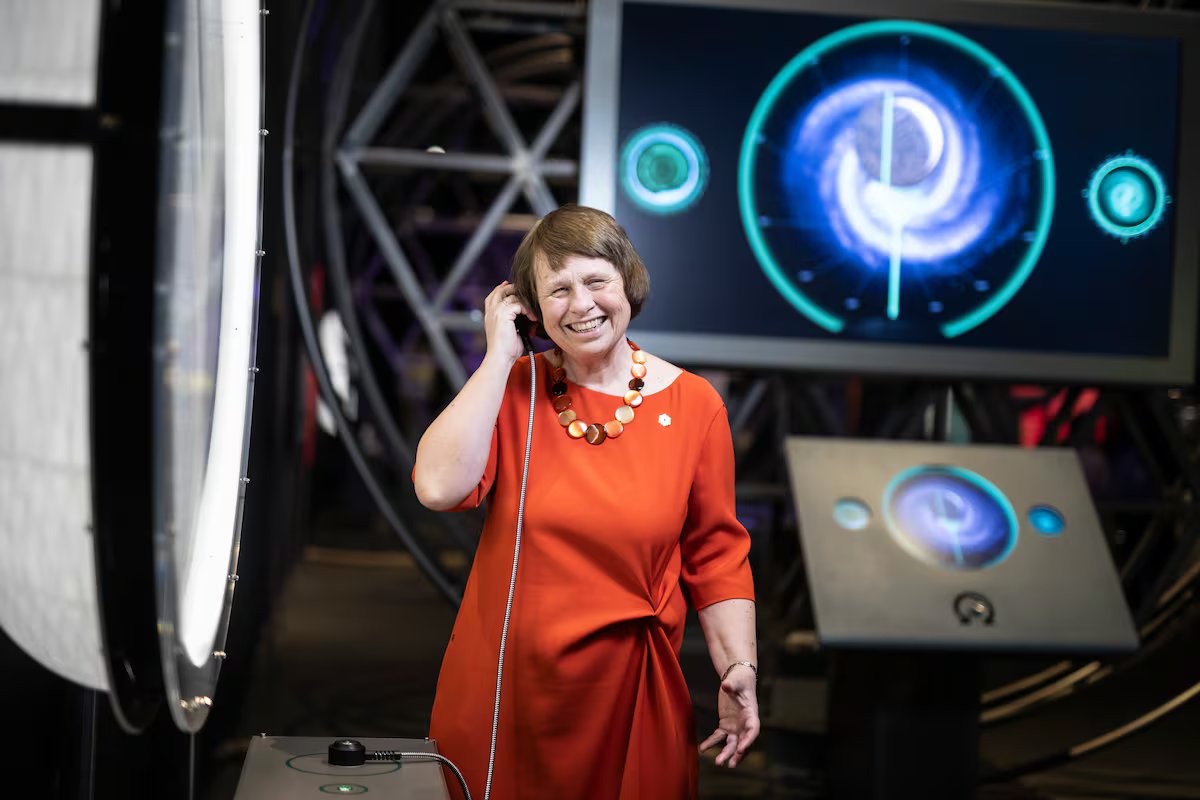
Astrochemist Ewine van Dishoeck’s laboratory is the universe, where chemical reactions take place that would be impossible on Earth. She calls herself a fan of interstellar dust and believes that as a woman, college was easier for her because “the professors noticed you.” Among her other honors, Van Dishoek won the Kavli Prize in astrophysics in 2018 “for her combined contributions to observational, theoretical, and laboratory astrochemistry, elucidating the life cycle of interstellar clouds and the formation of stars and planets.”
When she left her hometown of Leiden in the Netherlands in 1968 to travel to San Diego, where her father — an ENT specialist — had been invited to a six-month stay, she couldn’t have imagined that it was there that her interest in science would spark. “My parents always had this ambition that I would go into medicine, because my whole family were doctors,” says the 70-year-old Van Dishoeck. “And so here I was in San Diego in a public high school, and there was this fantastic female African American teacher that was so inspiring in science. It didn’t occur to me that this was special. In the Netherlands, I had lots of Latin and Greek and mathematics, but I’d had nothing of science yet.”
EL PAÍS took advantage of her trip to Barcelona to take part in Cosmocaixa’s “Greats of Science” series in order to speak with the scientist. Van Dishoeck’s orange-colored outfit immediately reminded one of her country of origin. She wore a pin of 19 golden hexagons representing the James Webb Space Telescope, which she helped develop.
Question. What most fascinated you in your youth was chemistry.
Answer. I was in quantum chemistry, hard stuff. And then the professor died, and as it goes with universities, they said, “You have very good grades, but you better start looking elsewhere.”
Q. How did you wind up getting interested in astronomy?
A. I started my PhD, and then it was my then-boyfriend and now-husband [Tim de Zeeuw, director of the European Southern Observatory from 2007 to 2017], who was an astronomer and very renowned. He actually said, “You know, I just saw this lecture about molecules in space. Isn’t that something for you?” And that’s how it all began.
Q. Chemists usually carry out experiments in a laboratory. How do you do chemistry in space?
A. The big advantage of having a lab on Earth is that you can turn the knob and you can study things under controlled conditions. In space, we don’t have any control. But it’s so empty there, and so cold, that certain types of reactions can take place that you normally wouldn’t have on Earth. You also see molecules there that are very stable under these cold conditions. That’s what I like; you basically study chemistry under exotic conditions.
Q. In space, we know that the building blocks are mainly hydrogen and a little bit of helium, as a result of the Big Bang. How do all the other elements form?
A. It starts with the first generation of stars, which carry out nuclear combustion. It is the nuclear fusion in the cores of the first stars that produces elements like carbon, nitrogen, and oxygen we have in our bodies. They do this over time. You need several generations of stars to build up the more chemically interesting elements in the universe. But what we are learning now, also from the data from the James Webb telescope, is that it is actually happening faster than we thought. Our universe is 13.7 billion years old, but already within the first one or two billion years, you have significant abundances of these heavy elements.
Q. How are the more complex molecules formed?
A. So you have this very diluted gas, a million times more empty than an ultra-high vacuum in a laboratory here on Earth. Say you want to make water. What you need to do is bring together hydrogen and oxygen, and form a bond. On Earth, the density is always so high that it carries off extra energy and you must get rid of about four electron volts. In space, that’s not happening, the only way to get rid of it is by emitting a photon. And that’s a slow process, it’s one of these types of reactions that are different in space than they are on Earth. The other way is to use these tiny little dust grains, sand that is in space, micron size, sub micron size, formed in the outflows from dying stars. So again, you need the first few generations of stars to build up the dust content in the universe. My colleagues will say they hate dust, because it obscures their vision of stars.
Q. But I hear you are a fan of dust.
A. I love it, because it helps us make molecules. These sand grains act as a place where — as one of my colleagues once put it — atoms and molecules can meet and greet. That is how we think a lot of the molecules are made, on the surfaces of these interstellar dust grids.
Q. How many generations of stars do we need to get enough material to build planets like ours?
A. It depends on the kind of star. The more massive stars burn the brightest, but also lift the fastest. They produce certain types of elements. For example, they’re good at making oxygen. Carbon, iron, if they go supernova. But a lot of carbon is made in the lower-mass stars, which live for a very long time, so they have fewer generations, but there are many more of them.
Q. And that is how elements are created. And then what happens?
A. You make simple molecules, like water. Most of the water that we have here was made on the surfaces of these gas grains. You can make carbon monoxide — you just add four hydrogens on it, and you have methanol and alcohol. And then sometimes with a little bit of heat, you will find that some of the radicals and the molecules become more mobile on the surfaces. There’s a sweet spot at 68 to 86 degrees above absolute zero [-459.67 degrees Fahrenheit], that you all of a sudden have even more chemical complexity building up. That can actually go quite far, to sugars and so on. It’s just impressive to see how far, with just a few ingredients like carbon monoxide and hydrogen, you can go all the way to glycoaldehydes, glycerol and more complex molecules.
Q. Do all planetary disks that form around stars have more or less the same ingredients?
A. We really needed the ALMA, the Atacama Large Millimeter Array, and the James Webb, in order to answer that question. In terms of star-forming regions, regions where new stars are being born, we see more or less similar compositions. We see water everywhere, in sufficient amounts to make a new solar system. I see enough organic molecules there. But then, how it makes its way to the planetary construction zones, that is still a different question, and that is only what we are trying to find now. We already see a large diversity with the Webb. Some of the planet-forming regions turn out to be very rich in water, others turn about to be rather poor in water. Some of them are rich in carbon dioxide, yet others are very rich in hydrocarbons.
Q. If we were to observe our planet from the outside, would it be rich or poor in water?
A. That’s a good question. Of course, as we see it now, it is already very evolved. But what we know of the water content in our solar system, on Earth, it’s almost nothing. If you were to put it in a volume, it wouldn’t be much more than the state of Colorado. The Earth is certainly in a rather water-poor region. Here, the snow line is very important, where a molecule goes from the solid state into the vapor phase. In our solar system, the snow line is approximately at the orbit of Jupiter, between Jupiter and Mars. Beyond that, water is almost equal amounts of rock and ice, but inside it starts to drop enormously, because it is basically vaporized and leaves the system. There’s one theory that Venus, Earth, and Mars were actually born with the same amounts of water, but then they evolved differently, and on some, it vaporized completely.
Q. Based on our solar system, it would seem that water is a necessary condition for the formation of life.
A. Water is still one of the best solvents that we know for bringing molecules together. I often get the question, “Why not ammonia or methanol?” That’s simply because there’s 10 times more water available than ammonia or methanol. And it’s just a very good solvent. So, why would you go to another? It’s the most logical one. So water has to be there for life, but then other things have to be there. You need to have at least some base of carbon and some nitrogen to get there. They could be relatively simple molecules, like formaldehydes and hydrogen cyanides with liquid water and a little bit of energy, and you get already very complex chemistry. The next step, how it all becomes life, that is a subject for my astrobiologist colleagues.
Q. You are skeptical that it will be easy to find the “signature of life,” chemical proof that life exists in other solar systems.
A. Some of my colleagues are very optimistic that the James Webb will find proof that there is life on other planets, as you can see from the detection of dimethyl sulfide. But I think that paper was much more balanced than its press release actually was — there is abiotic production of dimethyl sulfide in the universe, so you cannot be sure that it really needs life. I’m a little bit more cautious than some of my colleagues. We need at least the Extremely Large Telescope, which is being built in Chile by the European Southern Observatory. And perhaps the next space mission, the successor of James Webb, but that is going to take still another few decades. The technology has really been developed. It may be exciting that we are the first generation of humans that can bring the question of life on other planets from the realm of philosophy into real science. But we have to calm down.
Q. With the tools at hand, like the James Webb, what do you hope to be able to study?
A. First of all, that we can now study the chemistry in the planet-forming zones, close to the stars. We see a lot of chemical diversity there. You really need to build up statistics, because in astronomy you cannot go there, you cannot follow planet formation in time, because it takes a million years. So I’m looking at regions where planets are forming at this very moment. They are, for the first time, able to probe the composition of the atmospheres of giant exoplanets. They’re also starting to get the statistics on the Earth-like planets, though they still have difficulties even detecting an atmosphere.
Q. There was a lot of controversy surrounding the decision to name the telescope after James Webb, due to his alleged homophobia. What’s your opinion on that?
A. I think that was very well investigated by NASA. I really don’t buy into all of these arguments. In fact, he has been a proponent of a lot of human rights and diversity in NASA. I don’t want to go into details, but what I know is that it has been very well-researched and that he came out with shining colors.
Q. You were the president of the International Astronomical Union between 2018 and 2021. Do you think the role of science diplomacy in a world like the one that we have today is more important than ever when it comes to calming international tensions?
A. I really see astronomy as building bridges, rather than splitting us. If you look from space, we don’t see any borders. It’s just one beautiful Earth. Astronomy gives us perspective. We are just a pale blue dot, as Carl Sagan says.
Q. Do you think there is a problem with authoritarianism in academics, particularly for young female researchers?
A. I’ve been in physics departments, I’ve been in chemistry departments, I’ve been in astronomy departments, I’ve been in geology departments. The ones that have the most flat structure, in terms of hierarchy, is astronomy. As a PhD student in Leiden, we were treated already as young staff members. Personally — but again, my experience is probably different from that of other women — the fact that I was the only woman at that time in a class with men, the professors noticed you. If you did just a little bit, they recognized you. When I look at the classes that we have now, women make up 50%. Our PhD and postdoc populations have been at 35%, 40% female for quite some time. What has always been the problem is the leaky pipeline; as careers advance, there are fewer women. But that has always been the problem.
Q. Even so, do you think there is a structural issue for women in academics?
A. I really don’t see that. They are actually very well supported. I think the people who have it the hardest at the moment are some of the young men — just my personal opinion.
Sign up for our weekly newsletter to get more English-language news coverage from EL PAÍS USA Edition
