
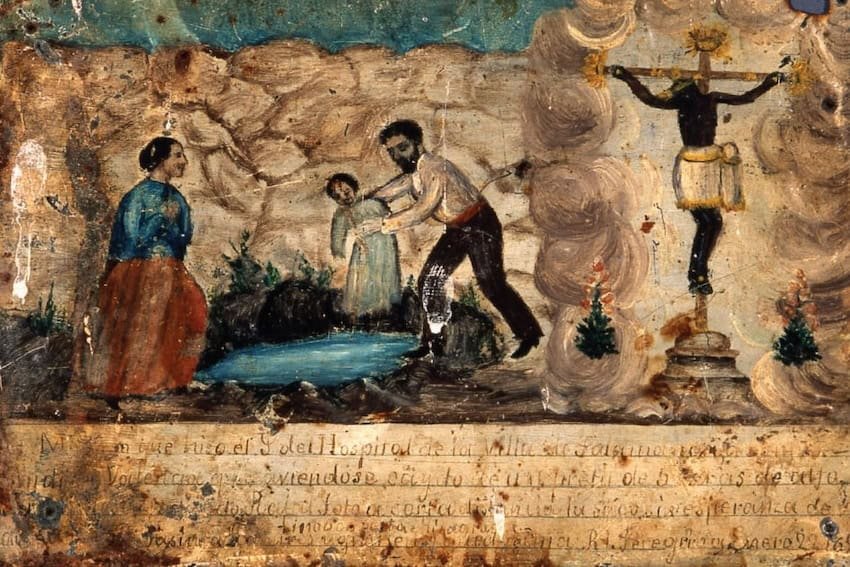
It is not an understatement that Mexicans like to party — and we’ve loved to make our saints and holidays the perfect excuse to let loose completely. The aftermath is what we’re not so happy about, naturally.
However, throughout centuries of intense Catholic holidays (and extensive hangovers), we have learned to establish almost transactional relationships with our deities — whether we are practicing Catholics or not. Enter Mexican exvotos, the quirky way to thank all the saints and God for fixing our greatest sorrows.
What exactly are exvotos?
As we’ve stated before, Mexicans fear God. It’s not as if we’re afraid of an almighty entity. On the contrary, as Bethlehem College and Seminary scholar John Piper explained, this implies “a sense of awe and respect for the Christian God”, their saints and the Virgin. What does this have to do with exvotos, exactly?
To understand this practice better, Mexican colonial art specialist Maria Montenegro spoke with MND. “Exvotos in Mexico are offerings given to a deity.” In the form of “small oil paintings,” explains the specialist, the practice can be traced to 16th-century Italy. However, it arrived in present-day Mexico with the Spanish invasion of the Americas.
Translated from Latin as ex votos, after a vow, per the Ministry of Culture, they were intended to thank a greater Catholic entity for its grace or a miracle. In the form of little paintings, Mexican exvotos are meant to tell the story of a miracle. It served wonders to the colonial friars, who were entrusted with the spiritual conquest of the native inhabitants. Unlike other artistic expressions in Mexico, this one is eminently Christian: a testament to the relationship of the Catholic faithful with God, Mary or a saint.
At that time, says Maira, “it was a very expensive practice, which only very wealthy families or churches could afford.” You can still find exvotos exhibited in their original prayer spaces in some churches in Mexico City’s Centro Histórico, and some wonderful examples at MUNAL’s historical collection.
Exvotos, the sacred bond between the people and their deities
Unlike the typical Baroque altarpieces of the Bajío region, which depict biblical passages with gold-plated statues, Mexican exvotos are intended to narrate passages from everyday life. Much of this practice, Montenegro explains, “arose from everyday life: from people going through difficult situations, illnesses and accidents, and in some way thanking God for having survived.”

Now, what distinguishes a Mexican exvoto? “If we are talking about the pictorial phenomenon of the 19th century,” says the specialist, the classic image is represented in “a small painting format, which has a graphic part and a textual part.”
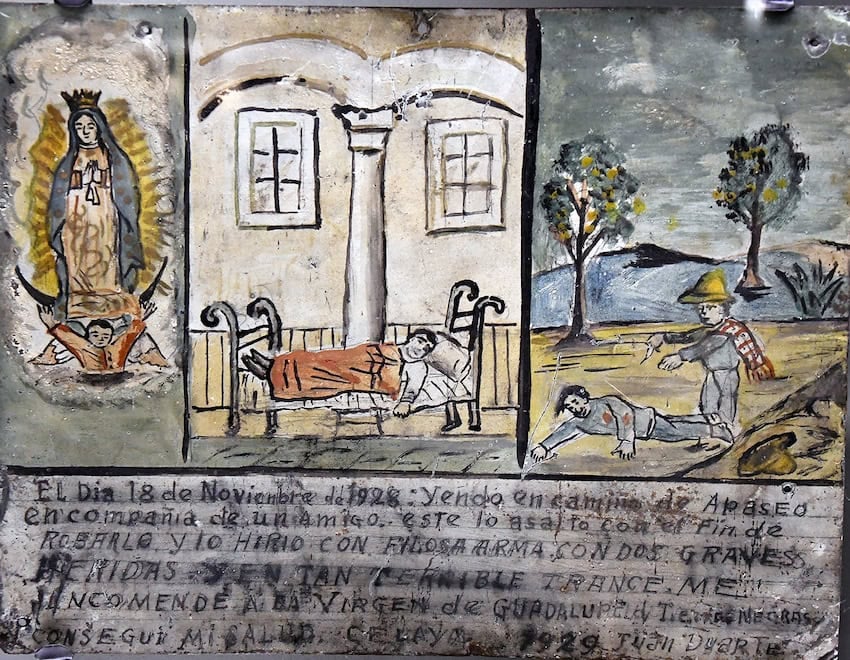
In the image part, Montenegro explains, “what happened is usually depicted.” For example, if there was a car accident, the scene is depicted on the street; if someone was ill, they are shown in bed, and so on. “In the corner, the sacred figure being thanked is painted, which could be God or the Virgin of Guadalupe.” Finally, at the bottom, there is a panel where “the miracle is narrated in text.”
Faith in popular culture
“It wasn’t until the Independence movement in the 19th century,” says the art historian, “that making these small paintings that narrated miracles or situations for which people thanked God became popular.” For this reason, the Ministry of Culture describes this artistic expression as “the materialization of faith in popular culture.”
Although the practice is at least 200 years old, ex voto production in Mexico has not stopped. Montenegro refers to the Museum of the Basilica of Guadalupe, where a vast collection of centuries-old pieces is preserved, created with the intention of making this type of offering to deities, Catholic or otherwise. “There are contemporary figurines of Peter Pan and Pikachu,” explains the art historian, “which were surely left by children: it doesn’t necessarily have to be the painting format that narrates a miracle.”
Are exvotos painted nowadays in Mexico?
And as is often the case in Mexico, the exvotos are imbued with a playful and celebratory spirit. They often carry a mocking and ironic undertone. And yes, exvotos are still crafted today in Mexico — the format has changed, though.
Montenegro points out that an exvoto can be any object. Strictly speaking, it is any offering made to a religious figure. “What really matters,” the specialist notes, “is the intention with which the person leaves the object in the church.” It is common to leave toys for the Niñopa, a sacred baby Jesus in Xochimilco, for example. Following Montenegro’s definition, those could very well be exvotos, as well.
Today, the specialist acknowledges, the original little-painting format is no longer as popular as it was in 19th-century Mexico. “Probably,” says Montenegro, “because the relationship with spirituality and Christianity is different.” However, “It is very human to seek a connection with the divine and to give thanks for what it gives us,” she concludes.
Andrea Fischer contributes to the features desk at Mexico News Daily. She has edited and written for National Geographic en Español and Muy Interesante México, and continues to be an advocate for anything that screams science. Or yoga. Or both.
