
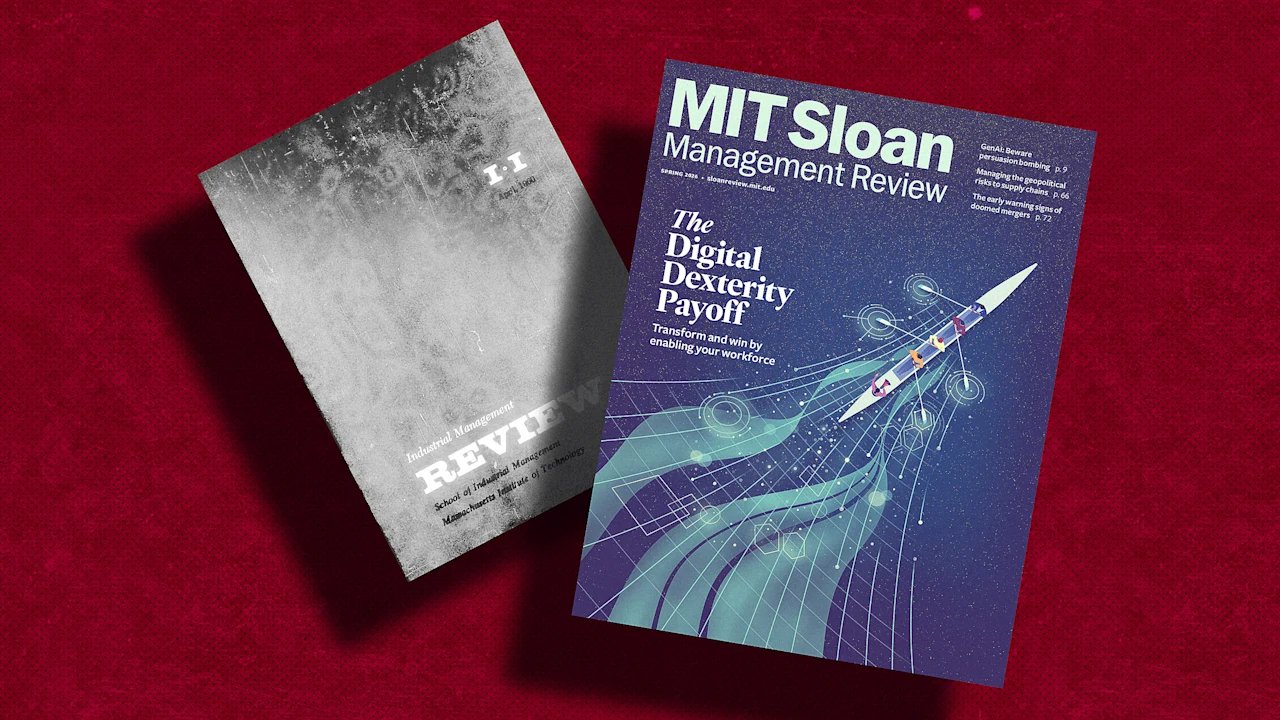
The news landed quietly, tucked into a letter from MIT Sloan’s dean to colleagues: After 67 years, MIT Sloan Management Review is shutting down. Future insights, the letter explained, will live on via “digital newsletters, short-form video, social-first content, and podcasts.”
This is a strategic inflection point for management thinking. It will have a major impact on the entire ecosystem through which serious management ideas travel from researchers to the people who run organizations. That ecosystem was already fragile.
Winner-take-all dynamics
MIT Sloan Management Review and similar journals were classic two-sided market propositions. They offered management ideas to subscribers, pulling in advertisers along the way. The scarcity factor was that only such journals had access to top faculty, even as faculty had relatively few major mainstream outlets to promote their ideas. MIT SMR, in particular, focused on evidence-based research and incorporated citations.
While the basic value proposition hadn’t changed, the world around it did. Today, ideas flow through blogs, thinkers’ own websites, and massive numbers of books (I’ve written about the peak book hypothesis here). The scarcity factor of its content went essentially to zero, and when that happens, people’s willingness to pay evaporates.
The publication’s departure leaves Harvard Business Review as a winner with network effect dynamics. If HBR is where the readers are, that’s where other ecosystem partners want to be. It will now be essentially the dominant institutional journal seeking to get research ideas into the hands of practicing managers.
HBR (which I am delighted to say has published a fair amount of my work) faces its own pressures. As a must-have platform, it often must reject worthy ideas. It needs credibility with “C” level executives. Without a peer playing the same translation game, those pressures intensify. The management field needs more venues doing serious practitioner-facing work, not fewer.
The Research-Practice Gap Was Always Major
There is an enormous, largely invisible backlog of management problems that research has effectively solved but whose solutions have never made it into organizational practice.
Just to take a few examples: We know, with considerable empirical confidence, how to design incentive systems that don’t destroy intrinsic motivation.
We know that most large-scale change initiatives fail not because of strategy but because of implementation dynamics that are entirely predictable and manageable.
We know that diverse teams outperform homogeneous ones under conditions of complexity, and we know specifically why and how to structure them to realize that advantage.
We know a great deal about how cognitive biases distort resource allocation decisions at the top of organizations, and we have tested interventions that meaningfully reduce those distortions.
We know that organizations and communities pay a terrible price for offering bad jobs.
We know that many workplaces are literally causing those in them to suffer terrible health outcomes.
None of this knowledge is secret. It lives in journals, in working papers, in the syllabi of good business school courses. What it largely doesn’t do is reach the CFO making a capital allocation call on Tuesday morning, or the division president trying to figure out why her transformation initiative keeps stalling.
The translation layer between “what research knows” and “what practitioners do” has always been thin and underfunded. MIT SMR was one of the few publications explicitly committed to that translation. Now it’s gone.
The Incentives Were Broken Long Before This
The design of business school incentive systems is partly to blame. The incentive structures in research universities have, for decades, pointed faculty away from practitioner-facing work. Tenure and promotion are determined by publications in top academic journals: outlets with tiny circulations, peer reviewers who are other academics, and editorial standards that actively discourage the kind of narrative accessibility that helps ideas travel.
Publishing in MIT SMR—despite its genuine rigor, its MIT imprimatur, its global reach among senior executives—counted for relatively little in most tenure cases compared to a placement in a top-tier academic journal that approximately 200 specialists might read. This reflected a conscious set of choices about what kind of knowledge production universities would reward.
The result, over time, was a faculty increasingly optimized for talking to each other, and decreasingly equipped, or motivated, to talk to the people whose organizations their research was nominally about. Imagine medical doctors not keeping up with discoveries in their fields, or someone studying engineering not understanding the materials that might be used to design a bridge!
MIT SMR existed in the gap that this incentive structure created. It depended on scholars who cared enough about practitioner impact to invest time in writing that their departments wouldn’t necessarily credit. That’s a fragile foundation, and it grew more fragile as the academic labor market tightened and junior faculty had fewer and fewer degrees of freedom about where they put their energy.
If business school leaders want to bridge these gaps, they would make journals such as MIT Sloan matter in promotion decisions. Of course, with the advent of agentic AI and the reshuffling of management structures, their hands may well be forced to change what gets recognized and promoted.
“For every complex problem there is an answer that is clear, simple, and wrong”
This quote, attributed to H. L. Mencken, reflects a broader issue. The dean’s letter frames the closure of MIT SMR as a response to “broader shifts in how audiences engage with management ideas.”
He’s not wrong about the shift. But there’s a subtle and important conflation happening: The shift in how audiences consume content is being used to justify a change in what kind of content gets produced. That has potentially serious consequences.
Short-form video and social-first content are extraordinary at spreading ideas that have already been simplified. They are almost useless at developing ideas that are genuinely novel and complex.
For example, my work on the need for companies to behave like habitual entrepreneurs, if they hope to survive for the long term, has taken (so far) five books (with one more on the way), lots of HBR and MIT SMR articles, and multiple interactions with large numbers of stakeholders. It cannot be reduced to a LinkedIn carousel. Action points coming from short-form outlets without essential context are mostly useless, and conceivably even dangerous.
The closure of MIT SMR doesn’t mean demand for serious management ideas disappears. It means that demand gets met by whoever has the biggest platform and the fastest content engine. Increasingly, that means AI-generated synthesis, influencer-driven frameworks with little empirical grounding, and the management consulting firms that have always been happy to position their proprietary models as received wisdom.
One major institutional referee is leaving the field, and if a journal with so much credibility and backing can’t thrive, it suggests that the market for management ideas is fundamentally changing.
There’s an irony worth noting: MIT Sloan is shutting down a publication in the name of reach and relevance at precisely the moment when AI is making it easier than ever to produce and distribute long-form, research-grounded content cheaply.
The problem was never that rigorous ideas couldn’t find an audience because MIT SMR’s digital readership was substantial. The problem is that sustaining an editorial institution requires organizational commitment that goes beyond traffic metrics.
What now?
So what happens now? We can expect that independent voices, publishing on their own substacks and podcasts, and potentially executive education programs, become more important as the institutional middle ground hollows out. That’s both an opportunity and a risk: We can expect more diversity of voices but less quality control and less shared vocabulary across the management field.
The gap between academic research and management practice, which MIT SMR existed to bridge, will widen. And the organizations on the wrong side of that gap—the ones whose leaders never encounter the research that might help them—will keep making the same avoidable mistakes.
Sixty-seven years is a long run. MIT Sloan Management Review shaped how generations of managers thought about strategy, innovation, leadership, and change. The right response to its closure isn’t nostalgia. It’s to ask, with some urgency, where the future high-impact management ideas will come from and how they will be disseminated.
That conversation has gone on for years, all the way back to management thinker Peter Drucker. With the disruption that is on the horizon as we enter an era of agentic AI and dematerialization, perhaps the topic will be revisited with renewed urgency.
