
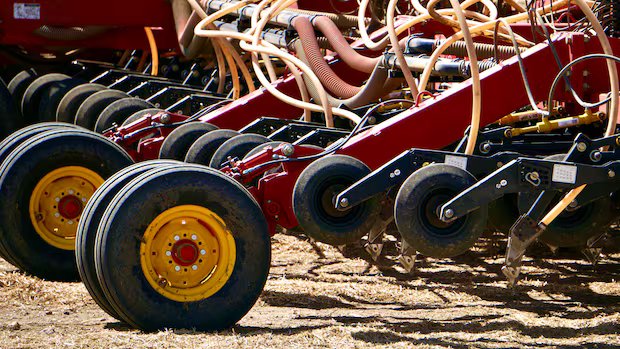
Spring seeding is underway, and as farmers spend long hours in the tractor planting crops, they’re facing hefty increases to the cost of diesel and fertilizer.
They’re also already concerned about the 2027 crop year, since many will be making large fuel and fertilizer purchases in the months ahead.
Fighting in the Middle East has sent commodity prices soaring. As the conflict stretches into its third month, nitrogen-fertilizer prices remain sky-high, while the cost of diesel fuel for tractors and other farm machinery continues to cut into the profits farmers hope to make on their summer crops.
Spring seeding is well underway for Leroy Newman, as he plants wheat, barley, peas and canola on more than 1,600 hectares near Blackie, Alberta, a short drive southeast of Calgary.
His family has grown crops on this land since 1904, and the fourth-generation farmer said they are coming off one of their best-ever years, thanks to near-perfect growing conditions in 2025.
But this spring is different.
Along with the usual spring optimism, there is anxiety about the rising financial pressure as fertilizer, fuel and freight costs continue to climb.
“I can maybe put a little less fertilizer on this year,” said Newman. Instead, he’s looking elsewhere to control costs.
“We’re probably not buying as much machinery this year,” he said. “We’re just holding tight.”
A 2027 problem too
The concern is shifting beyond this year’s crop.
Many farmers bought their fertilizer before the price spike, which is why steep fertilizer costs could have a much larger impact on what crops are planted in 2027. In particular, Newman warns many farmers could be forced to seed fewer canola acres next year.
Crops such as corn and canola require high amounts of nitrogen-based fertilizer, while farmers typically don’t use any when growing peas, lentils or fava beans.
Fuel and fertilizer expenses are a major concern, considering farmers were already expected to face slimmer profit margins this year after a bumper crop in 2025 created softer prices, said Craig Johnston, chief economist at Farm Credit Canada (FCC).
The Strait of Hormuz is a critical energy and commodity shipping choke point that has been squeezed by the conflict in the Middle East, including for about 30 per cent of nitrogren-based fertilizer, said Johnston.
“This is going to affect not just fertilizer prices right now, but also I think the conversations heading towards, ‘is this becoming a 2027 problem as well?'” he said.

Speculating on price
On a bright, sunny Tuesday morning, farmers arrived with empty semi-trucks at Stamp Seeds, one of the largest independent seed suppliers in Western Canada, based in Enchant, Alta., about 200 kilometres southeast of Calgary.
The trucks pulled up to one of the dozens of tall white bins, each one filled with a different variety of wheat, corn, canola, lentil or other seed.
Freight costs are up 20 per cent, said manager Greg Stamp, which “definitely impacts how far people are willing to travel for a product they want.”
Stamp recently bought a second 65,000-litre fuel tank so he can buy more diesel when prices begin to rise.
For fertilizer, he can typically spend upwards of $400,000 in the summer to load up for the upcoming season. But now, he’s having to wager whether that makes sense, with prices about 40 per cent higher than a year ago.
Buying fertilizer this summer would mean paying those higher costs, but it would also bring the peace of mind knowing he has the supply needed for next spring in case there are shortages.
“That’s going to be a tough decision this summer and fall,” Stamp said.
As a seed grower and retailer, he’s already having to speculate how crop markets will move and what farmers will want to buy.

Retail diesel prices across the country are averaging about $2.18 per litre this week, an increase of more than 50 per cent compared to 12 months ago. The cost is lower on farms, since agricultural producers are exempt from paying excise taxes.
For farmers who didn’t stock up on fertilizer before the price spike, the higher costs could push them to grow different crops.
This spring, farmers could shift to different crops on about 5.5 million acres, or 7.3 per cent of total fields, according to FCC. Some lower-quality soil may not be planted at all this year, as FCC estimates the amount of unseeded land could increase by as much as 280,000 acres, to 1.4 million.
Canada is the largest producer of potash in the world and also produces nitrogen in Western Canada. However, some parts of the country rely on imports because of the cost and complexity of transporting the fertilizer from Western Canada. Canada also imports other types of fertilizer.
“As a globally traded commodity, any impact to global fertilizer production can be felt throughout the market,” said Fertilizer Canada chief executive Michael Bourque, in a statement.
“This remains a fluid situation.”

Several food suppliers have warned grocers of fuel surcharges due to the soaring cost of fuel, and that could mean even higher prices on your next grocery run.
Consumer prices
Farmers are stuck with the higher costs because they can’t raise their prices, since they sell crops on an open market.
“A farmer is taking a lot of risk to grow a crop and spending a lot of money to grow a crop,” said Stamp, the seed grower. “They can’t control the price of the crop that they’re selling. It’s a global market.”
That’s also why the higher farming expenses won’t necessarily translate into more expensive food at the grocery store.
“Farmers don’t have any ability to set the price of what they sell,” said University of Saskatchewan agricultural economist Stuart Smyth.
“Whether it’s a grain company or a food processor, farmers take the price that is given to them.”
However, higher fuel prices will lead to rising price tags on grocery store shelves because of increased transportation costs throughout the agriculture and food supply chain, such as hauling grain to an elevator, chickpeas to a processing plant or packaged food across the country.
“It’s that additional cost in fuel that I think we will start to see this month and certainly into June just because of the cost of transporting food,” said Smyth.
