
A Honduran family that came to Canada seeking refuge says border officers forced them to choose between separating from each other or returning together to the United States, where they were detained and then deported back to Honduras.
Their case is now at the centre of a Federal Court challenge alleging Canada is failing to provide refugee claimants with safeguards required by the Supreme Court of Canada before turning them back under the Safe Third Country Agreement.
The application, filed Wednesday by the Canadian Council for Refugees, Amnesty International Canada and three members of the family, alleges Canada Border Services Agency officers are routinely returning asylum seekers to the United States without meaningful assessments of whether they face unfair detention, deportation or other serious rights violations.
“The Honduran family is tragically only illustrative of the systematic return of individuals and families to U.S. facing danger,” said Gauri Sreenivasan, co-executive director of the Canadian Council for Refugees.
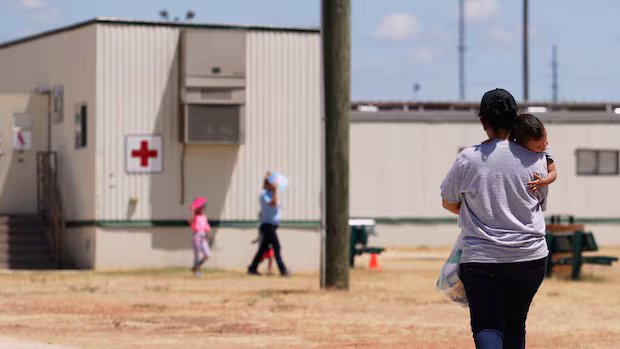
Court documents shared with CBC by Amnesty International Canada do not reveal the identities of the Honduran father, six-year-old son and mother, who, according to those documents, have been living in hiding since they were deported by the U.S. to Honduras after spending two weeks at a notorious U.S. Immigration and Customs Enforcement (ICE) detention centre in Dilley, Texas.
Last month, CBC reported that conditions inside the centre include poor food and unsafe drinking water, overcrowding and allegations of verbal abuse and mocking by guards.
Julia Sande, a lawyer for Amnesty International Canada, says the Honduran family experienced gang violence and death threats and were targeted for extortion. They made the land journey north to the U.S. in 2022, where they filed asylum claims. They settled in Maryland while waiting for their hearing, which was delayed several times.
Family’s U.S. asylum claims cancelled under Trump
In March 2025, a couple months into U.S. President Donald Trump’s second term, as the administration was undertaking sweeping and aggressive immigration reforms, the family was informed that their asylum claims had been cancelled.
“They never had an opportunity for a hearing, never had an opportunity to explain why they had fled,” Sande said.
The family consulted a lawyer in the U.S., who told them they could appeal, but that people showing up to appointments were being detained by ICE agents and later deported, Sande said.
“So what choice do you really have?” she said they were told.
That’s when they chose to come to Canada, where three of the father’s siblings live, making him and his son eligible to exceptions to the Safe Third Country Agreement.
Under the agreement, most people who arrive at Canada’s land border from the United States to seek asylum are deemed ineligible to make a refugee claim here and are returned south — unless they have a close family member residing in Canada. The agreement is based on the principle that both countries offer fair access to refugee protection.
But advocates argue conditions for asylum seekers in the United States have deteriorated significantly, particularly since Trump returned to office.

“The government needs to recognize that the U.S. is is not safe [for asylum seekers] and that the evidence is overwhelming that it’s not safe,” Sreenivasan said.
CBSA not informing claimants they can seek exemptions: court filing
At the Fort Erie, Ont., border crossing on April 4, 2025, a CBSA officer informed the family that the mother was not eligible to enter Canada because she did not have any close family members in the country. The father decided to withdraw his and his son’s refugee claims so he would not be separated from his wife, the Federal Court application says.
“PQ [the father] explained that his wife was at risk because their U.S. asylum claim was cancelled without adjudication, but was told that the actions of U.S.A authorities were outside the officer’s jurisdiction,” the court document says.
According to the court filing, refugee claimants are not informed about the possibility of seeking exemptions, are given little time to present evidence and often lack access to legal counsel before being returned to the United States.
“People arrive at the border, they have maybe minutes or hours and then Canada sends them back,” Sande said. “They don’t have time to gather evidence, they don’t have the ability to be represented by legal counsel.”
The application also alleges CBSA relies on internal policies governing those exemptions that are not publicly available.
The Supreme Court’s 2023 decision found the agreement could operate constitutionally only if individuals facing risks such as unfair detention or deportation to persecution had access to safeguards — often referred to as “safety valves” — that would allow Canada to exempt them from return.
The challenge alleges those safeguards exist largely on paper.
In an emailed statement, CBSA spokesperson Karine Martel said officers have limited discretion in “exceptional cases only” to delay a removal if a claimant provides credible evidence they would face death, inhumane treatment or a genuine risk of refoulement — being deported without due process — from the United States.
Cases involving credible allegations of risk can then be referred through an internal “escalation protocol” for further consideration before a person is returned to the U.S., Martel said.
The agency said officers consider humanitarian factors and the best interests of children but acknowledged that “it is still possible that decisions may result in split eligibility.”
Refugee advocates challenging the system argue those safeguards are largely inaccessible in practice because claimants often have only hours to present evidence and may not know the process exists.
“Canada has not made those safety valves available,” Sande said.
Sande said the broader issue is that the way Canada is applying the agreement is resulting in refugees being systematically handed over to ICE.

U.S. Immigration and Customs and Enforcement is holding about 60,000 people in detention centres, the vast majority without criminal convictions. For The National, CBC’s Jonathan Montpetit goes to Texas where lawyers say ICE detention is used as a tool to bully people into leaving the country and hears about the conditions from former detainees — including a 16-year-old boy.
The federal government has previously maintained that the United States continues to meet the legal requirements necessary to remain designated as a safe third country and says it conducts ongoing reviews of that designation.
The allegations in the court application have not been tested in court. A judge must first decide whether to grant leave for the case to proceed.
The challenge is one of several cases before the Federal Court that question how Canada has implemented a 2023 Supreme Court ruling that upheld the Safe Third Country Agreement while emphasizing the need for mechanisms to prevent refugee claimants from being returned to situations that could violate their Charter rights.
In a related case raising similar concerns, the Federal Court recently granted leave for a judicial review to proceed, according to immigration lawyer Jared Will, who has been acting as counsel in the cases.
CBC reported last year on families being separated or turned away at Canadian land border crossings and landing in ICE detention. One of those families, the Raqeeb family, is now the subject of a similar challenge to that of the Honduran family.
