
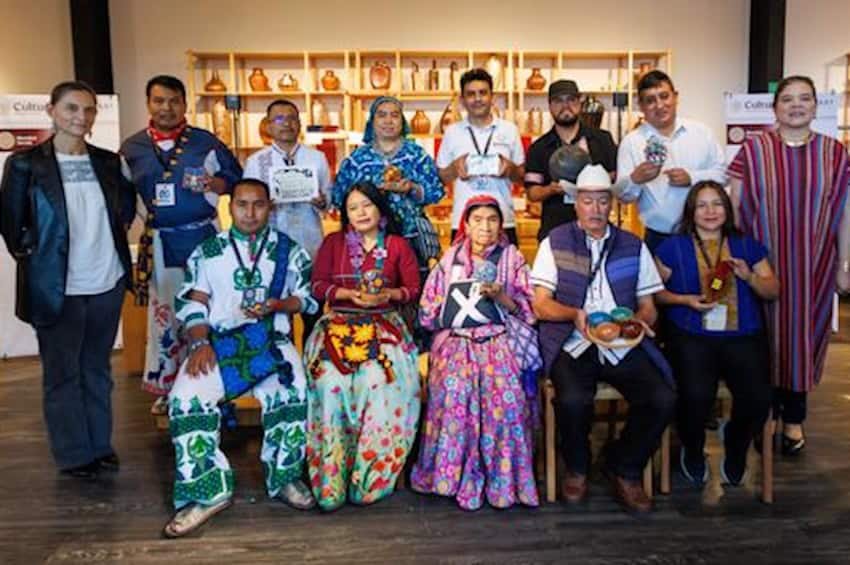
In a first, World Cup organizer FIFA is collaborating with Mexican artisans and Mexico’s National Fund for the Promotion of Handicrafts (Fonart) to help internationalize an official artisanal collection of limited-edition pieces.
The project aims to project Mexican folk art internationally, helped along by the inclusion of distinctive marks authorized by FIFA.
“These are true gems, unique pieces, just like the craftsmanship itself, because they’re made using very different techniques from diverse places, all of which are in Mexico,” Deputy Culture Minister Marina Núñez Bespalovary said during the program’s presentation.
Made up of 3,000 pieces, the collection was created by 11 female and 16 male artisans from Indigenous communities in Chiapas, Chihuahua, Durango, México state, Guerrero, Hidalgo, Jalisco, Michoacán and Oaxaca.
“With these handcrafted pieces, our country can proudly enter any market thanks to the creators and the care and mastery they put into each piece,” Núñez said.
The pieces feature 10 different craft traditions, including pottery and ceramics, lacquerware, textiles, and Wixárika art, among other emblematic expressions of the country. For this collection, the pieces combine soccer symbols like footballs, stadiums, and the World Cup colors, with traditional Mexican motifs.
To make visible and recognize the artisanal work, each piece carries a label with the name of the master artisan, the origin and the artisanal branch.

“When the world arrives, we want them to discover something bigger than stadiums and deeper than any scoreboard,” said Rodrigo Ortuzar, head of the Culture and Legacy Office at the Federal Government for the 2026 World Cup. “We want them to know the soul of Mexico, because the World Cup only lasts 39 days, but a country’s identity remains forever.”
The pieces will be available for sale at Fonart stores from June 5 through July 31.
Meanwhile, the west coast state of Nayarit unveiled a gigantic soccer ball more than 3 meters high, decorated with thousands of beads distinctive of the Wixákira art. Even though Nayarit has no host city, the monument serves as a symbolic bridge connecting the host cities with the rest of Mexico.
With reports from La Jornada
