
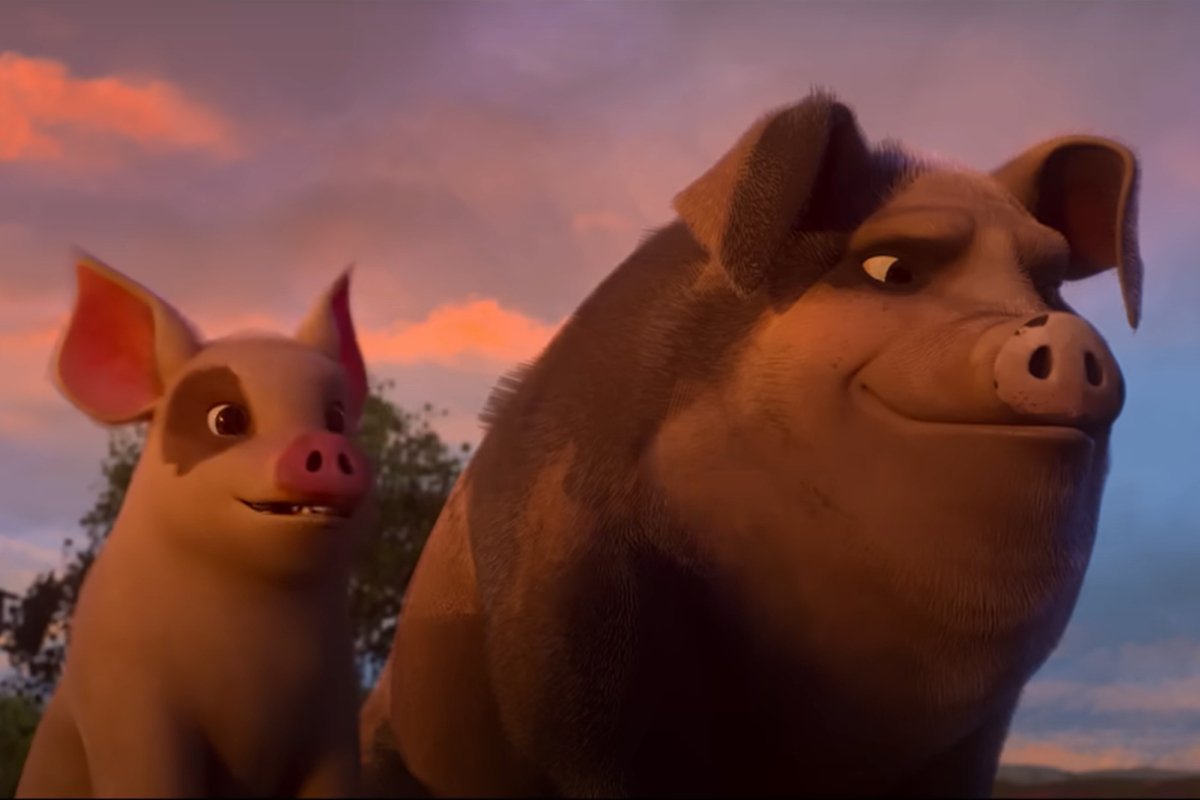
– Andy Serkis’s adaptation of Orwell’s Animal Farm is more hollow A-list spectacle than coherent manifesto
Before taking the director’s chair for the Lord of the Rings: The Hunt for Gollum next year, Andy Serkis has at last delivered his dream project: a feature adaptation of Animal Farm, which just screened at Anifilm. George Orwell’s 1945 masterpiece is an unforgettable critique of totalitarianism. Though it wears the mask of a children’s fable, it is, in reality, a blistering political manifesto on the corruption of ideals and the slide from revolution to dictatorship. However, Andy Serkis’ 2025 animated adaptation, a project 15 years in the making, with a star-studded voice cast including Seth Rogen, Glenn Close and Woody Harrelson, strips away this depth. What remains is a hollow, chaotic spectacle that regresses the story into Disneyified family entertainment.
The film’s opening act mirrors the source material, depicting a revolution sparked by a farmer’s bankruptcy. We witness the power struggle between the cunning boar Napoleon and the righteous leader Snowball. Once Snowball is eliminated and Napoleon ascends to power, a fascist era begins. Through the eyes of Lucky, a naive piglet, we watch the promised utopia crumble under the weight of systemic corruption. Yet, conditioned to stand with his own kind, Lucky supports the dictatorship until the very moment his close friend, the workhorse Boxer, is sent to his death. The farm’s collapse is driven not just by Napoleon’s tyranny, but by external pressure from the Pilkington Corporation, which aims to seize the land for power plants.
While the first half of the film attempts to stay faithful to the text, the second half devolves into a loose, freestyle adaptation plagued by a jarring inconsistency in tone. On one hand, the film tries to evoke the dark shadow of a dictatorship; on the other, Seth Rogen’s Napoleon spends his screen time pandering for laughs from children. This tonal whiplash doesn’t just blunt Orwell’s sharp edge; it turns the narrative into something resembling Zootopia. Furthermore, the richness of the original text was apparently deemed insufficient, as the filmmakers have cluttered the story with new enemies, unnecessary technologies and redundant motivations. While incorporating modern tech like drones might have been an interesting way to update the story, naming the Pilkington drone “Moses” seems like a religious reference – symbolism that is not coherently followed through in the casting or other clashing production choices.
Having pioneered motion-capture technology through iconic roles like Caesar in Planet of the Apes and Gollum in The Lord of the Rings, Serkis does deliver technically impressive animation. The character designs, the soft pink glow of Lucky’s skin and the farm’s increasingly atmospheric, grim aesthetics are all top-tier. Yet, this visual prowess cannot save the film. The higher the quality of the animation, the shallower the underlying narrative feels. The most unforgivable part, however, is the ending. Orwell’s original, haunting finale, “where pigs and humans become indistinguishable” is swapped for a hopeful, triumphant hero’s moment for Lucky. This choice guts the story of its cautionary power. In an effort to avoid upsetting children and families, the film tosses the allegories for Trotsky and Stalin into the trash, replacing them with a “say no to bad leaders” moral. Serkis’ ultimate goal as a director remains elusive; the film feels like a corporate product hiding behind its celebrity cast, chasing box-office numbers under the guise of a children’s movie.
Ultimately, we are left with a muddled mess that, despite its high-end animation and A-list talent, serves no clear purpose. If you truly wish to honour Orwell’s legacy, skip this film and go back to the book.
Animal Farm is a production by the Imaginarium Productions (UK), Aniventure (UK), Cinesite (UK/Canada) and 6th & Idaho Productions (US). Goodfellas is managing the film’s world sales.
