
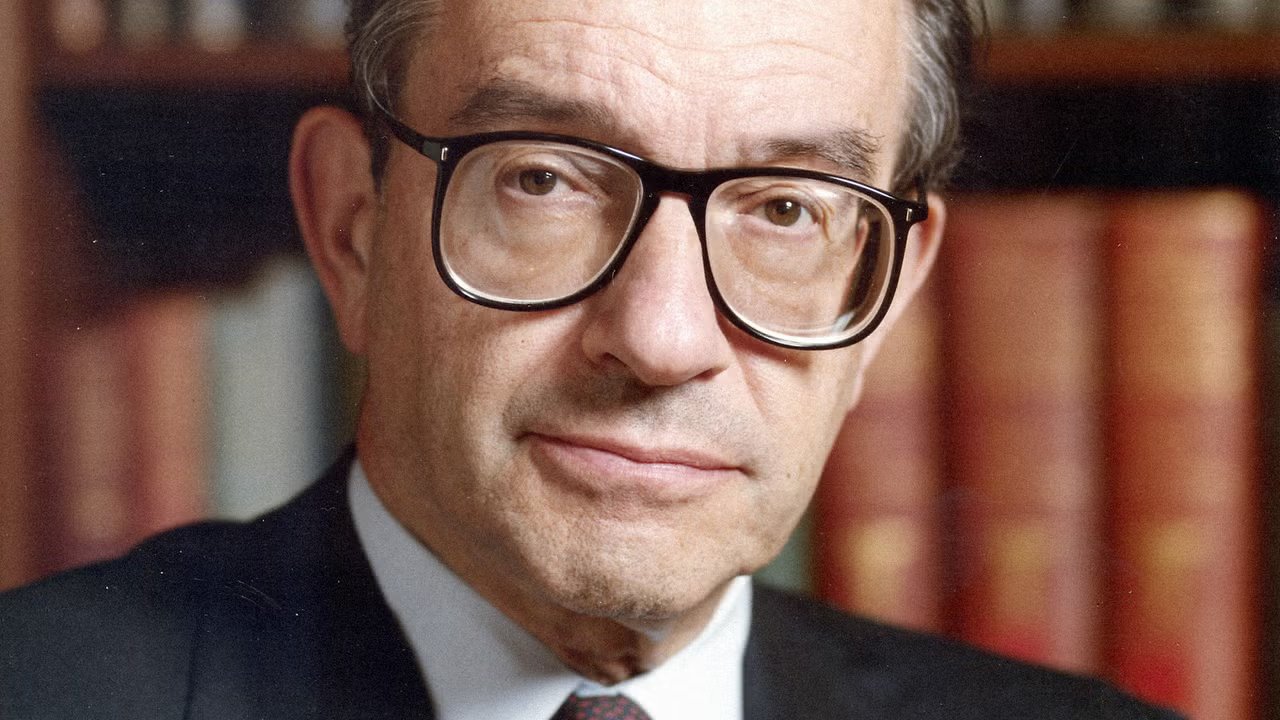
Alan Greenspan, who led the Federal Reserve for more than 18 years and whose comments could sway investors like few others, has died.
Greenspan died Monday at age 100 from complications of Parkinson’s disease. The news came in a statement from his wife, NBC News correspondent Andrea Mitchell.
“Alan passed away at our home this morning at the age of 100 from complications of Parkinson’s disease,” Mitchell said. “He was a giant of a man who helped shape the U.S. economy for decades under presidents of both parties, but was always honest in acknowledging his mistakes.”
One of the first “rock star” economists, Greenspan was nominated to lead the Federal Reserve by President Ronald Reagan in August 1987 and was reappointed by every subsequent president until 2006, when he was succeeded by Ben Bernanke. During his tenure, he steered the U.S. economy through two recessions, the 1987 stock market crash, the 1997 Asian financial crisis, and the aftermath of the 9/11 terrorist attacks.
Widely credited with helping preside over the longest economic expansion in U.S. history, Greenspan was also among the first prominent voices to warn that the stock market could be overvalued during the dot-com bubble. He did so with the now-famous phrase “irrational exuberance,” which he later said he came up with in the bathtub while writing a speech.
While “irrational exuberance” sent investors into a frenzy, Greenspan was better known during his tenure as Fed chairman for his measured, often opaque language. It became known as “Greenspeak,” a style built around long, complex sentences and obscure phrasing that could cloud his true meaning. The goal was to avoid triggering a sharp market reaction based on his testimony or public comments.
Working his way up
Greenspan attended New York University for his entire academic career, earning his bachelor’s degree, summa cum laude, as well as master’s and doctoral degrees in economics. In his younger years, he was a fan of Ayn Rand and once declared the Federal Reserve “one of the historic disasters in American history,” a view he would later, of course, reverse.
His first job, in 1948, was with the National Industrial Conference Board, a nonprofit organization where he analyzed demand for steel, aluminum, and copper. He started his own economic consulting firm in New York in 1954, taking a brief hiatus from 1974 to 1977 to serve as chairman of President Gerald Ford’s Council of Economic Advisers.
Shortly after Reagan named him to the Fed, Greenspan was confronted with the 1987 market crash. In that crisis, as in later tests, he built a reputation as an anti-inflation hawk, with a focus on controlling prices rather than maximizing employment.
He did this by a policy that became known as the “Greenspan put” (and later the “Fed put”). After the crash, he lowered interest rates to help companies recover, something that would become a precedent for the Fed. That was an enormous shift from the policies of his predecessor Paul Volcker.
Greenspan would later convince other Fed governors to lower interest rates when stocks plunged, including after the dot-com collapse.
The low interest rates of the early 2000s that resulted from the Fed’s policies, along with Greenspan’s skepticism of regulation, were later cited as among the chief causes of the mortgage crisis. His reputation as a maestro took a significant hit in 2008, as critics from both sides of the aisle accused him of placing too much faith in the self-regulating power of markets and keeping interest rates too low after the dot-com bubble burst.
Greenspan himself would later admit he’d “made a mistake” in presuming financial firms were able to regulate themselves.
Post-Fed
In his post-Fed years, Greenspan, who started a high-profile consulting business, was freer to speak his mind, and rarely hesitated to do so. Public speeches, op-eds, and interviews became commonplace, leading some to accuse him of trying to undercut his successor, Ben Bernanke. Greenspan disputed that. He also voiced support for current Fed Chair Jay Powell, saying “I’ve known him for years. He’s extremely competent. His competence is such that I don’t worry about where the Fed’s going.”
That openness extended to his views on the presidents he served. In his book “The Age of Turbulence,” Greenspan said Richard Nixon and Bill Clinton were “by far” the smartest presidents he worked with. He described his relationship with the first George Bush as “terrible.”
Greenspan is survived by his wife. He and Mitchell met in 1983, when she was covering the White House and interviewed him for a story. They married 14 years later.
