
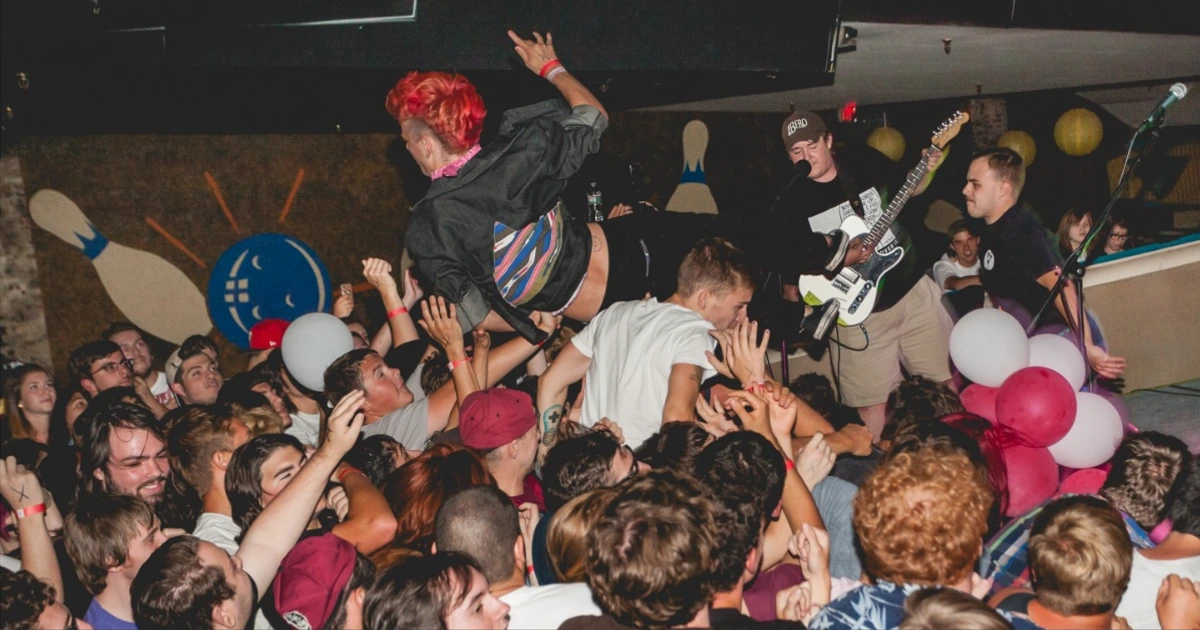
The cover of Andrew Sacher’s upcoming book, Emo Revival: Community, DIY, and Rebirth in Post-Hardcore and Emo (2008-2018), captures Snowing’s 2011 farewell show at the First Unitarian Church in Philly, a moment when “the entire scene was still under the radar but about to boil over into something much, much bigger.” It wasn’t until years later that the “second generation” of fourth-wave emo — characterized by Modern Baseball, the Hotelier, and Foxing, among others — began to take shape, balancing a love of ’90s emo and weirdo 2000s sounds. It’s this very scene that Sacher pens a love letter to in painstaking detail, collecting interviews from dozens of bands, label heads, and like-minded peers who lived those days up close and can testify to its cultural significance.
Summarizing this specific wave of emo and what sets it apart, Sacher says, “Most of the early music in this wave harkened back to ’90s bands, whether it was the mathy Midwest emo of Cap’n Jazz and Braid, the melodic post-hardcore of Texas Is The Reason, the emo-punk of Jawbreaker, the screamo of Saetia and Portraits of Past, or the heavier, alt-rock-leaning vibes of a band like Quicksand. Fourth-wave bands also really embraced the more leftfield 2000s emo and post-hardcore bands like mewithoutYou, Piebald, and the Weakerthans. As the ‘revival’ went on, you saw bands embracing stuff like indie rock, art rock, shoegaze, electronic music… one way to put it is that the pop stardom of third-wave emo wasn’t a goal, but critical acclaim was. The fashion element of third-wave emo — eyeliner, swoopy hair, etc. — was totally out, and everyday street clothes were in.
Read more: What does emo really mean? The story of the genre in 11 songs
“Socially and lyrically, there was a big push to be a lot more progressive and inclusive than mainstream third-wave emo, which was heavily white-male-dominated and full of songs by men who had unhealthy, if not violent, things to say about the women who broke their hearts,” he continues. “Fourth-wave emo wasn’t perfect when it came to these issues, but you saw a lot of clear efforts being made to promote diversity and inclusivity, speak out against abuse, and advocate for mental health awareness in song lyrics, onstage, and on social media.” Read an excerpt from the book, titled “Emo Is All The Rage,” below.
Just as Algernon Cadwallader, Snowing, and 1994!’s “Big Tour” helped spread the gospel of the lowercase emo revival around the country in 2011, early 2014 had its own pivotal package tour that took the emo revival show on the road, at the height of the media craze surrounding the phenomenon: Into It. Over It., The World Is a Beautiful Place & I Am No Longer Afraid to Die, and A Great Big Pile of Leaves.
In addition to being made up entirely of frequently-acronymed bands, the IIOI/TWIABP/AGBPOL tour was a perfect representation of where the revival was at in early 2014, just as the scrappy, noisy, combustible “Big Tour” was three years earlier. Into It. Over It. and TWIABP’s respective 2013 albums Intersections and Whenever, If Ever were watershed moments for emo revival which both experienced heightened levels of critical and commercial success. AGBPOL’s own 2013 album You’re Always On My Mind was also receiving love from the music criticism world, and all three of those albums delivered a version of “emo” that sounded distinctly like a version of indie rock, not a version of pop punk. Part of the narrative surrounding emo revival at that time was that these bands were the antithesis of what Warped Tour, Hot Topic, and Alternative Press had become stereotyped as, and these three bands’ new albums made that loud and clear.
The IIOI/TWIABP/AGBPOL tour packed and sometimes even sold out major venues in major cities, like Bowery Ballroom in New York, Union Transfer in Philly, The Bottom Lounge in Chicago, and The Echo in Los Angeles, but just like when these bands were playing house shows, the many friends they’d made in this community provided local support as the tour crossed through their various regions. Portland had Duck. Little Brother, Duck!, Austin had Pswingset, Houston had Football, etc., Gainesville had Dikembe, Pembroke Pines and Orlando had You Blew It!, Philly had Glocca Morra, Detroit had The Reptilian, and Chicago had Kittyhawk. “It was a very packed show and it really felt like [this] was going to be really successful,” says Kittyhawk singer Kate Grube.
Just like the acclaimed albums that each band released prior to the tour, the tour itself received attention from the music press outlets that were treating emo revival as the latest rock music phenomenon. “[Evan Weiss’] fans at the Grog Shop are eating it up tonight,” wrote Stereogum’s Chris Deville in an article titled Don’t Call It A Comeback: A Night On The Front Lines Of The Emo Revival. “As soon as the band kicks in, the audience is climbing all over each other, fighting their way to the top of the pile to lift their fists and shout along.”
As Deville wrote at the time, “the fervor around [these] bands went into hyperdrive about six months ago when what had been a slow-simmering grassroots scene boiled over into a media orgy. All at once, a critical establishment that had long turned its nose up at emo suddenly started doling out rave reviews. After years in the wilderness, emo was all the rage.”

**
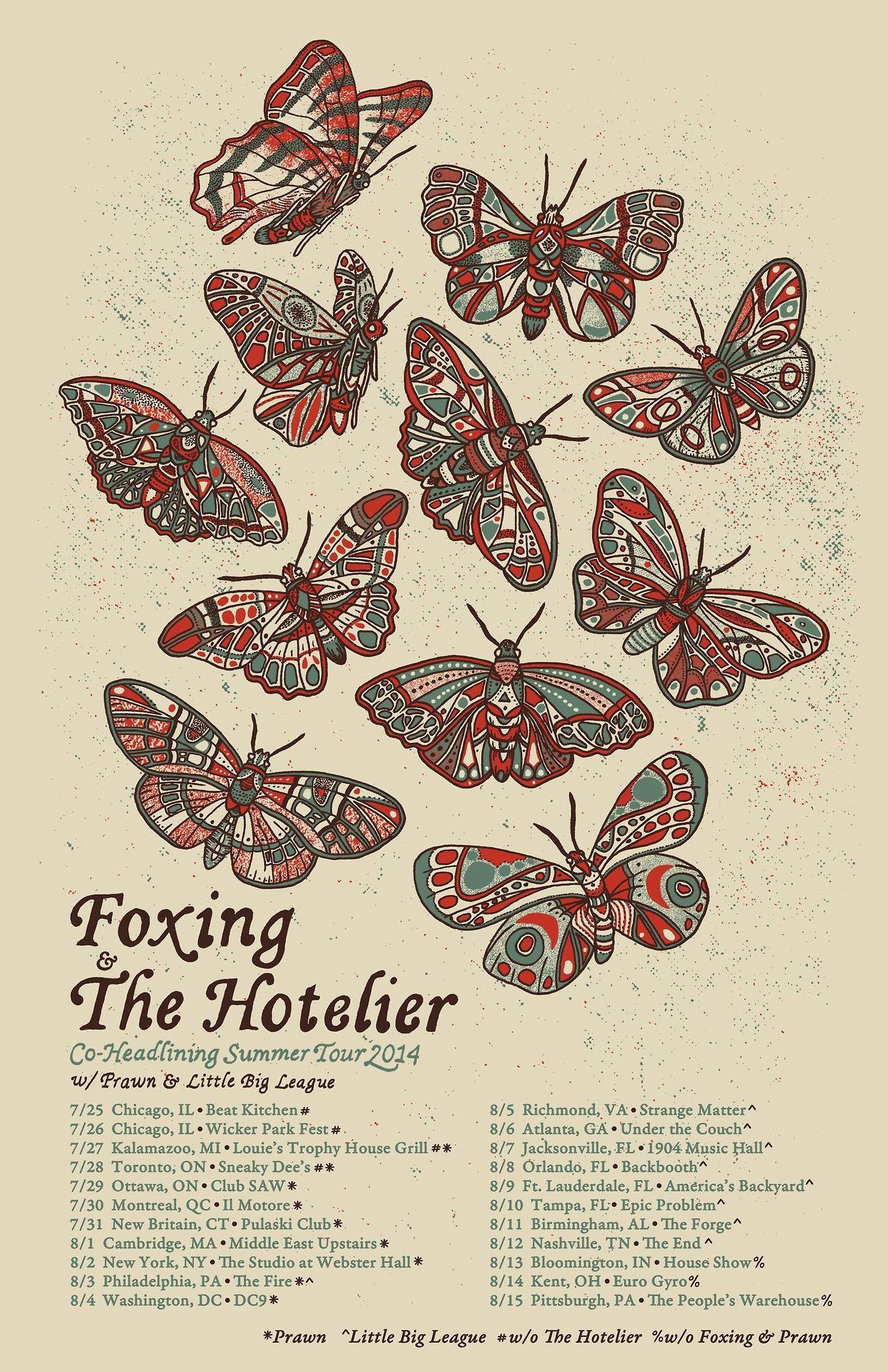
By 2014, Into It. Over It., TWIABP, and A Great Big Pile of Leaves felt like emo revival’s graduating class, and in many ways, it was really the incoming freshmen who seized the moment, raised the bar, and became the genre’s breakthrough bands. The slow-burning love for Foxing’s late-2013 debut LP The Albatross was getting faster, propelled in part by the band’s first Pitchfork review in January 2014—a track review for “Rory.” The first two months of 2014 also saw three younger bands massively leveling up with their new albums: You Blew It!, Modern Baseball, and The Hotelier, the new-and-improved version of the band previously known as The Hotel Year. (“You can say our band name the exact same way as before,” singer Christian Holden wrote in a Tumblr post at the time. “Or pronounce it in a French accent if you want. I don’t care.”)
First out of the gate was You Blew It!’s Keep Doing What You’re Doing, released in the second week of January on Topshelf. It was You Blew It!’s Tanner Jones who said that a key difference between the 2008-2012 emo revival era and the 2013-onwards era was that bands in the latter were no longer writing songs for the noisy confines of basement shows, and that really came through in the contrast between You Blew It!’s 2012 debut LP Grow Up, Dude and Keep Doing What You’re Doing.
To make a bigger, fuller, clearer record, they flew to Chicago to make it at Atlas Studios with Into It. Over It.’s Evan Weiss producing and Evan’s frequent collaborator Matt Jordan engineering. Evan also played bass on the record, after bassist Nick Inmann quit the band right before they went in to record. You Blew It! working with Evan was beneficial for all involved. You Blew It! had long looked up to Evan and they knew he could help them arrive at the musical destination they were looking for, and Evan was inspired by connecting with a band that felt like a younger version of himself and his own bands.
“The thing we saw in You Blew It! was an attitude that was really reflective of where we had come from at a point in time when we were feeling like, ‘Hey, I haven’t really seen a band that has exhibited that in a little bit,’” Evan recalls. He describes the music they were writing as “right in the wheelhouse of what I thought The Progress and Proper were.” When he first heard the demos, he thought, “I know exactly how to produce something like this.”
“Evan would try to uplift the things that were unique about us, and maybe add a little salt to it,” says Tanner. “It just felt really good to be in a room with someone who knew exactly what we were going for.”
You Blew It! and Evan approached Keep Doing What You’re Doing with a clear, concise vision. At a time when so many DIY emo bands were branching out into shoegaze or post-rock or indie rock, You Blew It! remained true believers in ’90s Midwest emo, and they wrote a record that helped the band cross over not because it was a departure from emo, but just because it exhibited such a mastery of the form. The band sounded tighter than ever on Keep Doing What You’re Doing, the intricate embellishments really came through, and Tanner was writing real-deal hooks. The noodly American Football/Cap’n Jazz moments were balanced out by the pop sensibilities of bands like The Get Up Kids and The Promise Ring, and You Blew It! emerged as worthy heirs to both factions.
When the band turned in the record to Topshelf, Kevin Duquette knew right away that it was something special. “That was the first one where I was like, without a doubt, I have no reservations, I know this is going to do amazing,” he remembers. “Everything’s in place for this to go really well, and it did.” The record was met with positive reviews across the board, including from Pitchfork, Stereogum, AbsolutePunk, Punk News, and Alternative Press, and it just made it onto the Billboard 200, peaking at No. 198.
The album also premiered on Pitchfork during a time when the website was regularly premiering full albums a week early with their streaming platform Pitchfork Advance, and coordinating press on that level was very new for Topshelf, who just a few months earlier had been hoping that Pitchfork would finally give one of their releases any mention at all. “I was like, ‘This is what it’s like,’” recalls Kevin. “‘This is what it’s like when there’s money, and people know it’s going to do well, and there’s gonna be traffic, and they’re gonna see ad revenue, and there’s gonna be clicks. This is insane.’”
But, he adds, “I also remember other labels taking notice, and this was around the time I was like, ‘I’m gonna lose this band, big time. And we’re gonna lose most of our roster, big time.’”
**
You Blew It!’s Keep Doing What You’re Doing sat on the fence between where emo revival had come from and where it was heading, but The Hotelier and Modern Baseball’s new records were rewriting the script entirely—like Foxing’s The Albatross—and doing so in drastically different ways. They also couldn’t have been timed more perfectly; both bands were fresh off career-making Fest sets, all eyes were on emo revival, and these two bands put out back-to-back records in February 2014 that took the genre and the community to new heights creatively, commercially, and critically.
For The Hotelier’s Christian Holden, getting to that point didn’t come without a little competitive spirit. “That was sort of the focus of every record,” they say. “There was some trend that I was noticing in art, and I was like, ‘I can do this way better than they are.’ And then I got super competitive about it, and just wrote a record trying to do it better than I felt like other people were doing. I would love for it to be a more wholesome, less dickheaded way of approaching music, but straight-up that was the motivation between all of the records that I had written.”
In the case of The Hotelier’s Tiny Engines debut Home, Like Noplace Is There, Christian was looking at the trend of emo and pop punk bands writing songs about their hometowns, and the frequently used trope of emo bands putting photos of houses on their album covers. If the artwork and title of Home, Like Noplace Is There seemed trope-y almost to the point of parody, that was sort of the point.
“Everyone was talking about their hometowns… but never really digging too deep,” Christian says. With these songs, Christian wanted to not just look at suburban malaise and the friendships that fall apart after high school, but ask “Why does our hometown suck? What is it about our friendships coming apart that is at the nugget of it? What’s really happening to all of our lives?”
“If you just actually followed all of this stuff to its logical conclusion,” Christian says, “we would hit something that’s very dark and very heavy.”
Home, Like Noplace Is There is indeed a very dark record that looks beneath the surface and examines abuse, addiction, gender dysphoria, depression, and suicide in great detail. “Your Deep Rest” replays memories over and over of a friend who took their own life. “Life In Drag” shows the dark underside of stereotypical gender roles and the expectations that come with them. “Housebroken” uses an abused dog as a metaphor for police brutality, though when the song was misconstrued by some listeners as containing damaging messages about domestic abuse, The Hotelier retired it from their live sets for many years. In a lesser songwriter’s hands, Christian’s lyrics would be too deep and elaborate to fit neatly into catchy, concise hooks, but their pop sensibilities still found a way to cut through, even on the lengthy, refrain-less opening track, “An Introduction to the Album.”
Home, Like Noplace Is There sounded very different than The Hotelier’s first album It Never Goes Out, and that was largely because it was made in a very different way. Where It Never Goes Out saw Christian writing songs that the rest of the band “pop-punkified,” the writing of Home was much less collaborative. And original guitarist/backing vocalist Zack Shaw had left the band. “Nobody really wanted to write anymore,” Christian says, “and I was kind of just like, ‘Well, if this band is gonna not die, I kind of have to write this whole record.’”
The more indie-emo-leaning influences that informed Christian’s songwriting in the first place like Weatherbox, Piebald, and The Weakerthans came through louder and more clearly on Home, which ranges from quiet, slow-burning moments to hard-charging emo-pop (“The Scope of All This Rebuilding”), screamo (“Life In Drag”), folk punk (“In Framing”), and more. It was made with the band’s frequent collaborator Ian Van Opijnen but it had much cleaner, more professional-sounding production than any Hotelier release before it. Each song sounds noticeably different than the last, and the album was sequenced in a way that sounded very intentional—not just a collection of songs but a capital-A Album.
The Hotelier were also physically in different places than they were when they were regularly playing with pop punk bands. They’d become immersed in the emo revival scene, and that had an impact on the music they were making too. When they wrote It Never Goes Out, they “didn’t know that other emo bands existed,” Christian says. “So when people look back on that and they’re like, ‘Oh, this emo band wrote this pop punk record?’ It’s like no, we were all in high school playing with pop punk bands at VFWs, and we just wanted to write something that was better than what they were doing.”
The day before Christian announced the new album, they put up a manifesto on Tumblr detailing their frustrations with their former label Mightier Than Sword, “the scene,” and “jock punk bro dweebs who write revenge songs for people who broke their hearts,” and also thanking those who had helped and supported the band thus far, including their new label Tiny Engines “for showing us there are people in this end of the music world who aren’t just trying to stay cool like some weird overbearing parent.” They revealed the slight band name change and ended by saying, “Apparently we are emo now.”
The Hotelier started rolling the album out in December of 2013, and even before it was released, there were rumblings of its greatness. First single “The Scope of All This Rebuilding” premiered on Pitchfork with a write-up from Ian Cohen that claimed the song “attempts to cram Home‘s entire syllabus into little more than two minutes and as a result, it can barely contain itself.” TWIABP member Greg Horbal could tell the bar for the entire scene was raised from the minute he heard an advance copy of the album. “They made everybody look like a fucking chump,” he says.
The Hotelier embarked on a tour as they were rolling out the album, and they asked their friends State Lines to go out with them, but most of the members were too busy with school to commit to the full tour. Singer Jade Lilitri had been writing some acoustic solo material on the side, though, and he ended up opening the tour himself. He called his solo project osoosooso, and he credits that tour as the thing that really kicked the new project into gear.
“That tour was a trip,” Jade says. “The start of the tour, you’re going like, ‘Is anyone gonna even be at the show tonight?’ and by the end of the tour it’s like, Oh my god, these little rooms are fucking packed. They were still small little places, but it just felt like this was the biggest thing in the world.”
The Hotelier’s album came out in the middle of the tour, and unlike Home’s quietly released predecessor, this one started leaving a mark almost immediately. It was met with universal acclaim, including from Pitchfork, who got behind this one even more than most of The Hotelier’s peers, with a high score of 8.2.
“I think that was the first one where it kind of proved that this genre could produce music every bit as exciting, every bit as emotionally rich and compelling, as proper indie rock,” Pitchfork’s Ian Cohen says of Home, Like Noplace Is There. “That was the first time I saw people kind of coalescing around [a new emo] record as like, ‘This isn’t just interesting, this is fucking important.’”
Pitchfork giving Home an 8.2 was a huge moment not just for The Hotelier but for emo in general, but receiving a score that high without a ‘Best New Music’ designation was also the first inkling that maybe there was a ceiling for bands from this world. Ian says “there were enough people that were into it” at Pitchfork that Best New Music felt like a real possibility, but no such luck. When it came to fighting for the influential publication to really get behind emo the way it had gotten behind so many other styles of music, “The Hotelier was the first real battle,” he says.
Regardless, change was clearly in the water for the emo scene in general. Shortly after The Hotelier’s tour with osoosooso and TWIABP’s tour with Into It. Over It. and A Great Big Pile of Leaves ended, those two bands met up for a show at the Brooklyn DIY emo house Suburbia, and it was one of the last times that something like a TWIABP/Hotelier bill could happen at a place that small. Having professional booking agents and publicists, putting real money behind an album campaign, and doing full tours of mid-size clubs was becoming the norm for fourth-wave emo, with genuine breakthrough albums like Home, Like Noplace Is There leading the way.
“We were cognizant of that we were being pulled into the music industry from the DIY world,” Christian explains, but they felt like they were doing what had to be done. “There’s no money, we can’t play as many shows if we do this without a booking agent or do this without taking these tours that we get offered. We just can’t make enough money to make it worth doing.”
“It always felt like there was sort of a battle between DIY and the music industry,” Christian continues. “DIY would build something cool, and then the music industry would be like, ‘Oh, thanks for doing that. Now, we’re gonna capitalize on it.’” Some bands at the time remained fiercely loyal to DIY, but bands like The Hotelier and many of their peers found ways to benefit from the industry lifting them up while still maintaining most of the ethics they had when they were starting out.
“It was awesome to be in that moment with them,” says Will Miller from Tiny Engines. “When you feel strongly about a record and then you see it connecting with people, it’s an amazing feeling. Probably good and bad for the label, to be honest. It definitely put more eyes on the label but I don’t think we were necessarily prepared for a band to blow up like that.”
**
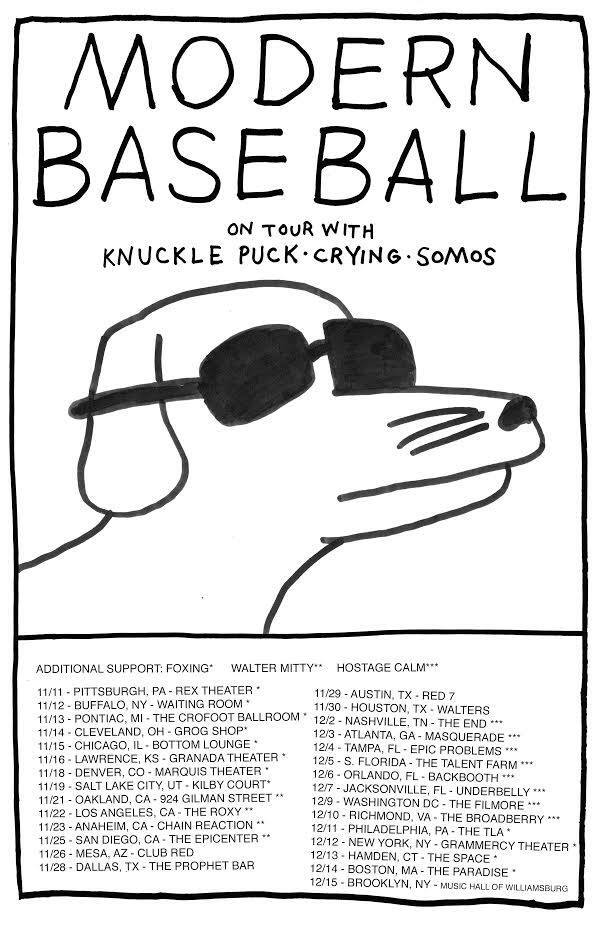
Modern Baseball were ready to take the leap too. As charming as their scrappy first album Sports was, they were dead set on making their Run For Cover debut, You’re Gonna Miss It All, better in every way—more refined, stronger production, catchier songs. They opened the album with a song called “Fine, Great” that showed off Bren Lukens’ heightened pop sensibilities within the first few seconds. Over just an acoustic guitar, Bren sings, “I hate worrying about the future ’cause all my current problems are based around the past,” perfectly capturing early-twentysomething anxiety with a melody that commands attention right away. And instead of going right into the band’s charged-up scrappy pop punk, it takes a more subdued turn towards jangly folk rock, showing off the bat that this wasn’t just Sports Part 2. With lyrics about Instagram and the quirky “spoken asides” that were becoming the band’s trademark, it’s a masterclass in how to mature and remain defiantly youthful all at once.
The song on You’re Gonna Miss It All that towered above the rest, though, was “Your Graduation.” It’s a song that Bren had fully mapped out even before they showed it to the rest of the band, down to drummer Sean Huber singing the third verse in his grittier punk shout, down to the guitar solo. But when co-singer Jake Ewald first heard it, it didn’t fully click for him.
“It was just so clear and structured and concise, that I was almost like, ‘Oh, this has less going on than a lot of our other songs that are really fun and goofy and people go nuts for,’” Jake remembers. “I was picking up on stuff from huge bands that I grew up with like Green Day or blink-182, and at that point in our lives, those bands were on a different planet, so I couldn’t even put those pieces together that Bren figured out how to do that. That didn’t even connect for me really until we were recording it in the studio and I started hearing it with the drums and the electric guitars and everything and I went, ‘Oh, this is like an actual song that could have a music video.’”
They did make a music video for it—directed by their Drexel classmate Kyle Thrash, it was a much more cinematic, conceptual video than the one Kyle had made for “The Weekend” a year prior—and they released it as the album’s first single in December of 2013. It left an impact right away, earning praise from the likes of Pitchfork and The A.V. Club for its ability to tap into the feelings surrounding high school graduation and the end of a high school relationship, and it put all eyes on Modern Baseball as they geared up to release You’re Gonna Miss It All.
The record came out in February and was met by mostly positive reviews. A 7.2 Pitchfork review from Ian Cohen suggested that the band “deserves to engage a wider audience,” and that’s exactly what they did three weeks later, when they hit the road as the first of five bands on The Wonder Years’ headlining tour in support of The Greatest Generation. The Wonder Years had already done Warped Tour and a handful of tours opening for other bands since releasing the 2013 album, but now—nearly a year after its release—they were finally celebrating it with their own tour, and they’d curated a lineup that highlighted so many different corners of the punk and emo community of that time: Modern Baseball, Citizen, Real Friends, and Defeater.
Modern Baseball and Citizen were two younger emo bands that The Wonder Years were excited about giving a bigger platform to, Real Friends’ brand of pop punk was perfect for The Wonder Years’ core fanbase, and Defeater would have been the sole hardcore band on the bill—the reverse scenario of The Wonder Years’ early days as the sole pop punk band on hardcore shows. Unfortunately, vocalist Derek Archambault had been dealing with hip issues that he couldn’t ignore any longer, and Defeater were forced to drop off the tour before it began. So, with Fireworks taking Defeater’s place, the tour got underway in Upstate New York on March 5, and the next night it hit The Wonder Years’ original hometown of Lancaster, PA.
Modern Baseball’s You’re Gonna Miss It All had only been out for a few weeks, and they were the first of five bands, but Dan Campbell could see at the Lancaster show how much the band was already connecting with people. “I went upstairs in the third-floor balcony to take a video of them playing, and when they did the ‘Bullshit, you fucking miss me’ part [of ‘Your Graduation’], it was like, they could’ve been headlining,” he remembers. “The crowd was insane for it.”
“Show after show, [Modern Baseball got] bigger and bigger.”
Excerpted from EMO REVIVAL by Andrew Sacher and reprinted with permission from CLASH Books. Copyright 2026.
