
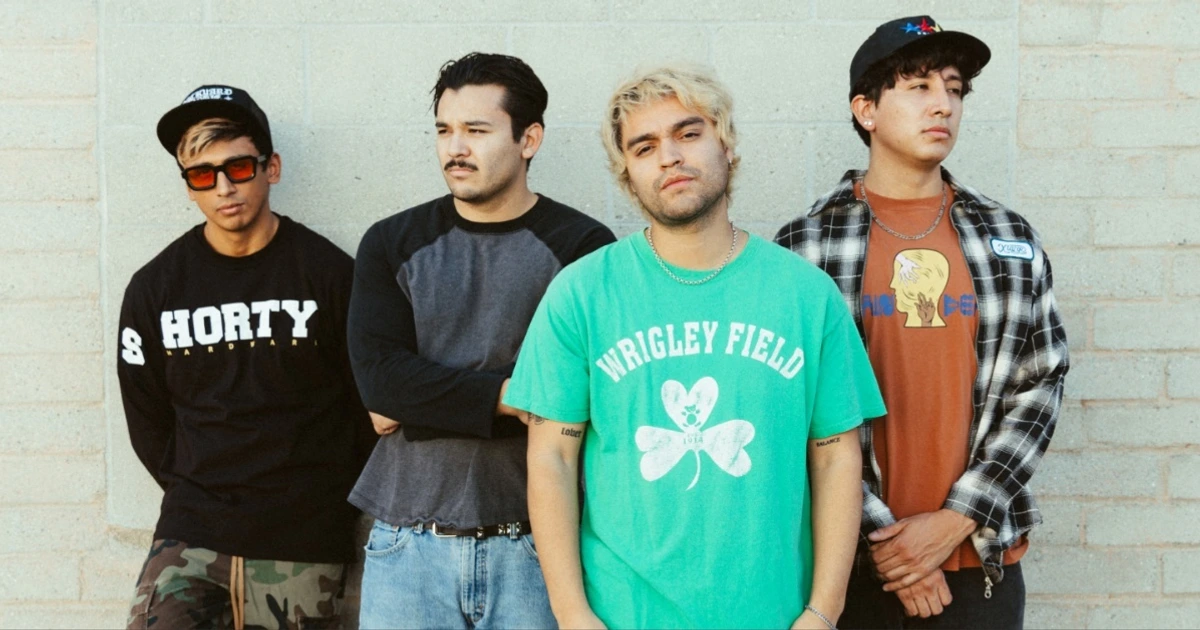
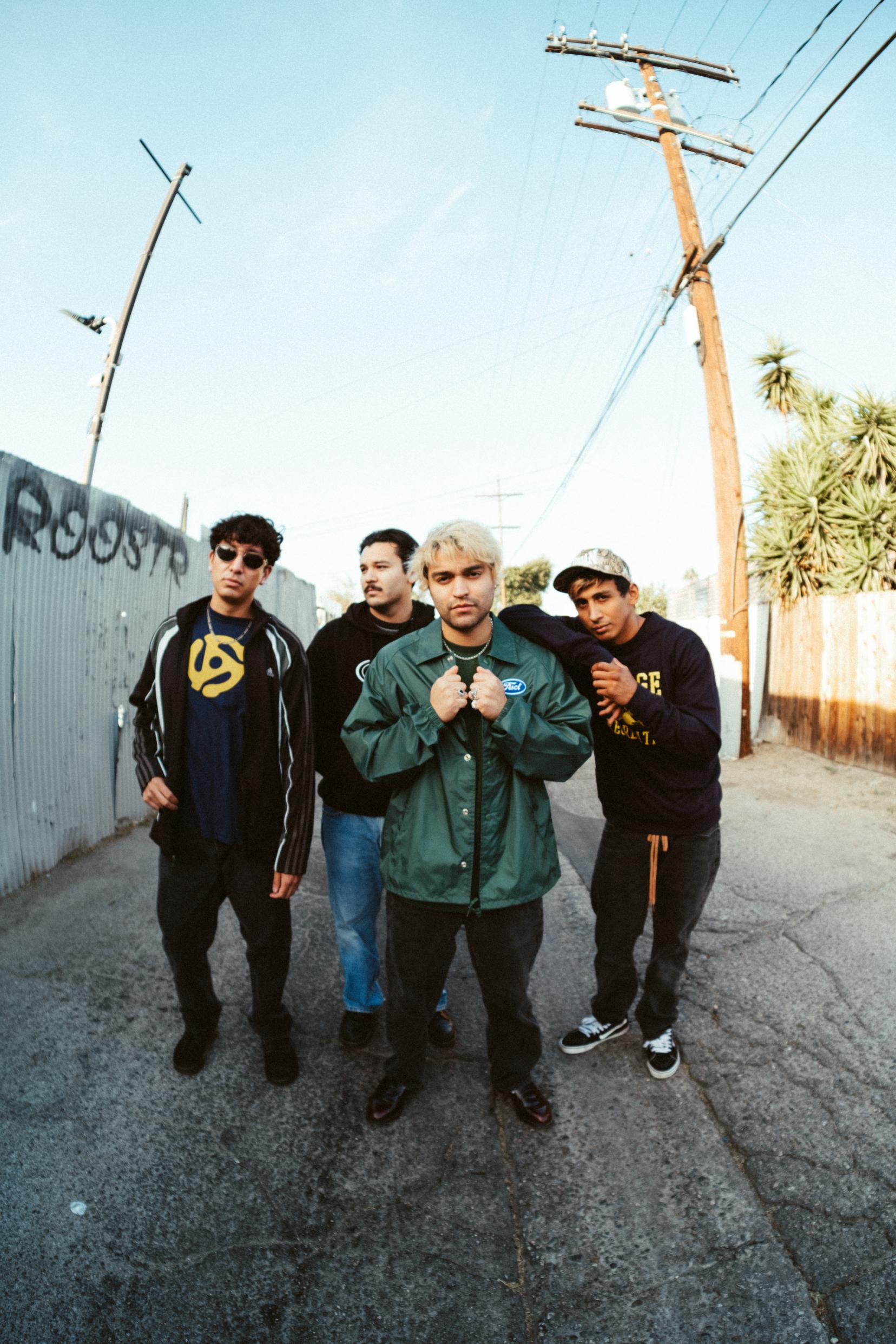
Grave Secrets came together through happenstance. Born and raised in different corners of Los Angeles, the band’s foundation began with vocalist Vinny Morales and Kevin Gonzales — one in the Valley, the other in East Hollywood — both absorbing the same underground culture from different vantage points before ever actually meeting.
Their early years were defined by underground hardcore shows in gritty venues that became a place for kids to find community. But those spaces didn’t just influence their sound — they taught them how to go against the grain. Despite their different upbringings, they eventually converged in the hardcore scene during their teens, both playing in separate bands, unknowingly sharing the same venues and crowds. That shared ecosystem built before they even knew each other became the groundwork for Grave Secrets.
Read more: What does emo really mean? The story of the genre in 11 songs
From the start, Grave Secrets were meant to function like a diary. “The whole point of Grave Secrets was that I wanted the catalog to feel like a diary,” Morales says, calling from his home in the Valley. “Nobody gets to read your diary. You can be honest and talk about things you’d never tell anyone.” The idea was that their music would hold deeply personal stories — the things that are too private or too complicated to say out loud, and that every release would be grounded in lived experience. Their song “No One to Hear You,” which deals directly with the relationship with Morales’ father, explores generational trauma, absence, and the complicated process of understanding someone only after you’ve grown older. “Writing it was therapeutic because it helped me understand my dad better,” Morales reflects. “If my twin brother had committed suicide when I was 15, I probably would’ve become a raging alcoholic, too, and probably not been the best dad.”
Since 2023’s Til Your Lungs Fall Out, they’ve been in a phase of transition. After releasing a body of work that felt like a closing chapter on adolescence and working with artists like Militarie Gun and Travis Barker, they now find themselves sitting on a large collection of songs, including their new single “Take Your Pictures Back” from their forthcoming EP, A Place Like This, out later this fall. But despite that growth, the central idea behind Grave Secrets hasn’t changed much since the beginning. The name itself still reflects its original intention: music as a private archive made public.
Josh Beech
How did growing up in the Los Angeles emo scene shape you and the band?
The band was formed primarily by Kevin [Gonzales] and me. When I say “the band,” I’m talking about him and me growing up in LA. Carlos [Bayona] grew up in the South Bay — we got Carlos a couple of years after we started the band. Dylan [Galvan], our new drummer, who joined six months ago, grew up in the Valley. Kevin grew up mostly in the Valley, like the Canoga Park area, and I grew up in East Hollywood, like the Thai Town area.
What were some bands you grew up listening to? That was such a pivotal time in emo music — very formative MySpace experience.
My story’s a little different than Kevin’s. I grew up in the hood in LA with a single mom, and my cousin was into gangs and shit like that. So I grew up with a lot of hip-hop — Tupac, a lot of West Coast rap. I always loved blink and all the early 2000s shit, because it was everywhere. That’s what was popping at the time, maybe even more than rap sometimes.
Kevin grew up like a proper pop-punk kid. He found his first pop-punk CD when he was 8 or something. He’s been into it from the very beginning. I think we both found the hardcore scene around similar times in our lives, and that’s really what got us into the music scene. We were both in hardcore bands when we were like 15. We played the same venue — we just didn’t know each other. We were at the same hardcore shows.
I don’t know if you know bands like Rotting Out or Minority Unit, but that was the scene. I was friends with their little brothers and in bands with their little brothers, and that’s kind of how I got into shows. I never really went to big concerts. I never saw Smashing Pumpkins or anything like that. My whole show experience was hardcore shows.
In 2010, I saw a video of Joyce Manor online, and I became obsessed. I was like, “Dude, I could fucking do that.” It inspired me to start my first project. I saw Joyce Manor in a garage in 2010 with 20 other people. It was a benefit show. The singer of the Neighbourhood was there before he started that band. A band called Summer Vacation was there. After that, I started going to all the Joyce Manor shows, seeing Tigers Jaw super early on. I missed a couple of Title Fight shows because I was like, “I’ll see them next time.”
Josh Beech
You and Kevin were in separate bands, so at what point did you decide to pursue making a band together?
It was around 2020 or 2021. One of my best friends, Eric — I call him ET — knew Kevin from the printing world because they worked at the same screen-printing place. He kept telling me, “Bro, you should link up with this guy. He makes music.” At first, I didn’t think much of it. Then I became a fan of his band at the time called New Leaf. What I didn’t know was that he was a fan of my stuff, too, even though it was just me making songs in my room. I had a song on SoundCloud that got a lot of streams, and apparently, he’d play it at his Muay Thai gym all the time, so we were mutual fans of each other for a while.
Then, at the beginning of COVID, he had a rehearsal space in the back of a tattoo shop. It was basically a giant closet our homie Ozzy let us jam in. People would be getting tattooed while we jammed in the back. That’s where we originally started under the name No Spirit. We made a little EP together, but then I realized like 80 people already had that name.
You were like, “Gotta change that.”
Yeah. Alex Estrada, our producer, gave us this underrated tip. He said one of the biggest rookie moves is being a brand-new band with a name everyone already has, because if someone checks out your shit, they’ll never find you. I changed the name to Grave Secrets and just started releasing stuff. At first, I didn’t know what direction it was gonna be. No Spirit was really pop punk. The first Grave Secrets song was this darkwave thing inspired by the Smiths. That’s what I thought the band was gonna be. But Kevin and I love pop punk and punk, so the next stuff we released ended up being all pop punk.
It speaks to your origin story, though. What about the words “grave secrets” felt fitting to represent the band, your sound, and where you wanted to take both?
The whole point of Grave Secrets was that I wanted the catalog to feel like a diary. Diaries are personal. Nobody gets to read your diary. You can be honest and talk about things you’d never tell anyone. So, Grave Secrets is basically a diary for the world to read. Kind of corny, but that’s what it is.
There are a lot of stories in the songs, and they’re all 100% real. There’s a song called “No One to Hear You” about my dad. He took off when I was 5, but I learned more about him as I got older. The song talks about his twin brother committing suicide when he was 15 and how that affected him. Writing it was therapeutic because it helped me understand my dad better. If my twin brother had committed suicide when I was 15, I probably would’ve become a raging alcoholic, too, and probably not been the best dad.
Josh Beech
You need that perspective because when you’re younger, you don’t understand. You don’t have the context. Then, when you’re older, you can give someone grace and process it through writing. It must be freeing to put that out into the world.
It is. It’s personal as fuck. We don’t play that song very often, and I don’t really talk about it. What’s cool is I feel like our music is aging well. Til Your Lungs Fall Out is just now catching steam, and “No One to Hear You” is one of the songs trending more. I feel like the truth always prevails.
It’s nice, too, that you released the music instead of sitting on it waiting for the perfect algorithm moment.
Yeah, exactly. Now we’re in the phase where we’re holding onto so much stuff, and it’s honestly the worst part of all this. We have like 25 tracks done. We have a song with Travis Barker done. Three songs with Matt Squire. A few Nick Long songs. And it’s all just sitting there. I don’t want to give all that to the world until we have more of a platform.
I saw that video the band made with Loyal to the Craft, where you performed for a bunch of School of Rock kids. You said, “You don’t need to be fancy to make and play good music,” and I thought that really spoke to your beginnings. How has that mindset carried through the band?
It’s definitely challenging. I didn’t have my first electric guitar until I was 17 and saved up my own money for it. My first acoustic guitar was basically permanently borrowed from my neighbor for like 10 years. My mom did her best, but we didn’t have money for music. Music was a luxury. Even in high school, I bought a little USB mic for 50 bucks from a local music shop and recorded my first song with it. It sounded sick. You don’t need money to do this, but as you gain experience, you realize some equipment does matter. Luckily, we’ve been able to acquire stuff along the way.
What was it like performing in front of those kids? You were kind of in their shoes once.
It was sick. Some of them were in tears. They all follow our band now, too. I see them liking and commenting on our stuff. I talked to all of them like, “What’s your band called? Are you starting a band?” That’s why we do this shit. That’s why I make merch cheap. I always hook people up at the merch table, even though I get yelled at for it. I can’t bring myself to charge some kid their last 20 bucks. Shows are already expensive enough.
That was before your Warped Tour debut, right?
Yeah, before Orlando. The first Warped Tour we played was Long Beach, and it was insane. TikTok actually made our set pop off.
Your song “Talk Less, Do More” is one I really resonated with because I know people who talk big and don’t act, and I can be like that too sometimes. Tell me about writing and recording that song.
That song was heavily inspired by Militarie Gun. I actually just had a writing session with Ian [Shelton]. I helped Ian with a Militarie Gun track for their next record, and he helped me with an idea for a Grave Secrets song. I made it way too pop-punk in the end, but it’ll probably be on the next EP. “Talk Less, Do More” was inspired by how Militarie Gun uses catchy phrases and themes throughout songs. Stuff like, “I thought you were waving/Turns out you were drowning.” I wanted that kind of theme. “Talk less, do more” just came out naturally while freestyling over the music. It’s about people who talk a lot of shit about others but won’t do things themselves. It takes courage to do this shit.
Josh Beech
Was it therapeutic to release that song?
Yeah, and it was very different for us. It was the first time we worked with a different producer. Alex Estrada has this really raw style where what you record sounds like what you’ll play live. For “Talk Less, Do More,” we worked with Jesse Field under Zach Tuch, so it was more polished and poppy. I love the song, but I don’t know how our audience reacted to it. I feel like they mostly want punk shit from us.
Fans don’t have to love everything an artist releases. Artists evolve and test out different things.
Exactly. We wanted to do something different. Now we’re going back to fundamentals. We have a whole EP done. The lead single is just high-energy punk fun. The lyrics are all real stories, too: “Took a bus to Adam’s house and saw his mom on acid, watched a movie, drank a beer, showed me all the hardcore classics…” Those are all real things.
Your last EP felt like saying goodbye to adolescence. When you release a body of work, does it feel like a beginning or an ending?
That’s a good question; probably more like an ending, like closing a chapter and putting things in the past. A lot of those stories aren’t great memories, so releasing them feels like letting them go. That EP was fun, though. It was kind of thrown together for Warped Tour with Emo Nite.
When you look back over the last five years, how would you describe the band’s growth and evolution?
Every year has been bigger than the last. We’ve never had a year where we were like, “Should we pack this up?” Last year was obviously huge because of Warped Tour. This year, we signed with MDDN, which is insane. Getting to talk to Joel Madden is crazy. Joel invited us to meet him because he liked our song “Stuck Inside.” He basically said, “Maybe we’ll work together, maybe not, but let’s meet.” Then he put on our “Mood Ring” music video in the office, and there’s a shot of Kevin wearing this old Good Charlotte shirt. We’re huge Good Charlotte fans, especially Kevin, so having them manage us is insane. Doing the song with Travis Barker this year was crazy, too, and now Famous Stars and Straps sends us boxes of clothes and had us do a photoshoot. Every year just keeps getting cooler.
Josh Beech
Can you recognize that growth while it’s happening, or do you need distance from it?
I definitely need distance sometimes because it can be overwhelming. Even our first writing sessions were scary. I was like, “I don’t know scales. What if they ask me to play something in G?” But now all the things we were nervous about have become normal.
You recently played some shows in Arizona and San Diego, and you posted about finally getting to play longer sets instead of 20-minute support slots. What was that like?
Honestly, I’d rather headline for 70 or 100 people who care than open for 1,000 people. When we open for bands, people do convert — they buy merch, follow us, support us. But it’s a different feeling when people are there specifically for you. In Arizona, people were lined up at the merch booth asking for signatures. That’s crazy to me. In San Diego, we did a three-song encore because people kept asking for more. Then the crowd started singing the intro to “Ticket,” which we never play live, so we had to play it. That shit is awesome.
That must be so affirming, realizing these aren’t just streams — these are real people who care.
Exactly. “Ticket” is one of our least-streamed songs, but one of our most requested live songs. Kids cry during it. That felt really cool.
Lastly, what kind of legacy do you want the band to leave behind?
I’d say if you have something to say to the world, say it with confidence. Don’t be afraid to pursue your dreams because you never know where things can take you. And specifically for the kid who feels like an outcast at school — like Kevin and me — go to shows. Listen to music. Start a band. You’ll find your community there.
